
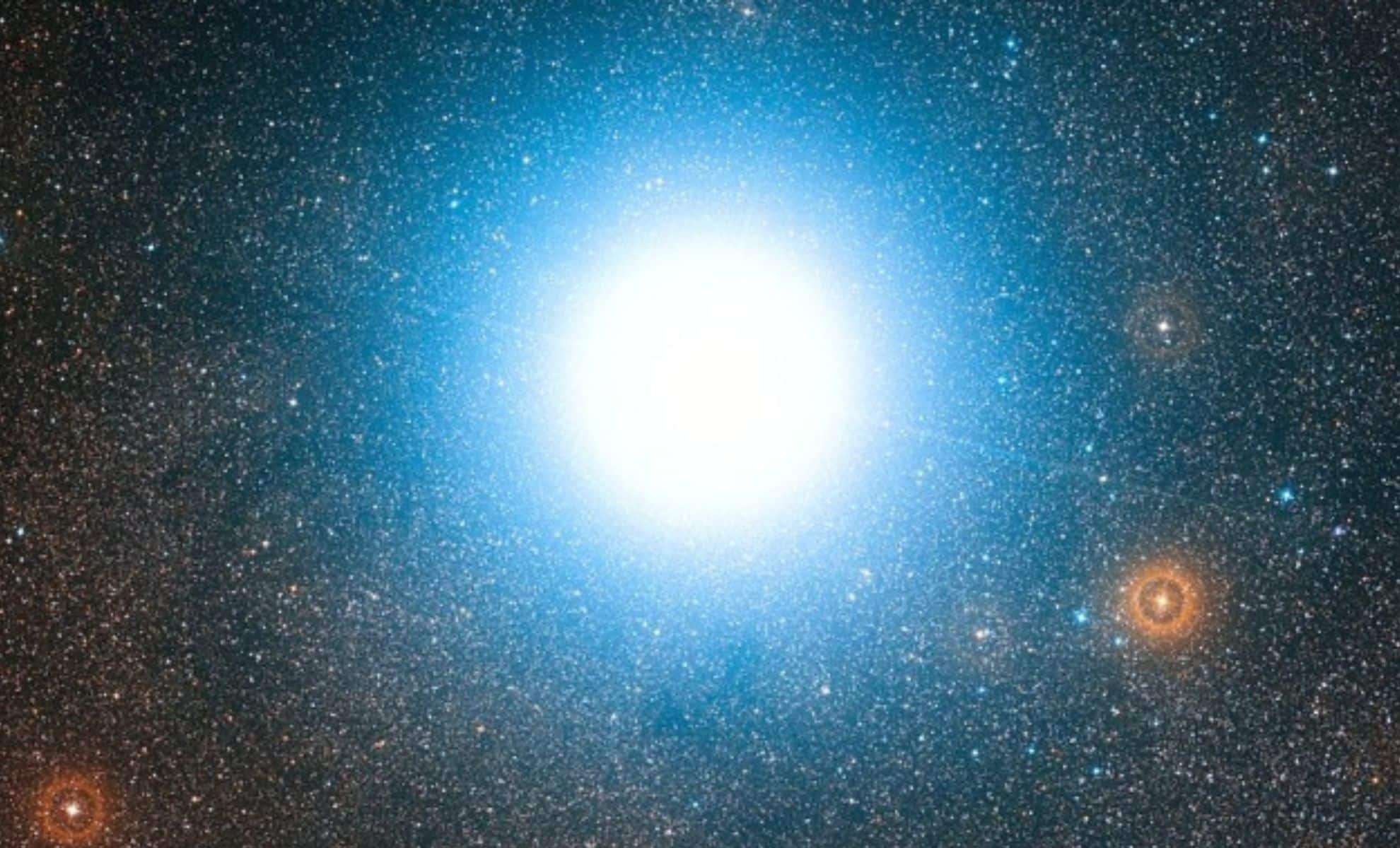
Scientists have revealed compelling evidence of a “cosmic highway”—a stream of interstellar debris originating from the Alpha Centauri system that could be linking our solar system to more distant stars. This novel discovery enhances our comprehension of how material is exchanged between stellar systems and deepens our understanding of the dynamic interconnections shaping the Milky Way. Tracking the trajectories of particles emitted from Alpha Centauri, the study explores the journey of cosmic fragments and their possible influence on our solar environment.
Stargazers have long contemplated the immense distances between solar systems, but recent findings suggest the cosmos is more intertwined than previously believed. Positioned closest to us, the Alpha Centauri star cluster—comprising Alpha Centauri A, Alpha Centauri B, and Proxima Centauri—is moving rapidly toward our solar system. New data indicate that debris from this neighboring system is already on its way to our vicinity, traversing the vastness of space and potentially shaping conditions within the solar neighborhood. This breakthrough opens new avenues for understanding the continual movement of material across star systems and its implications for our cosmic backyard.
Tracing the Cosmic Highway: How Alpha Centauri’s Debris Could Be Arriving in Our Solar Space
While the idea of a “cosmic highway” facilitating the movement of matter between star systems is longstanding, this study offers fresh insights into the process. Concentrating on Alpha Centauri, our nearest stellar neighbor, researchers explore how debris ejected from this system might already be present within the solar system, potentially located in the distant Oort Cloud. The findings illuminate the pathways through which material from a seasoned star cluster travels across the galaxy and eventually arrives near our own solar region.

As emphasized by the researchers, “Interstellar material has been discovered in our Solar System, yet its origins and details of its transport are unknown.” Decoding the mechanisms behind this galactic exchange is a principal aim of the study. By investigating the Alpha Centauri system, the team proposes a novel model to clarify how particles journey from far-off star systems to join our solar environment. Given its proximity, Alpha Centauri serves as a key laboratory for studying how such material transfers occur and their broader effects on galactic structure.
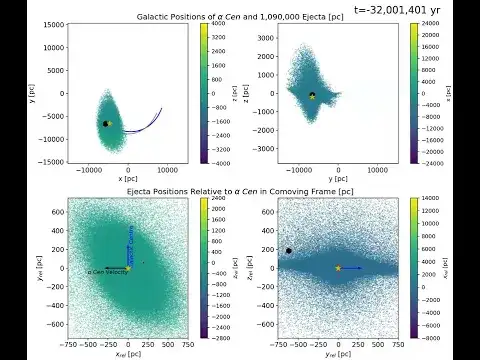
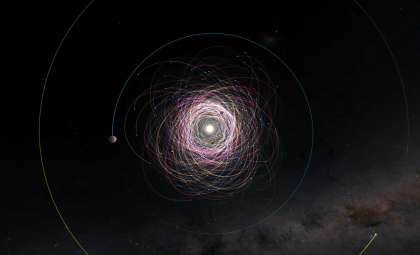
The research incorporates detailed simulations depicting Alpha Centauri’s orbit around the Galactic Center alongside projected orbits of the debris it expels. “Alpha Centauri’s orbit about the Galactic Centre viewed on the xy and yz planes (top row), as well as the orbits of the ejecta from Alpha Centauri viewed in a comoving frame (bottom row),” the authors illustrate. This model tracks how Alpha Centauri’s motion affects the trajectories of the particles through space. It further suggests that some of this material could come within reach of our solar system, possibly settling in the Oort Cloud, providing a visual narrative of the material’s galactic voyage.
According to the authors, “The colours of the ejecta represent the 3rd dimension of position, except that any particle that will at any point come within 100,000 AU of Sol is plotted in red. This shows the time evolution from t? -100 Myr to t? 10 Myr.” This elaborate time-dependent mapping offers a dynamic perspective on how Alpha Centauri’s debris might be traveling along a trajectory intersecting with our own solar realm. The study reveals an exciting prospect: particles from Alpha Centauri could be traveling a cosmic route leading to our solar neighborhood.
Exploring the Mechanics Behind Alpha Centauri’s Material Ejection
An especially captivating element of this study is its examination of how Alpha Centauri expels matter into interstellar space. Although established star systems typically eject less material than those actively forming planets, the presence of multiple stars and planetary bodies in the Alpha Centauri system enhances the chances of gravitational scattering. This process could propel debris—such as asteroids and comets—out of the system and potentially toward our own.
“Though mature star systems likely eject less material than those in their planet-forming years, the presence of multiple stars and planets increases the likelihood of gravitational scattering of members from any remnant planetesimal reservoirs, much as asteroids or comets are currently being ejected from our Solar System,” the authors note. This indicates that despite Alpha Centauri’s evolved status, its complex gravitational landscape still enables the ejection of material that might travel across space to reach our solar system.
Including the red dwarf Proxima Centauri increases the gravitational interactions in the system, raising the odds that debris can be cast into interstellar space. Although these particles may be minute and difficult to detect, the findings hint that over extended timeframes, Alpha Centauri’s debris could journey to the fringes of our solar system and beyond. This discovery encourages further investigation into the long-distance movement of star system material and its broader implications.
This article has been republished from the following materials. Note: material may have been edited for length and content. For further information, please contact the cited source.
- Categories:
- Astronomy






0 comments
Sign in to Comment