

Scientists have detected a rare intermediate-mass black hole, offering vital clues about how supermassive black holes form and evolve over cosmic time. This remarkable find inside the Omega Centauri star cluster is an important breakthrough in astrophysics.
Unveiling the Hidden Middleweight Black Hole
For the first time, researchers have confirmed an intermediate-mass black hole within Omega Centauri, a stellar cluster located roughly 16,000 light-years from Earth. This black hole has a mass around 8,200 times that of our Sun, classifying it as an intermediate-mass type.

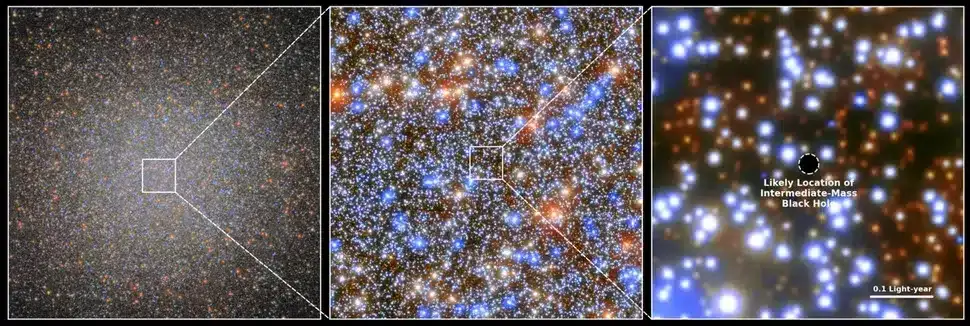
Intermediate-mass black holes are thought to bridge the gap between stellar-mass black holes, which have masses up to about 100 times that of the Sun, and the colossal supermassive black holes that reside in galactic centers, weighing millions or even billions of solar masses.
Maximilian Häberle from the Max Planck Institute for Astronomy in Heidelberg, who spearheaded the study, remarked on the discovery’s importance: “There’s a wide mass range, from 100 to 100,000 solar masses, where detections are scarce. It’s fascinating to determine whether they’re truly absent or simply difficult to observe.”
Implications of the Finding
Confirming the existence of an intermediate-mass black hole fills a critical void in theories about black hole development. Scientists have long suspected that supermassive black holes didn’t grow solely by accumulating surrounding gas and stars but may have been built from smaller black holes merging over time.
Astronomer and data analyst Eva Noyola, who was not part of the research team, highlighted the significance: “This discovery acts like a missing puzzle piece explaining supermassive black holes. Proving their existence in dense star clusters offers a straightforward and elegant solution.”
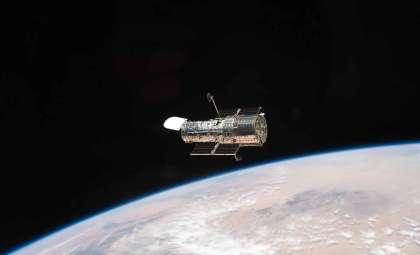
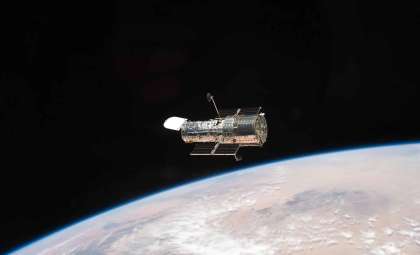
Leveraging two decades of Hubble Space Telescope data, Häberle’s team followed the movements of 1.4 million stars in Omega Centauri. They observed seven stars with exceptionally high velocities between 66 and 113 kilometers per second. Such speeds would likely expel them from the cluster unless a massive compact object, like a black hole, was exerting gravitational pull. The team deduced these rapid stellar motions reveal a single large black hole’s presence.
The Unique Role of Omega Centauri
Omega Centauri is a captivating object for study. As the Milky Way’s most massive star cluster, it might be the dense core leftover from a small galaxy that merged with our own around 10 billion years ago. “It’s essentially a galactic nucleus preserved in time,” explains coauthor Nadine Neumayer from the Max Planck Institute for Astronomy. This ancient galactic collision likely prevented the intermediate-mass black hole from evolving into a supermassive black hole like Sagittarius A* at our galaxy’s center.
This nearby intermediate-mass black hole discovery offers an unmatched chance for detailed observation compared to far-off black hole mergers detected by gravitational wave observatories like LIGO, located billions of light-years away. Häberle and colleagues are planning to employ the James Webb Space Telescope (JWST) to refine measurements of the stars' orbital velocities around the black hole.
Meanwhile, astrophysicist Oleg Kargaltsev of George Washington University is carrying out a separate JWST project aimed at detecting light from intensely heated gas falling into the black hole. “This will provide an independent and distinct verification method for the intermediate-mass black hole’s existence,” Kargaltsev states.
Insights into Black Hole Growth Processes
The detection of this intermediate-mass black hole reinforces the hypothesis that such entities can form in crowded star clusters and grow through collisions and mergers. This knowledge is essential for uncovering the initial phases of black hole development and the mechanisms leading to the formation of supermassive black holes.
Published in Nature, the study offers new perspectives on how black holes behave and evolve within stellar systems.
In summary, identifying an intermediate-mass black hole in Omega Centauri is a pivotal achievement in astronomy. It bridges the observational gap between stellar and supermassive black holes, advancing our grasp of how these extraordinary cosmic phenomena originate and evolve.
As Häberle concluded, “This discovery confirms that Omega Centauri hosts an intermediate-mass black hole, situated about 18,000 light-years away—the nearest massive black hole known. This opens up exciting avenues for further research into the universe’s most enigmatic forces.”
- Categories:
- Astronomy ,
- News ,
- Space ,
- Nasa






0 comments
Sign in to Comment