
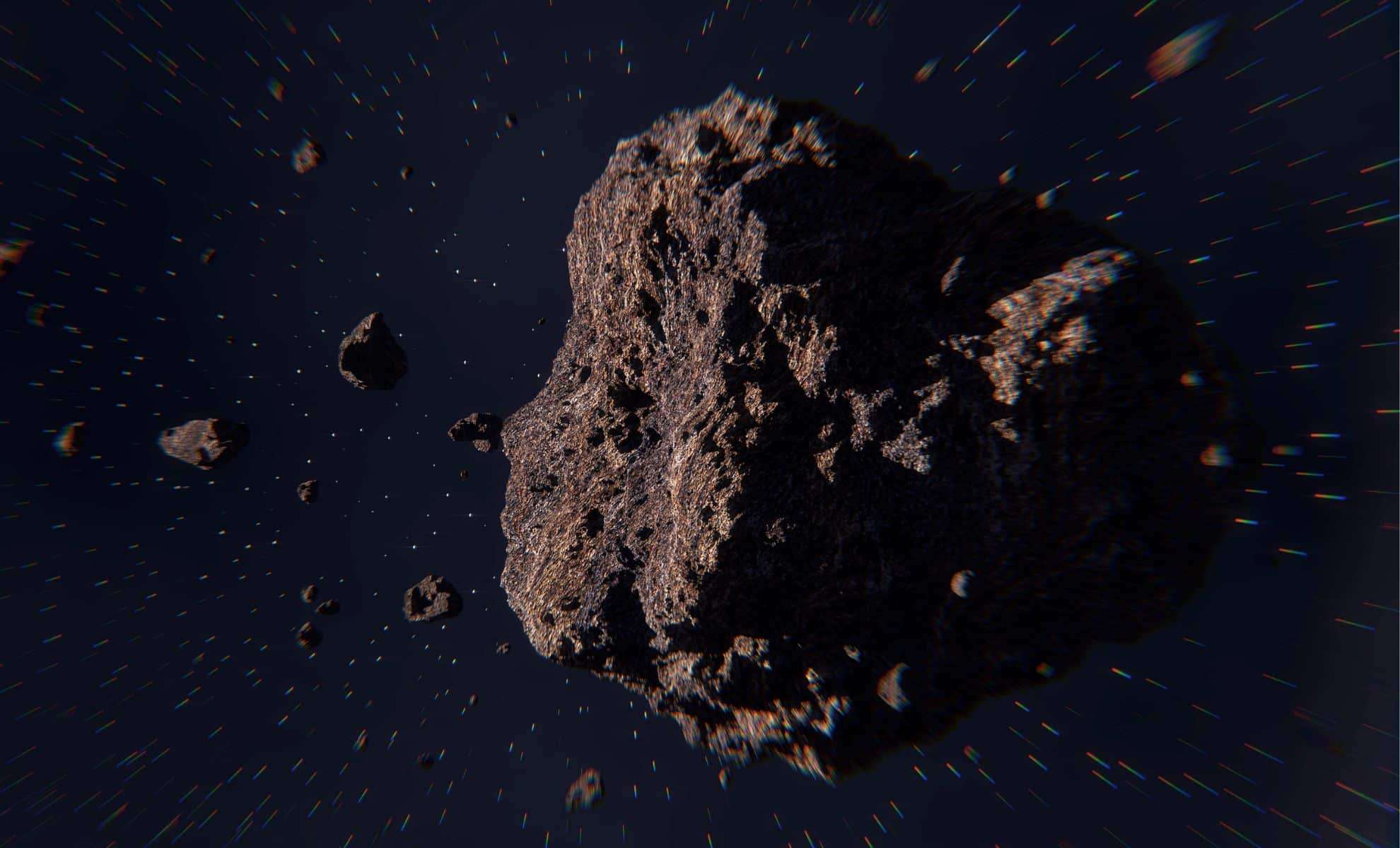
Recent research has focused on asteroid 33 Polyhymnia, unveiling the possibility that it contains elements not yet identified on Earth. This pioneering study, featured in The European Physical Journal Plus, examines the asteroid’s exceptional density and proposes that its unique features might stem from unknown elements beyond the established periodic table. Spearheaded by physicists from the University of Arizona, this work opens new avenues for understanding materials beyond current scientific knowledge.
Unraveling the Density Anomaly
Asteroids often appear as simple space rocks, but their true nature is far more intricate. Objects like 33 Polyhymnia display mass densities that challenge conventional expectations. Its remarkable density has led researchers to speculate that the asteroid might contain substances denser than any known on Earth. The Arizona-based team suggests it may be composed of Compact Ultradense Objects (CUDOs), a hypothesized form of matter with unknown composition.
“In particular, some observed asteroids surpass this mass density threshold. Especially noteworthy is the asteroid 33 Polyhymnia,” the team writes. “Since the mass density of asteroid 33 Polyhymnia is far greater than the maximum mass density of familiar atomic matter, it can be classified as a CUDO with an unknown composition.”

This discovery pushes the limits of our understanding, indicating asteroids could contain rare, previously undetected materials. Polyhymnia’s exceptional density significantly raises such possibilities.
Exploring a Novel Matter Class: Compact Ultradense Objects
The concept of CUDOs introduces a fascinating new category of matter characterized by extraordinary densities. These bodies might consist of elements beyond the scope of the current periodic table. While elements like osmium, the densest naturally occurring material on Earth, have been extensively studied, Polyhymnia’s density indicates its internal structure may not conform to known atomic configurations. Researchers propose that its core could be made from matter denser than anything currently synthesized or theorized.
The ramifications are profound, especially if such materials prove stable. Extracting and utilizing them could revolutionize industries ranging from aerospace engineering to advanced material development.
Superheavy Elements: Extending the Periodic Table
This study also contemplates the existence of superheavy elements—atoms with atomic numbers exceeding the known periodic table. Although elements such as oganesson (Z = 118) have been created in labs, they generally exhibit fleeting stability. However, this research posits that certain superheavy elements might be stable enough to naturally occur within dense space objects like Polyhymnia.
“However, elements in the other theoretical island of nuclear stability near Z = 164, which we predict to populate mass density values between 36.0 and 68.4 g/cm3, are reasonable candidates,” the team wrote. “If some significant part of the asteroid were made of these superheavy metals, it is plausible that the higher mass density could be near the experimentally measured value.”
This “island of nuclear stability” near atomic number 164 refers to a hypothesized group of superheavy elements with potentially novel properties. Their presence in 33 Polyhymnia could revolutionize our understanding of chemistry and physics alike.
Stability of Exotic Elements and Prospects for Space Resource Utilization
The possibility that superheavy elements might be stable in nature challenges existing theories on atomic stability. Though most superheavy elements decay rapidly, some may persist under the conditions found within asteroid cores. “Our results on mass density allow us to hypothesize that if superheavy elements are sufficiently stable, they could exist in the cores of dense asteroids like 33 Polyhymnia,” the authors note.
This opens potential for future space mining opportunities. While speculative, these materials could be highly valuable, inspiring interest from space mining ventures. Jan Rafelski, co-author of the paper, remarked, “All super-heavy elements—those that are highly unstable as well as those that are simply unobserved—have been lumped together as ‘unobtainium’… The idea that some of these might be stable enough to be obtained from within our Solar System is an exciting one.”
Should these exotic materials be harvested, they might significantly impact technologies such as propulsion, quantum devices, and materials engineering, marking a new era in space exploration and resource utilization.
- Categories:
- News








0 comments
Sign in to Comment