
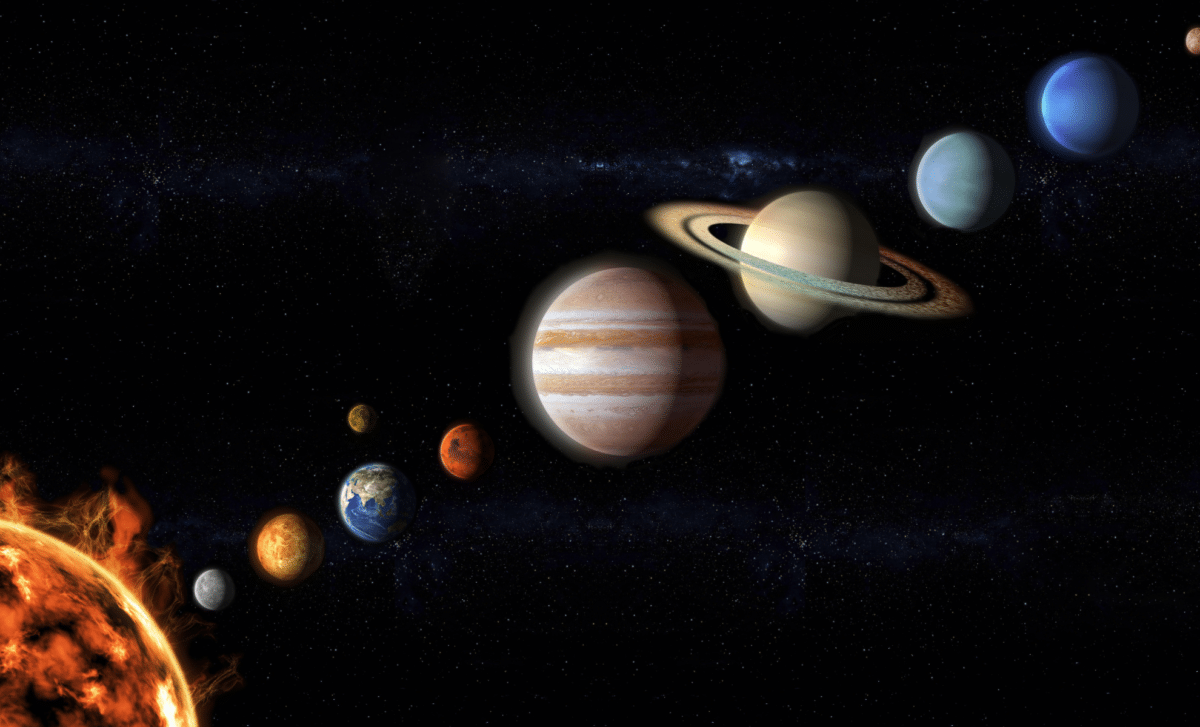
The formative years of our solar system might have been far more tumultuous than previously believed. Recent findings published in Icarus indicate that an additional massive planet could have existed long ago before being expelled billions of years back. This vanished planet might hold the key to deciphering the peculiar orbital patterns and characteristics of Jupiter, Uranus, and their satellites.
The Nice Model: A Glimpse into Early Solar System Chaos
Shortly after planetary formation around 4 to 4.5 billion years ago, the outer reaches of the solar system underwent a turbulent phase known as the Nice Model instability. During this time, the gravitational interactions caused significant reshuffling of the orbits of Jupiter, Saturn, Uranus, and Neptune. These giant worlds approached each other closely multiple times, triggering dramatic gravitational disturbances across the system.
One enduring question has been how the moons orbiting these giants managed to survive such chaotic conditions. Did mere fortune protect them, or did collisions and debris eventually help shape their current formations? To investigate, experts conducted 122 high-resolution computer models simulating early solar system dynamics, specifically designed to match the characteristics of today's outer planets.

Modeling the Turbulent Beginnings
Using cutting-edge simulation tools, researchers tracked gravitational effects over millions of years, including interactions among planets, their moons, the Sun, and transient asteroids. Some scenarios assumed five to six giant planets, following versions of the Nice Model where one or two additional gas or ice giants were expelled from our solar system.
As the scientists state in their publication,
“We find that the survival probability for the Jovian and Uranian moon systems are both less than 15%.”
This strikingly low chance of survival illustrates how fragile moons were amidst the violent gravitational encounters that almost always threatened their existence.
The Birth of Uranus’s Moons Through Catastrophe
When the simulated giant planets approached Uranus, the planet’s powerful gravity nearly guaranteed the destruction of its original moons. Instead of escaping, many moons smashed into one another at tremendous velocities, breaking apart into debris. Over time, these fragments gradually reassembled into new moons.
This may explain the origin of Miranda, one of Uranus’s most enigmatic satellites. The study in Icarus proposes that Uranus’s moons faced not one but two significant collision events: first a giant impact tilting the planet, then the instability among giant planets. This sequence resulted in a moon system battered but surprisingly stable.
Survival Against the Odds: Jupiter’s Moons
Similarly, Jupiter’s collection of moons confronted hazardous close gravitational encounters with other massive planets. Their enduring existence was rare in the simulations, underlining the exceptional conditions that allowed these moons to persist.
Overall, this research reveals that the solar system we observe today is the outcome of both cosmic upheavals and a measure of fortuitous survival, providing new insights into why certain moons endured while others formed anew amid cataclysmic events.
- Categories:
- Science







0 comments
Sign in to Comment