
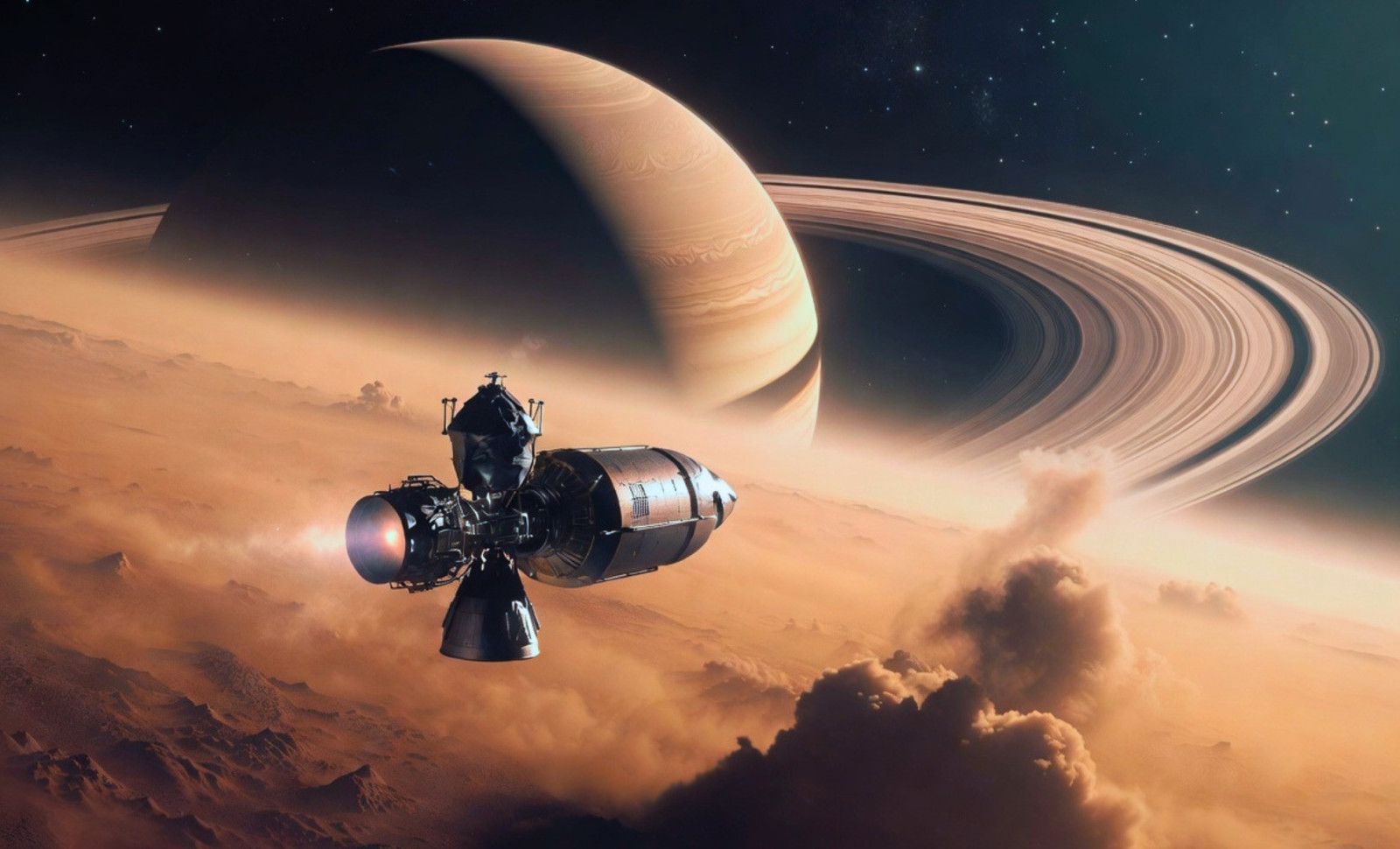
Within NASA’s strategic outlines for Mars exploration lies a caution: a mission lasting 375 days might exceed astronauts’ safe exposure limits to cosmic radiation. Now, two engineers have explored what it would take to send humans even further—to Titan, Saturn’s largest moon—and their calculations reveal a challenging reality. Using a uranium-powered rocket, the journey one-way could take as little as 220 days. The entire mission, including time spent on Titan’s surface, might approach 1,000 days in duration.
No astronaut has yet endured such an extended stay in deep space. The record is held by Valeri Poliakov, who spent 437 consecutive days aboard the Russian Mir space station from 1994 to 1995. Because Mir orbited within Earth’s magnetic field, it was shielded from much of the galactic cosmic radiation that deep-space missions must confront. A Titan expedition would require more than double Poliakov’s endurance—and without that protective barrier.
William J. O’Hara and Dr. Marcos Fernandez-Tous presented their study at the Lunar and Planetary Science Conference 2025 in The Woodlands, Texas, this past March. Their publication, available via the Universities Space Research Association, evaluated four nuclear propulsion designs aimed at making one-way trips ranging from one to two years. The top candidate, a nuclear thermal propulsion system named Copernicus, would carry 172 metric tons of liquid hydrogen heated by a uranium-235 reactor, enabling arrival at Titan in just 220 days. Adding extra fuel tanks to this craft could reduce transit time further to 90 days.

However, extra fuel increases launch mass and expenses, and the study does not address the challenge of protecting the crew from intense cosmic radiation during the voyage.
Evaluating Propulsion Concepts for the Saturn Mission
The Copernicus design was initially developed in 2013 by NASA Glenn, under the leadership of Stanley K. Borowski, with fast Mars travel in mind. O’Hara and Fernandez-Tous adapted this concept for the much greater distance to Titan, located approximately 8.5 astronomical units away—about 17 times farther than Mars at its nearest approach to Earth.
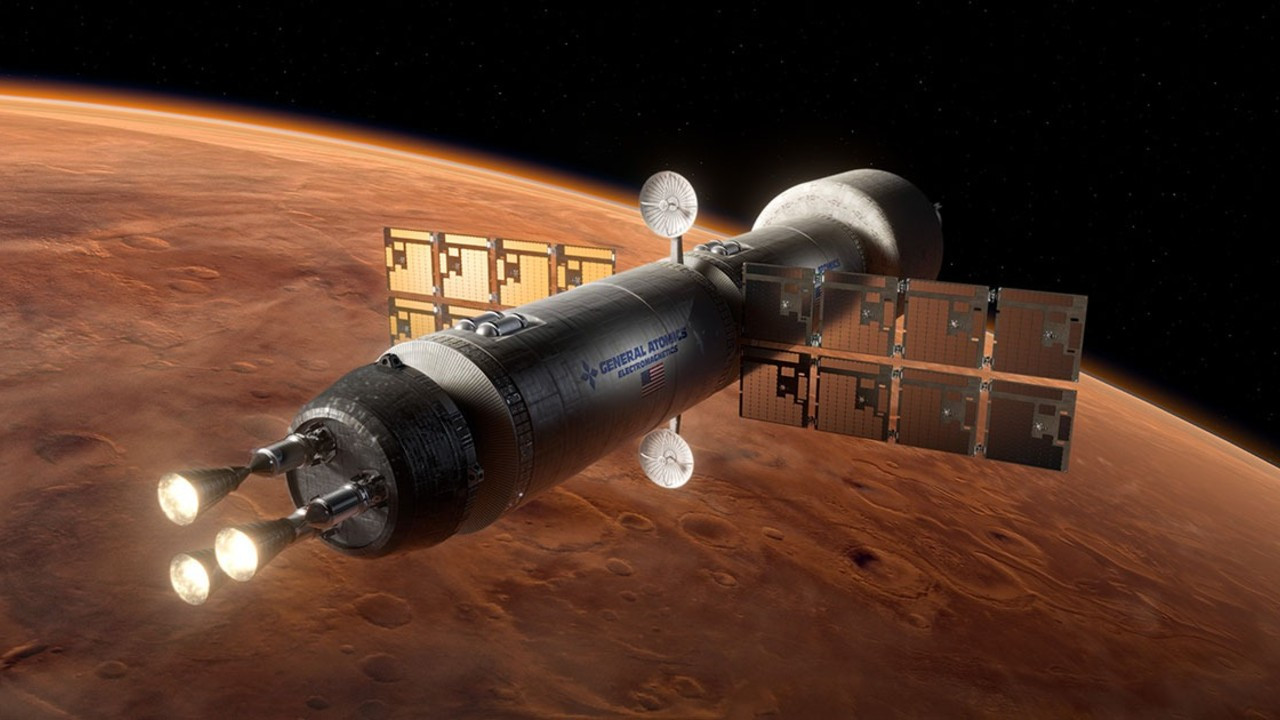
The researchers also assessed competing technologies like nuclear-electric propulsion. The VASIMR plasma engine, developed by Ad Astra, might shorten the outbound journey to 149 days. A direct fusion drive, still in experimental phases, could enable a robotic round-trip lasting between two and 2.6 years.
Fernandez-Tous serves as a space studies professor at the University of North Dakota, while O’Hara divides his time between Blue Origin, focusing on lunar habitats, and the nonprofit Explore Titan, which advocates repurposing Mars-capable systems for the outer solar system. As highlighted in a separate Universe Today analysis, Explore Titan promotes a "Mars-to-Titan” stepwise plan. Their research considers nuclear propulsion to be the “essential component” for human exploration of Titan.
What Makes Titan a Compelling Destination
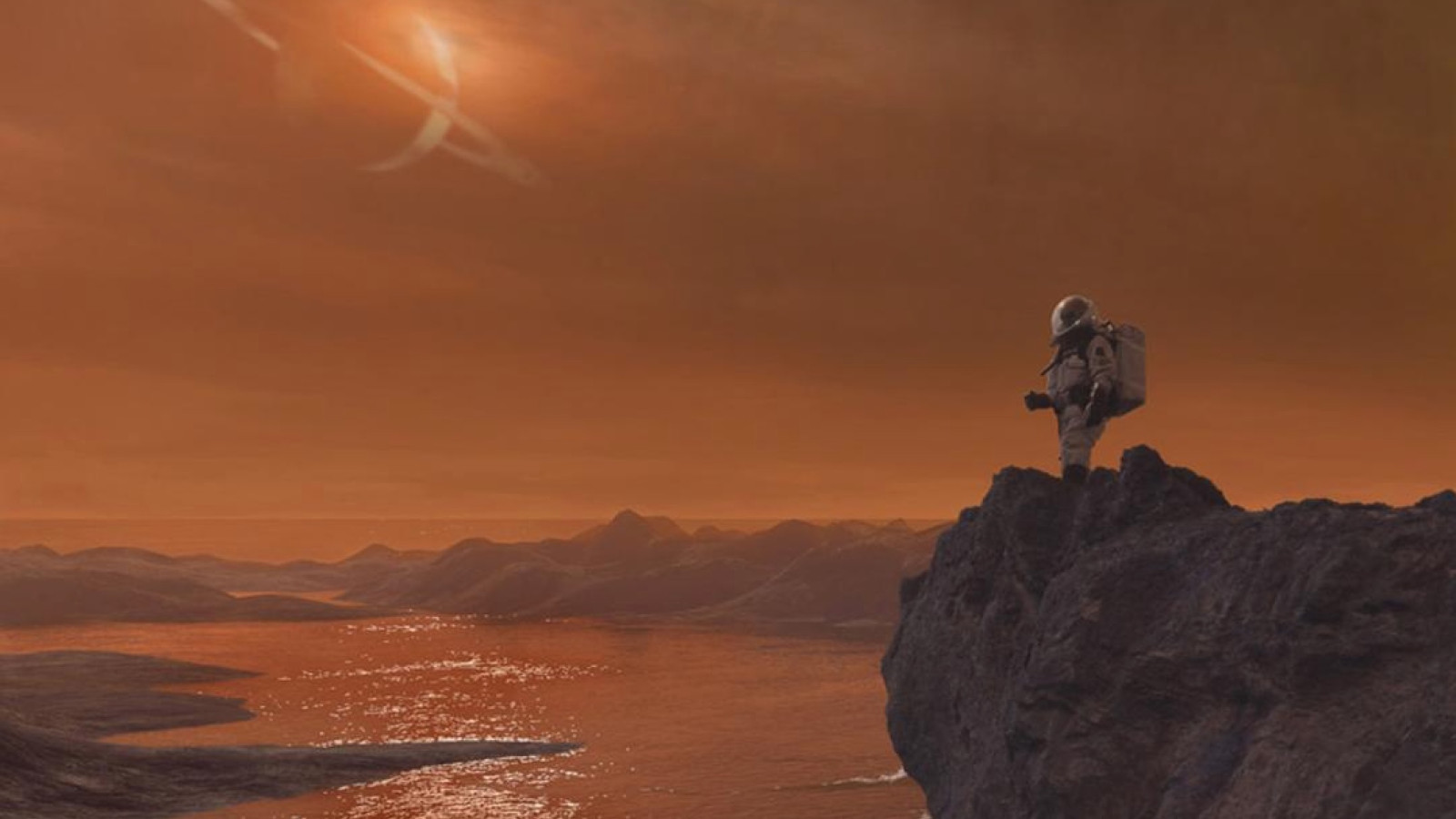
Titan’s environment poses immense challenges. Surface temperatures hover near minus 179 degrees Celsius, sunlight levels are just 0.1 percent of Earth’s, and gravity is about one-seventh as strong—causing bone and muscle deterioration even when standing.

Yet Titan offers advantages Mars cannot match. Its nitrogen-rich atmosphere is six times denser than Earth’s, allowing landers to decelerate aerodynamically without firing retrorockets. The surface contains liquid methane and ethane, which could be harvested and processed into fuel by visiting crews. Furthermore, once on the ground, the thick atmosphere shields inhabitants from much of the cosmic radiation encountered during transit.
While Titan’s atmosphere complicates things, it also makes surviving surface operations possible in ways Mars does not.
Extended Deep Space Missions and Their Impact on Human Health
Exposure to cosmic radiation begins the moment a spacecraft exits Earth’s magnetic cocoon. NASA’s Mars mission designs already concede that a 375-day round trip risks surpassing career radiation exposure limits.
A crewed Titan journey would nearly triple that duration. No lightweight shielding materials have yet been validated in orbit for protection against the high-energy particles that penetrate spacecraft. The paper does not present a solution for this critical concern.
Microgravity also causes predictable damage. Bone mass declines at about one percent per month, muscle atrophies, and bodily fluids shift, resulting in optic nerve pressure and deformation of the eyeball's rear.
Some astronauts have returned from six-month missions with lasting vision impairment. No data exists for continuous spaceflight lasting around two and a half years since it has never been attempted. The study mentions psychological challenges from isolation and confinement but does not quantify their impact. Poliakov’s 14-month stay remains humanity’s endurance limit, a duration a Titan mission would more than double without a quick abort option.
Dragonfly: The Robotic Pathfinder for Titan Exploration
Before humans make such a journey, robotic exploration will provide crucial groundwork. NASA’s Dragonfly mission, led by the Johns Hopkins Applied Physics Laboratory, is slated for launch in 2034, with arrival at Titan after about seven and a half years of travel.
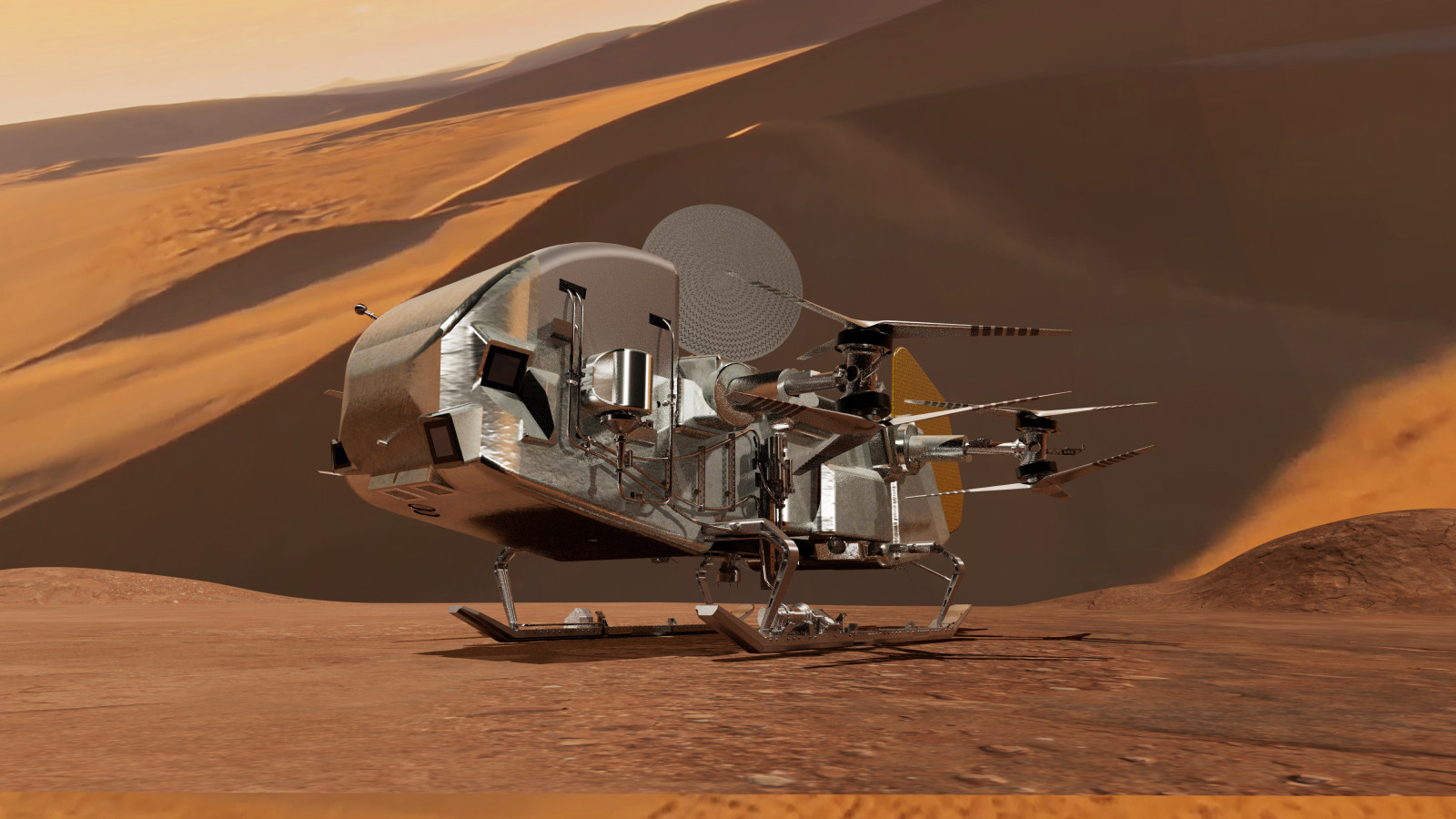
This nuclear-powered rotorcraft will analyze surface chemistry, evaluate terrain conditions, and measure radiation levels at the surface. These data will verify assumptions about Titan’s environment crucial to mission planning and could lead to redesigns before human-rated systems are finalized.
The propulsion technology is the most predictable component; engineers can design a reactor-powered spacecraft to reach Titan. The true uncertainty lies in whether humans can endure the extended journey and safely operate once on the moon.
- Categories:
- Science











0 comments
Sign in to Comment