
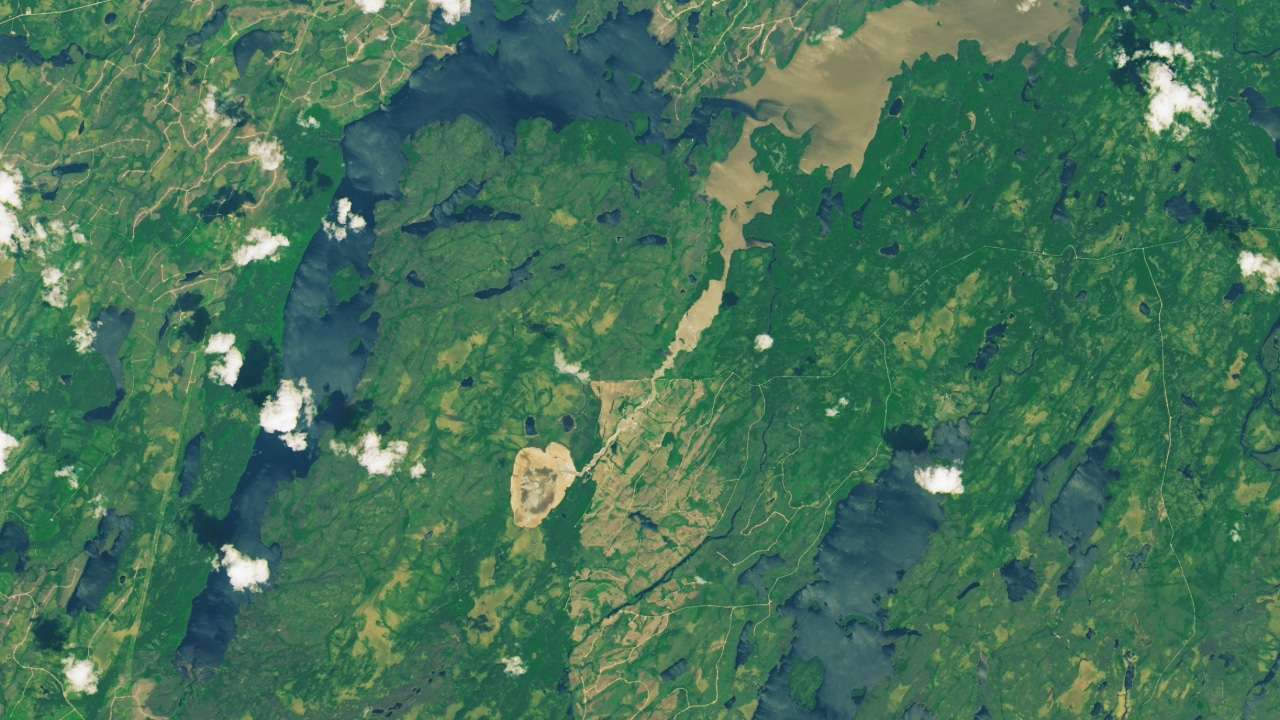
In May 2025, people living near Lac Rouge in Quebec encountered an astonishing event. A nearby roadway was destroyed, leading investigators to discover that the entire lake had drained almost instantly. Experts describe this phenomenon as exceptionally rare, and imagery from Landsat 9 satellites later confirmed the lake had shrunk into a barren brown basin.
Local Residents Stunned by Rapid Disappearance
Situated in the Lac-Walker area of Sept-Rivières in Quebec, Lac Rouge covers around 0.86 square miles (1.4 square kilometers). This water body has been a vital resource for the Cree First Nation of Waswanipi, supporting fishing, hunting, and trapping traditions. The lake’s sudden vanishing has sparked concern among locals and visitors alike about the effects on native species such as moose and sturgeon, which rely heavily on this habitat.
On-site inspections revealed that the ground beneath the lake had collapsed, creating an unanticipated route for water drainage. This geological event caused water to reverse its flow, moving from the usual outlet through small ponds and streams before eventually reaching Lac Doda, approximately 6 miles (10 kilometers) distant.

Satellite Data Maps Out the Event Timeline
Visual evidence from the NASA Earth Observatory, utilizing data collected by the U.S. Geological Survey’s Landsat 9 satellite, provided a detailed picture of the transformation. The images document the lake’s transition from a thriving aquatic environment into a desolate land form. While the precise timing of the drainage is unclear, scientists estimate it occurred between April 29 and May 14, 2025.
This discovery highlights the crucial role of satellite-based Earth observation in monitoring environmental phenomena. Purpose-built to explore planetary dynamics, Landsat 9 technology captured this extraordinary event in remarkable detail. As a result, the draining of Lac Rouge stands as a compelling example of how landscapes can abruptly change.
Origin of the Incident Still Unclear
Ongoing research has yet to pinpoint the exact cause of the lake’s drainage. According to the Cree First Nation of Waswanipi, “the cause of the lake draining is still unknown.” Some experts hypothesize that factors like wildfires, intense rainfall, or rapid snowmelt may have contributed to the collapse of the lakebed. Notably, wildfires in the area during 2019 and 2023 might have compromised soil stability, increasing susceptibility to sudden ground failure.
This unprecedented event has attracted interest from scientists and community members, prompting further questions about whether similar occurrences might be possible elsewhere.
- Categories:
- News








0 comments
Sign in to Comment