

A graduate researcher at Pennsylvania State University has revitalized a 100-year-old aerodynamic equation, paving the way for innovations in wind turbine efficiency and advancing clean energy solutions.
Modernizing Glauert’s Classic Aerodynamic Equation
Over a century ago, British aerodynamicist Hermann Glauert formulated an equation to estimate the maximum power coefficient, indicating how efficiently wind turbines convert wind into electrical energy. However, Glauert’s original model omitted critical factors like axial force and root bending moments that impact the design and durability of actual turbines.
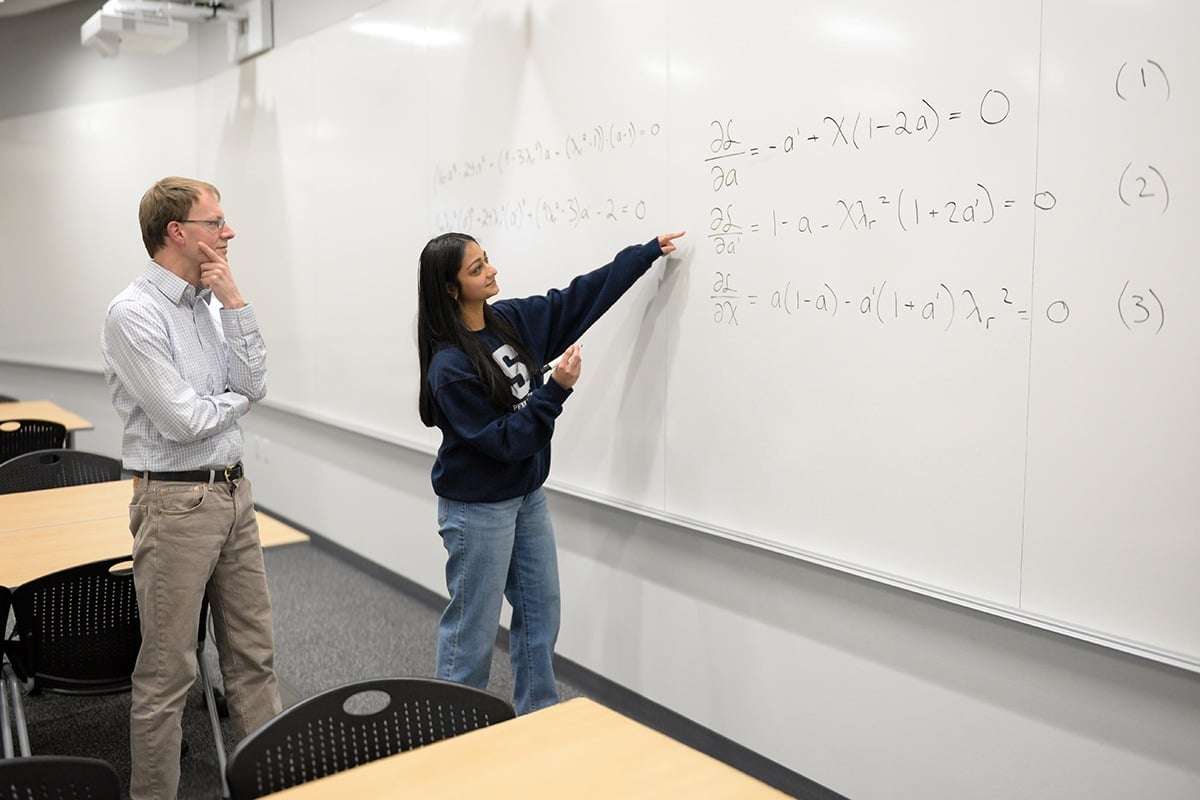
Now, Divya Tyagi, a Penn State aerospace engineering graduate student, has advanced and clarified Glauert’s equation into an improved and more practical format, according to PennState. Her enhancement offers a current methodology to identify the optimal aerodynamic conditions for turbine blades, enabling designers to increase efficiency while managing mechanical stresses.

From Undergraduate Project to Published Research
Tyagi created this extension of Glauert’s formula during her time at the Schreyer Honors College, guided by Dr. Sven Schmitz, Boeing/A.D. Welliver Professor in Penn State’s Department of Aerospace Engineering. The work formed her senior thesis and was published in Wind Energy Science.
Schmitz had regarded the original Glauert model as complex and incomplete. Tyagi was the fourth student he presented the challenge to, and the only one to successfully solve it.
Using methods from the calculus of variations, her approach recasts the problem through constrained optimization, simplifying its relevance in engineering practice.
Assessing the Practical Benefits
Tyagi highlighted that a mere 1% boost in the power coefficient could considerably raise the output of individual large turbines — potentially generating sufficient electricity to serve entire communities. When scaled across multiple turbines, these enhancements could transform renewable energy productivity and reduce costs.
Her revised model also incorporates coefficients related to total loading and blade stress, aspects omitted in Glauert's initial calculation.
Recognition and Future Directions
Tyagi received the prestigious Anthony E. Wolk Award for the finest senior thesis in aerospace engineering at Penn State. Schmitz anticipates that the clarity of her refinement will encourage its adoption in upcoming aerospace engineering programs and research facilities.
“The real impact will be on the next generation of wind turbines using the new knowledge that has been unveiled,” said Schmitz. “As for Divya’s elegant solution, I think it will find its way into classrooms, across the country and around the world.”
Currently pursuing her master's degree, Tyagi is concentrating on computational fluid dynamics (CFD) and simulations concerning airflow patterns around helicopter rotors. Supported by the U.S. Navy, her research seeks to enhance pilot safety and precision in ship deck landings by understanding how air turbulence affects rotor performance.
This research complements her expertise in fluid dynamics, linking wind turbine aerodynamics to aerospace and defense applications.
Dedication Behind the Discovery
Tyagi committed 10–15 weekly hours to untangling complex mathematical challenges while drafting her thesis — an effort that ultimately yielded significant results.
“Proving the solution on paper was tough,” she said. “But I feel really proud now, seeing all the work I’ve done.”
Schmitz praised her determination and clarity, noting, “There had to be an easier way to do it. That’s when Divya came in. Her work is truly impressive.”
- Categories:
- Science








0 comments
Sign in to Comment