
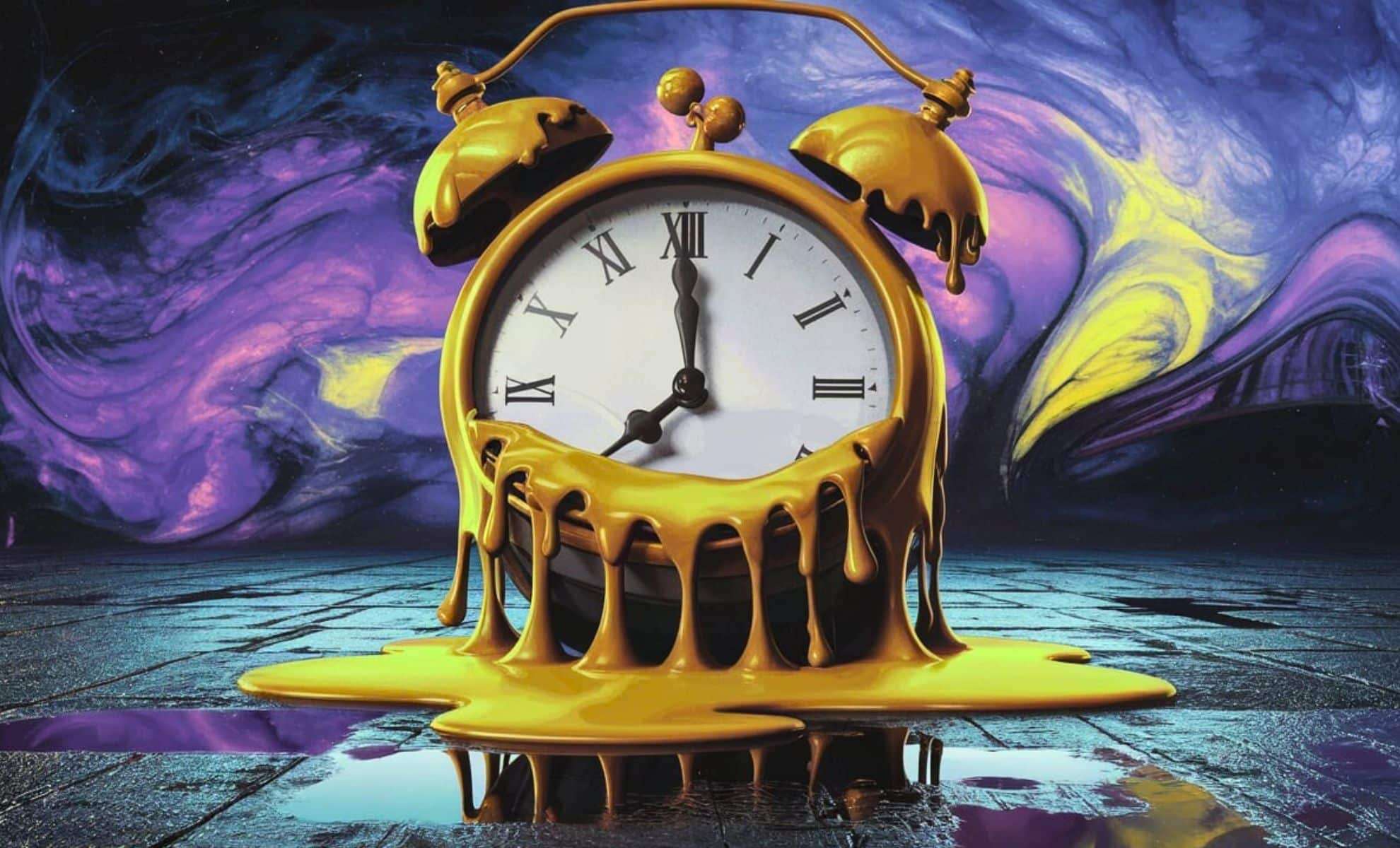
Does time genuinely exist, or is it simply a construct of human cognition? Carlo Rovelli, a leading theoretical physicist affiliated with Aix-Marseille University in France, presents a thought-provoking perspective in his influential book, “The Order of Time”, suggesting that our traditional ideas about time may be misleading.
Forget the steady ticking of a clock or even Einstein’s concept of space-time as flexible. Rovelli contends that the sensation of time’s passage stems from limited knowledge, not an absolute aspect of reality.
Questioning the Existence of Time
For a long time, Newton’s deterministic universe portrayed time as uniform and constant. Einstein revolutionized this view, showing through his special relativity theory that time can dilate depending on velocity and gravity. Still, Rovelli pushes this further, proposing that even Einstein’s framework is an approximation.

What does this mean? Rovelli argues that the core elements of the universe are events, rather than particles or fields. In his view, fundamental physics does not include time in its equations; time emerges from how events relate to each other. Essentially, reality resembles an intricate network of happenings instead of a straightforward timeline.
Entropy’s Role in Our Perception of Time
Why then does time seem to flow from past to future? Rovelli points to entropy, the measure of disorder introduced by Ludwig Boltzmann in thermodynamics. As systems evolve from order toward chaos, we experience a temporal direction. This perception results from ignorance—we cannot observe the universe in its entirety. The essence of quantum uncertainty fosters the illusion of a consistent, ticking clock.
Put simply, you recall the past but not the future because entropy steadily rises, dispersing information irreversibly. This phenomenon connects our sense of time’s arrow with the second law of thermodynamics, which states that entropy in isolated systems generally increases.
Imagining a Timeless Universe
Rovelli is a founder of loop quantum gravity (LQG), a theory devoted to reconciling quantum mechanics with general relativity. A fundamental aspect of LQG is the absence of fundamental time. The Wheeler-DeWitt equation, pivotal in quantum gravity, models the universe without a time variable, treating time as something that arises rather than an intrinsic property.
Within this paradigm, time is born from causal links between events. As Rovelli notes, “A storm is not a thing; it’s a collection of occurrences.” In this context, what we call past, present, and future are ways of ordering sequences of events according to their interconnections.
Impact and Considerations
Though Rovelli’s framework is intriguing, it challenges long-standing, everyday assumptions. How can societies rooted in scheduling and chronology adapt to a view where time is not fundamental?
Critical Points to Note:
- Entropy defines time’s arrow: The direction perceived in time’s flow derives from increasing entropy, not from time itself.
- Loop quantum gravity: This approach suggests time emerges from event relations, with no universal, underlying clock.
Looking Ahead in Time Research
Rovelli’s concepts are not without controversy. Critics highlight that space-time quantization—a cornerstone of LQG—has yet to be experimentally confirmed. Furthermore, the thermal time hypothesis, proposing that time springs from thermodynamic states, remains to be fully validated.
Despite these hurdles, “The Order of Time” asks profound questions about our universe’s fabric. Rovelli urges a shift in viewing time as a construct shaped by limited perception, closely linked to entropy and causation.
Will these notions endure, or eventually be set aside? Regardless, they have sparked fresh dialogue within physics, philosophy, and our grasp of existence.
What’s your take—could time simply be an illusion, or is it an essential facet of reality? Share your view below!
The Study is originally published in nature
- Categories:
- Science











0 comments
Sign in to Comment