

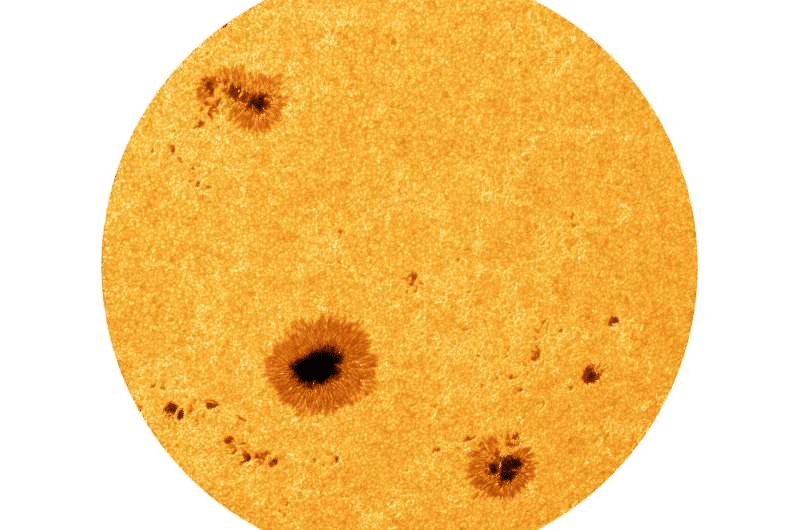
A major leap in solar observation has been realized with the introduction of a cutting-edge 8K camera setup at the Vacuum Tower Telescope (VTT) located at the Observatorio del Teide in Tenerife. Developed by the Leibniz Institute for Astrophysics Potsdam (AIP), this advanced imaging technology dramatically improves resolution, enabling scientists to capture and refine ultra-high-definition visuals of the sun’s surface. The comprehensive study outlining this breakthrough and its scientific benefits is available in the journal Solar Physics. This camera system significantly boosts the telescope’s capability to observe intricate sunspot formations alongside dynamic solar phenomena, merging expansive field coverage with extraordinary spatial detail, a combination rarely seen in current solar observations.
Enhancing Solar Observation with Unmatched 8K Resolution and Expansive Coverage
Conventional solar telescopes often wrestle with balancing detailed imaging of small solar features against covering broad active regions. While larger telescopes focus on tiny solar areas to capture intricate structures, satellite or network observatories image the entire solar disk but lack the magnification necessary for in-depth analysis. The VTT bridges this gap by delivering both high spatial resolution and wide-area views. This innovative camera takes 100 rapid-exposure images at 25 frames per second, each boasting a resolution of 8,000 by 6,000 pixels. Subsequent image restoration produces 8K resolution visuals, removing the blurring effects caused by Earth’s atmospheric turbulence. The resulting clarity reaches scales as fine as 100 kilometers on the sun’s surface, allowing observation of vast solar structures spanning about 200,000 kilometers, opening new avenues to study solar behaviors.
In-depth Solar Activity Insights Enabled by Enhanced Magnetic Field Imaging
The upgraded imaging technology reveals unprecedented details of the sun’s magnetic fields and plasma flows, which are key drivers of solar events like flares and sunspots. Using specialized filters, researchers visualize minuscule magnetic features as luminous structures within the sun’s photosphere and chromosphere. Time-lapse imaging at wavelengths of 393.3 nm (singly ionized calcium line) and 430.7 nm (Fraunhofer G-band) captures the dynamic progression of active solar regions and plasma motion. As Rolf Schlichenmaier of the Kiepenheuer Institute for Solar Physics (KIS) explains, “In order to better understand solar activity, it is crucial not only to analyze the fundamental processes of the fine structure and the long-term development of global activity with various instruments, but also to investigate the temporal evolution of the magnetic field in active regions.”

Synergizing Cutting-Edge Tech with Established Solar Instruments
The 8K camera enhances the VTT’s suite of sophisticated instruments, including HELLRIDE, LARS, and FaMuLUS, facilitating simultaneous observation of multiple solar phenomena and providing a holistic understanding of solar activity. Robert Kamlah, who spearheaded the camera development during his doctoral research at AIP and the University of Potsdam, shares, “Our expectations of the camera system were more than fulfilled right from the start.” The improved image precision and temporal fidelity allow scientists to examine sunspot interactions within supergranulation and decode the complex magnetic structures responsible for solar eruptions. These findings underscore the impact of retrofitting existing telescopes with state-of-the-art technology to dramatically enhance their research capabilities.
Impact on Future Solar Telescopes and Space Weather Monitoring
This advancement demonstrates the promise of affordable CMOS 8K cameras in next-generation solar telescopes, especially those with apertures around 4 meters. Compared to current 4K systems, the new technology can triple the observable field while maintaining intricate detail. Carsten Denker, head of the Solar Physics Section at AIP, observes, “The results obtained show how, together with our partners, we are teaching an old telescope new tricks.” High-definition, broad-view imaging will be essential for tracking solar flares and eruptive events that influence space weather, affecting satellites, communications, and power systems on Earth. As solar cycles continue to evolve, this innovative technology will help unlock a deeper understanding of our star’s behavior like never before.
- Categories:
- News






0 comments
Sign in to Comment