
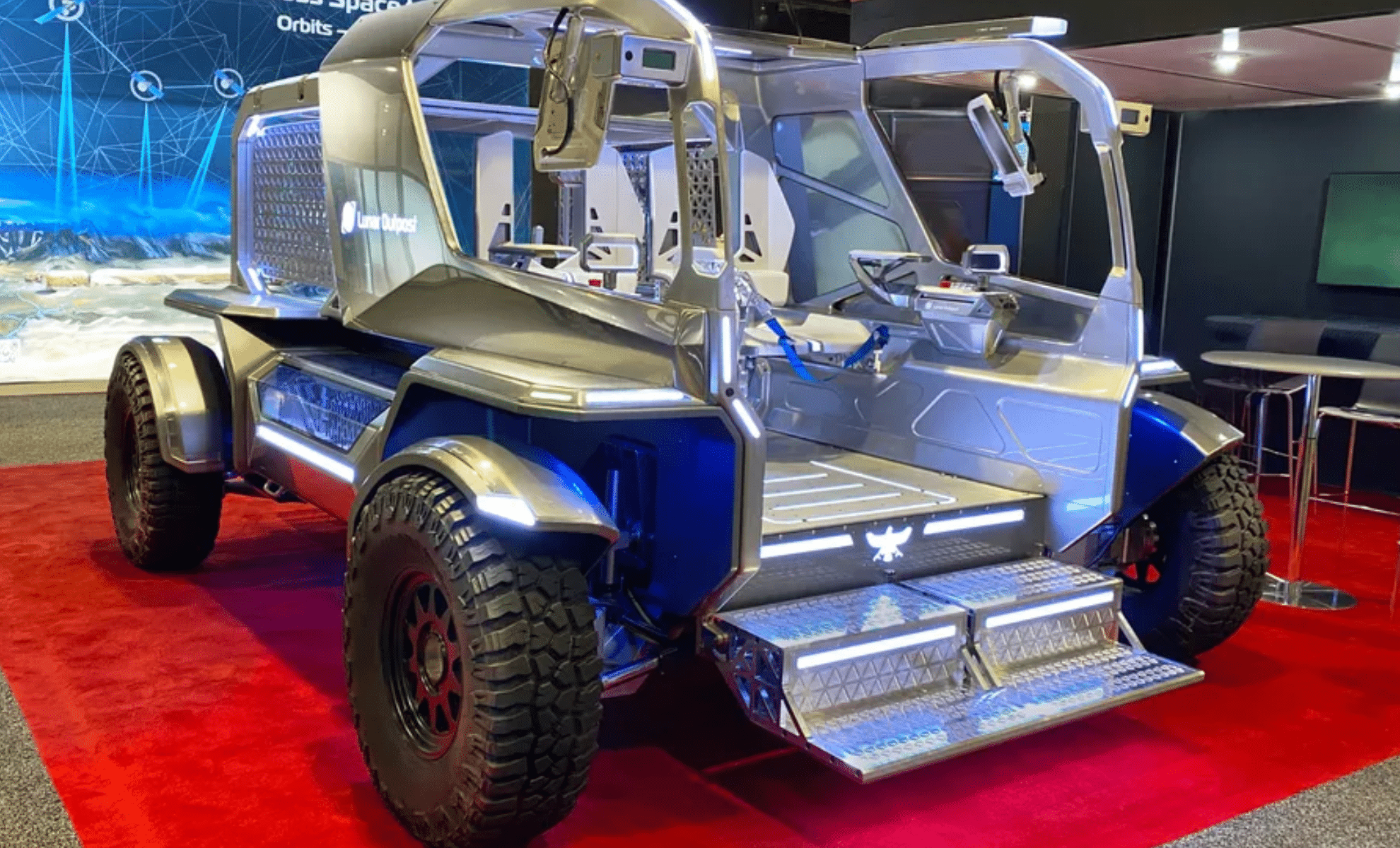
The vision of traversing the moon’s uneven landscape with sophisticated rovers is rapidly nearing realization. Companies such as Lunar Outpost are advancing their lunar terrain vehicles (LTVs), promising new tools for NASA’s Artemis program. Their rugged, autonomous rover named “Eagle” is poised to transform the way astronauts conduct missions on the lunar surface.
Concept and Design of the Lunar Outpost Terrain Vehicle
Lunar Outpost, an innovative private aerospace firm, has crafted a Lunar Terrain Vehicle merging all-terrain durability with state-of-the-art technology tailored for moon operations. CEO and co-founder Justin Cyrus describes the “Eagle” as a mix between “a dune buggy and a heavy-duty truck.” This hybrid design is essential to endure the moon’s severe environment, including drastic temperature swings and challenging terrain. Selected by NASA for an extensive feasibility study alongside two other teams, Lunar Outpost plays a significant role in shaping upcoming lunar exploration efforts.
Though their initial missions faced hurdles, the team remains committed to enhancing the LTV’s capabilities. “Unfortunately, that first mission didn’t go quite as we hoped,” Cyrus admitted. Still, the mission yielded important data from operating in cislunar space, despite the rover not landing on the lunar surface. “We came extremely close to actually maneuvering on the moon,” he added, highlighting the company’s progress towards a major milestone.

Command Hub at Lunar Outpost: Centralizing Lunar Operations
The Lunar Outpost headquarters in Arvada, Colorado, houses the mission control center overseeing Eagle LTV’s activities. This facility features advanced, fast-refresh-rate monitors that provide real-time mission insights. The workspace adapts visually to different operational states by changing lighting colors—red signaling emergencies, for example—to keep the team alert and coordinated. “We use red, green, blue, purple for different modes and operations,” Cyrus explained, underscoring how color cues maintain smooth workflow.
Mission Control works closely with the Autonomous Test Facility in Rye, Colorado, which is specially designed for large vehicle trials. Simulating lunar-like landscapes with craters and rocky obstacles, this testing environment enables extended durability and performance evaluations for the Eagle LTV. “This is one of our most informative test sites. We can test large-scale vehicles for long periods of time,” Cyrus noted. These rigorous simulations help perfect the rover’s autonomous and remote-controlled functions, vital for future lunar endeavors.
Multiple Operation Modes Empowering Moon Missions
A standout feature of the Eagle LTV is its versatility across autonomous, human-operated, or hybrid modes. Autonomous operation lets the rover handle routine tasks like clearing solar panels or maintenance, thereby freeing astronauts to concentrate on scientific objectives. The rover also supports teleoperation from Earth and manual control when astronauts are on the lunar surface.
Designed for speeds up to 25 kilometers per hour (around 15 mph), the vehicle’s pace is intentionally kept moderate to prevent incidents caused by unexpected rocks or uneven ground. “You don’t want to go faster than that. When you hit a rock at that speed, you can get a pretty dramatic response,” Cyrus remarked. Typically, the LTV moves slower to maintain stability and safety, making it adaptable for daily activities and emergency use alike.
Addressing Lunar Challenges: Thermal Control and Nighttime Survival
One of the major hurdles for the Eagle LTV is coping with the moon’s extreme thermal variations — from scorching days to freezing nights. To tackle this, Lunar Outpost has engineered advanced thermal regulation systems that keep the rover operational across these conditions.
Remarkably, the LTV is designed to function within the moon’s permanently shadowed regions (PSRs)—areas in perpetual darkness. These zones are scientifically valuable due to the presence of water ice, which can be converted into essential resources such as water, breathable oxygen, and rocket propellant. “We can not only survive but operate in PSRs for many tens of hours at a time,” Cyrus explained. This innovative capability unlocks new frontiers for exploration in areas previously deemed too harsh for robotic or crewed missions.
- Categories:
- News







0 comments
Sign in to Comment