
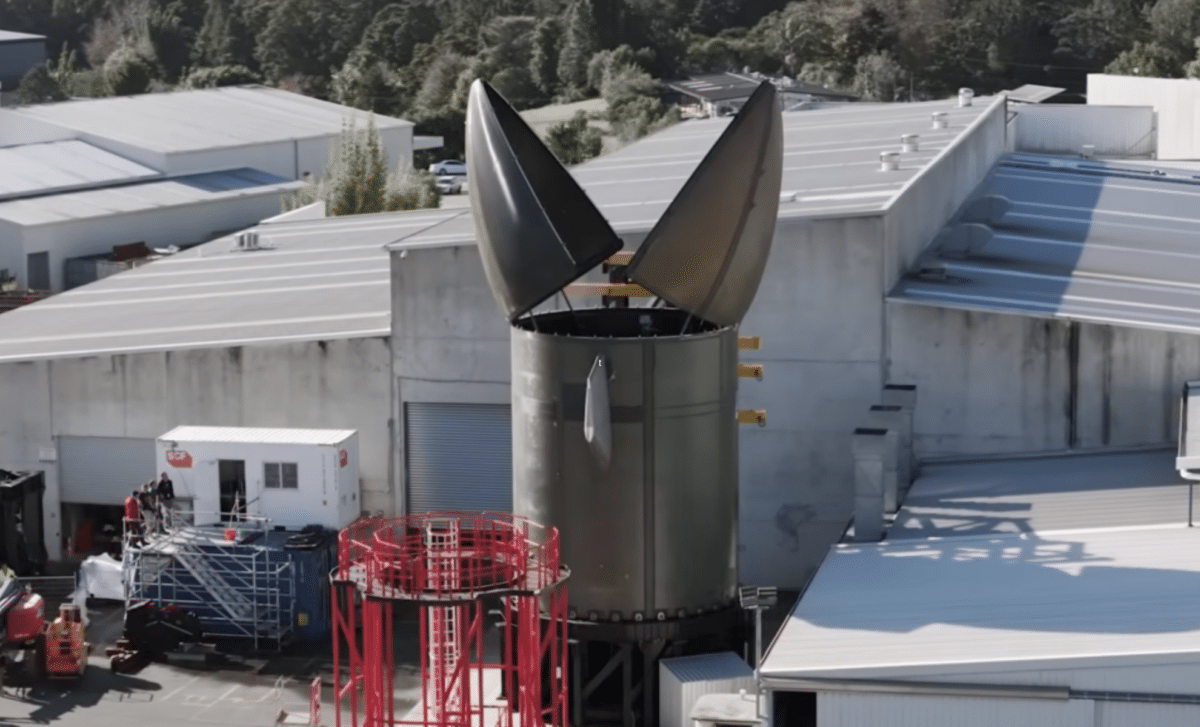
Rocket Lab, renowned for its small Electron launch vehicle, is now expanding into the heavy-lift launch arena with its upcoming Neutron rocket. Recently, the company completed final qualification trials for its innovative reusable “Hungry Hippo” fairing, a pivotal element in their next-generation rocket design. This fairing introduces a novel approach to reusability, aiming to revolutionize orbital launch systems. With Neutron’s maiden flight planned for early next year, the aerospace community anticipates a transformative step forward in space technology.
Introducing the Hungry Hippo: Reusability Redefined
The Hungry Hippo fairing is a distinctive, reusable component developed by Rocket Lab that departs from traditional single-use fairings. Unlike conventional fairings that are jettisoned after each mission, this design features a mechanism resembling the jaws of the classic “Hungry Hungry Hippos” game, enabling it to open and close efficiently. This inventive system not only gives the fairing its name but also significantly enhances the rocket’s overall reusability and operational flexibility.
Rocket Lab’s development emphasizes rapid and reliable reusability. The fairing endured stringent testing, including withstanding external forces up to 275,000 pounds, replicating the robust conditions of launch. Additionally, the opening and closing systems were stress-tested to ensure they operate faster than mission requirements, guaranteeing dependable performance during flight.

Neutron Rocket: Power and Innovation Combined
The Neutron rocket is set to stand 141 feet tall and deliver payloads up to 28,700 pounds to low Earth orbit (LEO). This positions it to rival SpaceX’s Falcon 9, currently the leader in orbital launches. While Falcon 9 has demonstrated effective reusability, Neutron aims to challenge this with a fresh architecture and a lower overall cost, bringing new competition to the expanding launch sector.
“A rocket like Neutron has never been built before, and we’re doing it at a pace and price point that’s going to bring the innovation and competition needed in today’s industry,” said Shaun D’Mello, Rocket Lab’s Vice President for Neutron.
By incorporating carbon composite materials alongside the innovative fairing mechanism, Neutron aims to provide substantial payload capacity at a reduced cost compared to current competitors. Rocket Lab’s commitment to affordability and reuse is designed to attract a diverse customer base, ranging from emerging satellite companies to major space agencies globally.
Comprehensive Testing Ensures Mission Success
Before being transported to the Mid-Atlantic Regional Spaceport in Virginia for integration, the fairing underwent extensive qualification testing. These procedures intensely challenged the fairing’s durability and performance, simulating the extreme forces and environmental factors it will encounter during actual launches. Simulations of dynamic pressures during ascent played a critical role in validating the fairing's robustness.
Integrating the fairing with the Neutron rocket also involved sophisticated software coordination and structural load assessments to verify flawless operational harmony through liftoff. This rigorous approach illustrates Rocket Lab’s dedication to dependable, innovative space technology.
A New Chapter in Space Launch Technology
Rocket Lab’s progress with Neutron and the reusable Hungry Hippo fairing signifies a major advancement in the company’s mission and strategy. By blending the rapid iteration speed typical of smaller rocket programs with cutting-edge reusable technology, Rocket Lab is establishing a competitive presence in the heavy-lift market. The Neutron launch promises to influence future space mission paradigms, especially as demand for economical and frequent launches grows.
As the countdown towards Neutron’s inaugural launch continues, the aerospace sector watches with anticipation. Success for this reusable system could usher in a new wave of sustainable, cost-efficient rocket technologies, revolutionizing access to space.
- Categories:
- Space




0 comments
Sign in to Comment