
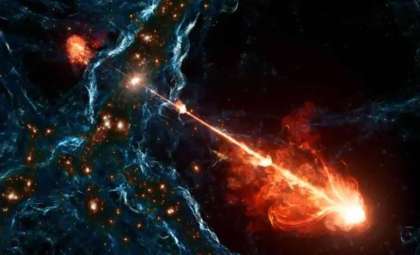
A supermassive black hole may have been observed fleeing its home galaxy, leaving behind a spectacular 200,000-light-year stream of newly formed stars. This discovery offers compelling evidence supporting the idea that gravitational-wave recoil can expel black holes from their galactic centers.
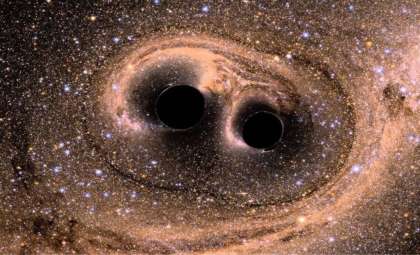
Astrophysicists have long proposed that when two supermassive black holes collide and merge, the resulting object can be propelled at incredible speeds. This phenomenon arises from Albert Einstein's general relativity theory: if the emitted gravitational waves are asymmetrical, the combined black hole experiences a powerful momentum kick.
Gravitational-wave Recoil Powerful Enough to Eject a Giant Black Hole
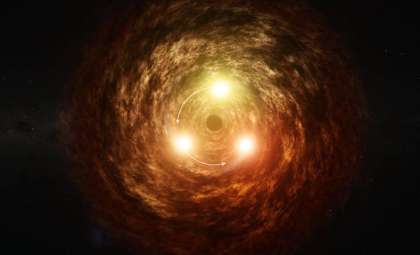
During galactic mergers, the central black holes gradually approach and merge. This dramatic event emits gravitational waves as energy. When these waves radiate unevenly, conservation of momentum causes the merged black hole to recoil in the opposite direction.

According to ScienceAlert, this recoil can be so strong that the black hole is launched entirely out of its galaxy. Recent observations seem to exhibit this scenario, showing a black hole shifted far from its host’s core and hurtling through space at extraordinary speed.
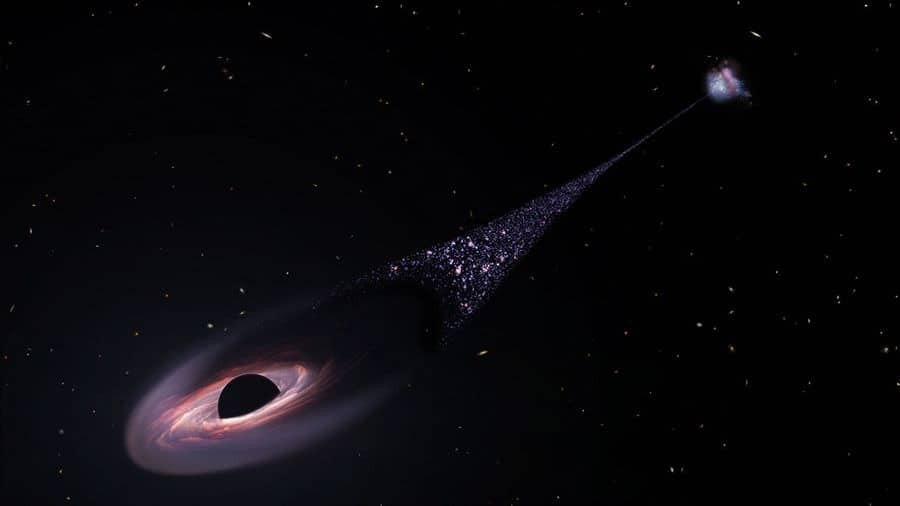
Scientists estimate this black hole's velocity at about 1,600 kilometers per second, fast enough to break free from the galaxy’s gravitational pull.
A 200,000-light-year Trail Signaling Star Formation
This runaway black hole distinguishes itself by the enormous luminous tail extending behind it. This narrow ribbon spans roughly 200,000 light-years, exceeding the size of the Milky Way's diameter.
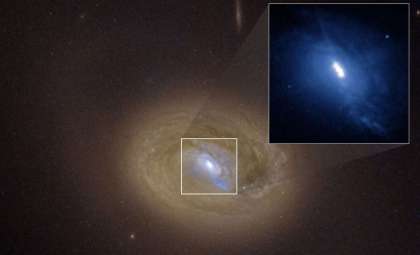
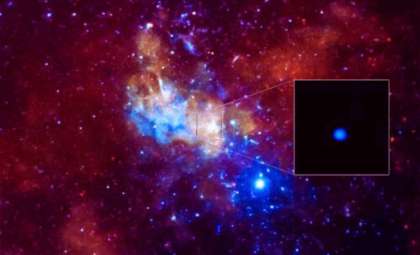
As reported in the same article, astronomers interpret this feature as a wake of star birth caused by the black hole's rapid journey. Its movement compresses gas particles, sparking the formation of new stars. At the trail’s forefront, a compact, bright source matches the characteristics of a supermassive black hole actively consuming matter.
The arrangement fits predictions from theoretical models, showing a clear and organized path rather than a random extension — demonstrating a distinct escape trajectory.
The Changing Face of Galactic Centers
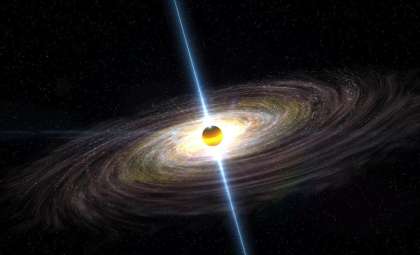
Typically, supermassive black holes reside at galaxy cores, governing gas flow and impacting star formation. If a black hole suddenly escapes, the galaxy loses its central gravitational influence.
ScienceAlert has pointed out that finding additional examples like this could deepen our knowledge of how often these recoil events happen and their consequences for galaxy development. Upcoming gravitational-wave observatories, especially the future Laser Interferometer Space Antenna (LISA), aim to directly detect mergers involving supermassive black holes.
- Categories:
- Space


0 comments
Sign in to Comment