
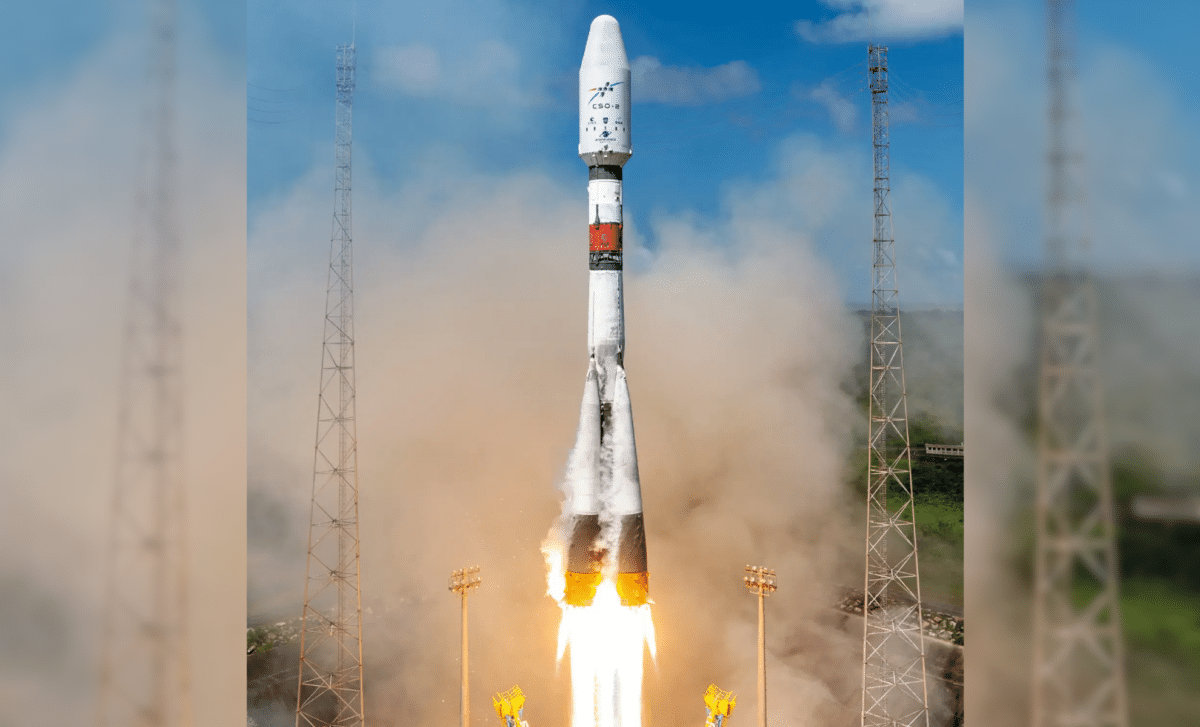
Russia has successfully launched a Soyuz-2.1a rocket from its Plesetsk Cosmodrome, deploying the Obzor-R No. 1 radar Earth observation satellite into orbit. Managed by the Russian Aerospace Forces, this launch marks the sixth Soyuz mission of 2025 and underscores Russia’s enhanced commitment to independent space-based surveillance technologies.
Accurate Launch from Russia’s Northern Spaceport
The Soyuz-2.1a medium-lift rocket took off at 5:11 p.m. local time (1411 GMT) from the State Test Cosmodrome in Arkhangelsk Oblast, roughly 800 kilometers north of Moscow. The Plesetsk facility, widely used for military and classified deployments, was pivotal in this operation.
The Obzor-R No. 1 satellite is tailored to enter a Sun-synchronous orbit, which maintains consistent lighting conditions optimal for radar observation. Unlike optical satellites, radar satellites like Obzor-R operate effectively in varied weather and lighting, capturing data during both daytime and nighttime conditions.

Following the launch, the Russian Ministry of Defense confirmed mission success, stating:
“The launch of the carrier rocket and the insertion of the spacecraft into the designated orbit proceeded normally. After liftoff, the medium-class Soyuz-2.1a carrier rocket was taken over for tracking by the ground-based automated control system of the Main Test Space Center named after German Stepanovich Titov.”
Originally scheduled for Wednesday, the launch was postponed by a day for unspecified reasons, which typically relate to weather conditions or technical adjustments.
Understanding the Obzor-R Satellite Project
Obzor-R represents a new class of radar imaging Earth observation satellites from Russia. Unlike traditional optical systems that depend on sunlight, radar instruments are capable of penetrating clouds, smoke, and darkness. This capability makes them indispensable for surveillance, environmental monitoring, border security, and emergency response.
This mission reflects Moscow’s strategic effort to enhance its autonomous satellite reconnaissance capabilities without reliance on external partners. The Obzor-R No. 1 satellite will supply ongoing surveillance data across diverse environments including urban areas, oceans, and forests.
As reported by TASS, this satellite launch is expected to be the first in a series within the Obzor program and aims to support both defense and civilian sectors, highlighting Russia’s focus on versatile space technology applications.
The Importance of Soyuz-2.1a and Plesetsk Launch Site
In service since 2004, the Soyuz-2.1a rocket remains a dependable platform for a variety of missions, ranging from crewed flights to advanced reconnaissance satellites.
Plesetsk Cosmodrome is favored by the Russian Aerospace Forces for missions requiring polar and Sun-synchronous orbits. Its remote position limits risks to populated areas and ensures security for sensitive launches.
The operation was controlled by Russia’s Space Forces, emphasizing the military’s key role in advancing the nation's outer space capabilities.
Significance of Radar Satellites Like Obzor-R
Radar satellites offer a critical edge in today’s global security and surveillance landscape by providing continuous, all-weather monitoring of terrain, infrastructure, and environmental conditions.
International powers such as the United States, China, and Europe have developed similar radar satellite programs. Russia’s Obzor-R No. 1 marks its entry into this high-tech arena with a domestically produced system capable of real-time, detailed observation.
This initiative not only showcases Russia’s technological progress but also signals its strategic intent in space-based intelligence, climate tracking, and disaster management.
- Categories:
- Space






0 comments
Sign in to Comment