
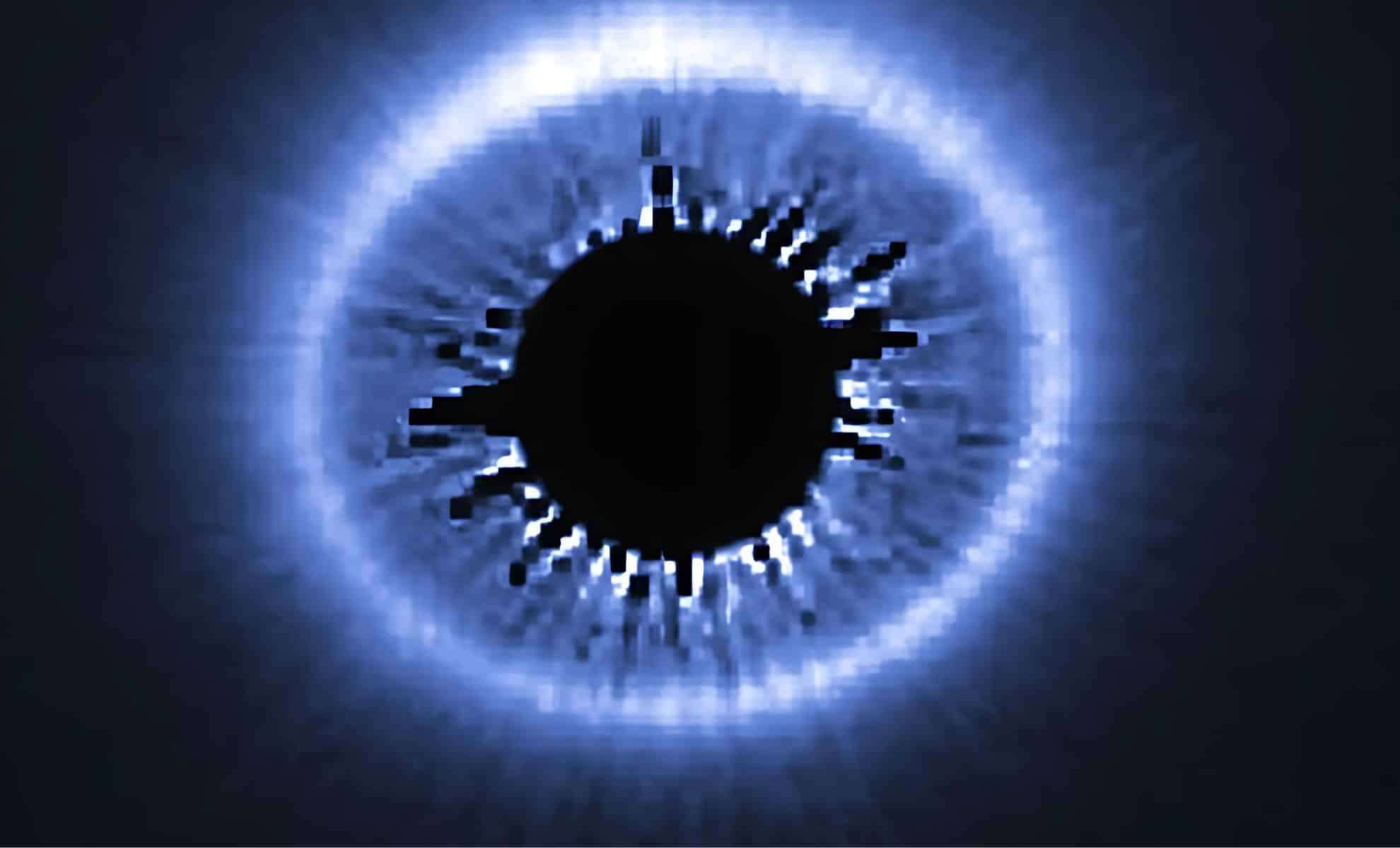
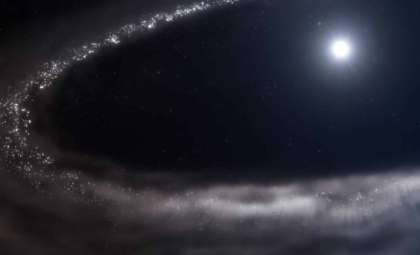
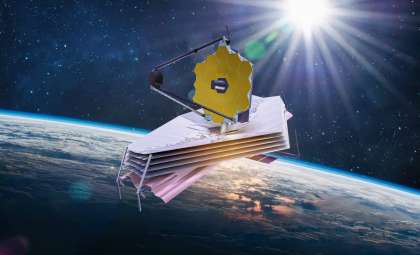
For the first time, astronomers have identified water ice encircling a young star closely resembling our own Sun. This groundbreaking observation lends strong support to long-standing hypotheses about the presence of water during the earliest phases of solar system development. The breakthrough was achieved with the help of the James Webb Space Telescope (JWST), which studied the star HD 181327 situated approximately 155 light-years away.
Insights Into the Birth of Planetary Systems
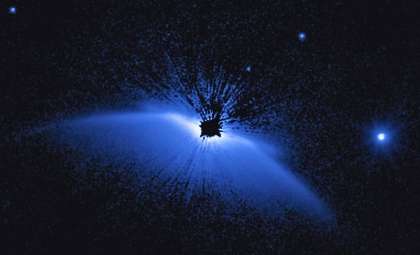
The star HD 181327 is a youthful celestial body, only about 23 million years old, a stark contrast to our Sun's age of 4.6 billion years. Unlike our mature solar environment, this star remains surrounded by a cloud of dust and ice debris, a protoplanetary disk where planets have yet to form.
Utilizing JWST’s near-infrared spectrograph (NIRSpec), a team from Johns Hopkins University identified crystalline water ice within this dust ring. This icy composition resembles that found on Saturn’s rings and icy objects in our Solar System’s Kuiper Belt.

Lead researcher Chen Xie stated, “Webb has definitively detected crystalline water ice,” highlighting the crucial role this form of ice plays in planet formation. She further noted, “These icy components might eventually be delivered to rocky planets forming over hundreds of millions of years in similar stellar systems.”
Concentration of Water Ice in the Outer Ring
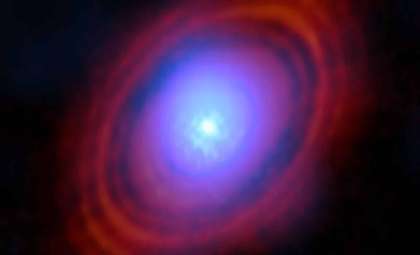
JWST's observations showed that water ice comprises more than 20 percent of the mass in the star’s outer debris ring, mixing with dust to create aggregates called “dirty snowballs.” This closely mirrors the composition found in the Kuiper Belt of our Solar System. However, the amount of water ice diminishes significantly closer to the star, dropping to roughly 8 percent midway through the disk and becoming nearly undetectable near the star itself.
This distribution is likely caused by ultraviolet radiation emitted by the star, which causes ice to evaporate in the inner regions. Alternatively, water molecules might be trapped inside rocky bodies or planetesimals closer to the star.
A Vibrant, Collisional Debris Disk
The debris disk around HD 181327 is characterized by high activity, with frequent collisions among icy objects. These impacts release fine particles of ice-laden dust, which are well detected by JWST. Co-author Christine Chen from the Space Telescope Science Institute reported, “HD 181327 is a highly dynamic environment,” and noted that the observations align with what we see among Kuiper Belt objects in our own cosmic neighborhood.
Additionally, JWST unveiled a broad dust-free gap separating the star from the debris disk, echoing features found in our Solar System and reinforcing the idea that examining such young stars can reveal the early evolutionary steps of planetary systems.
Looking Forward: Advancing Our Understanding of Planet Formation
This milestone confirms earlier hints provided by NASA’s Spitzer Space Telescope in 2008 and sets the stage for further exploration of water's role in planetary genesis. By employing JWST along with forthcoming advanced telescopes, astronomers aim to deepen their study of debris disks and emerging planetary systems, enhancing knowledge about how planets and life-essential water come into existence.
Such research not only sharpens models of planetary formation but also enriches our understanding of how water is delivered to worlds, including Earth, offering a window into our solar system’s distant origins.
- Categories:
- Space



0 comments
Sign in to Comment