
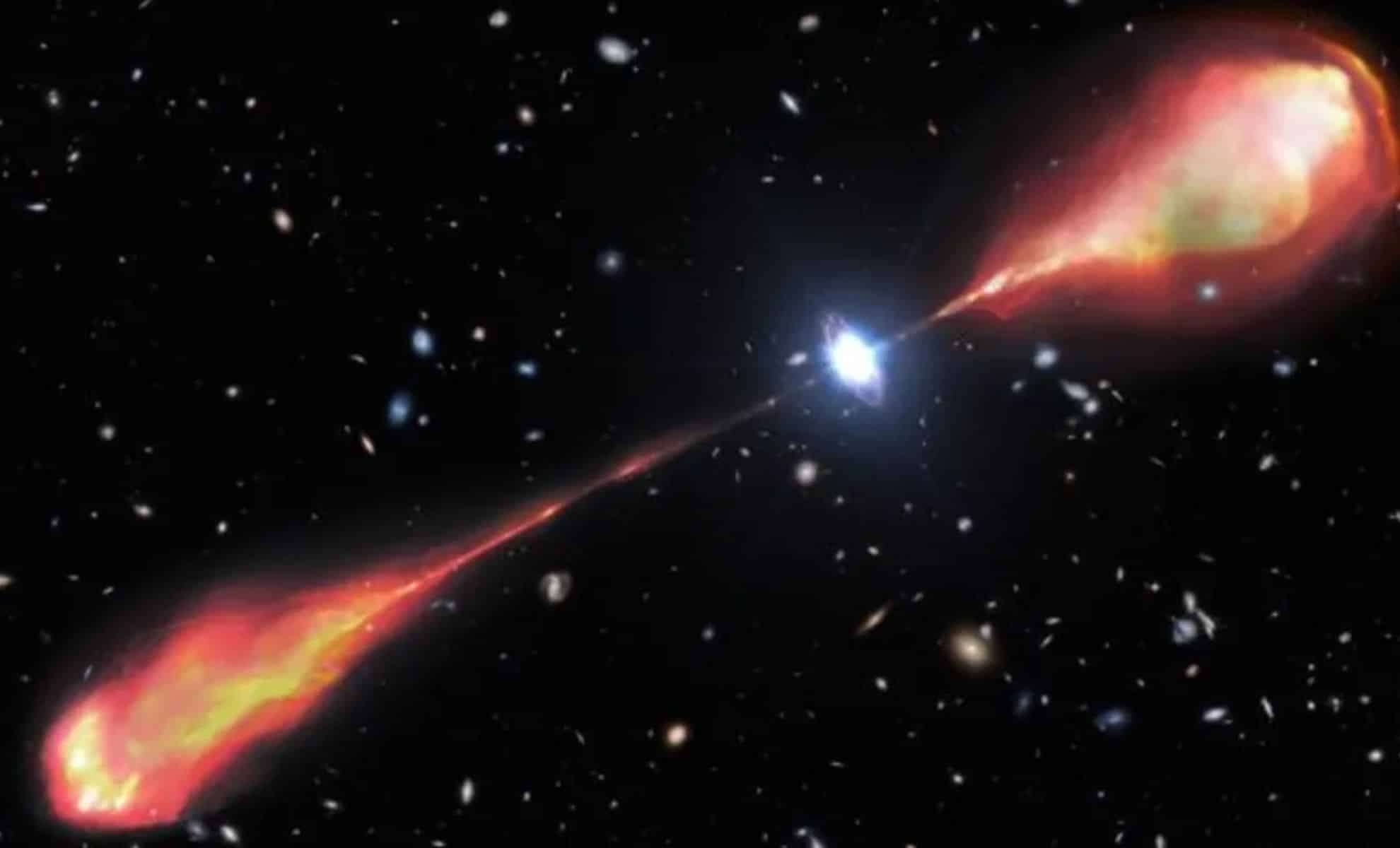
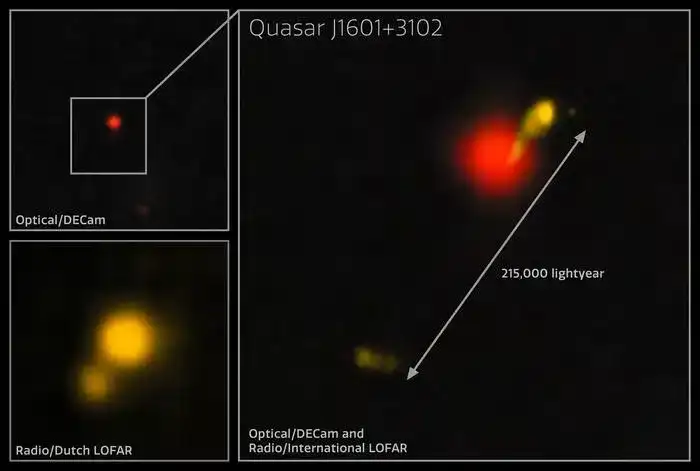
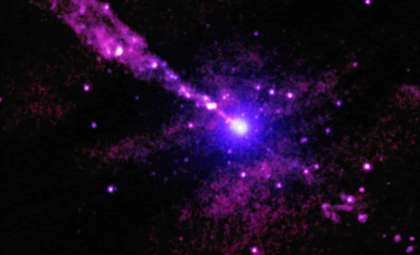
Researchers have identified a massive jet powered by a black hole, extending an incredible 200,000 light-years—surpassing twice the diameter of our own Milky Way. This immense jet originates from the quasar J1601+3102 and dates back to a time when the universe was a mere 1.2 billion years old, less than 10% of its current age.
Notably, the supermassive black hole fueling this quasar isn’t exceptionally large among others of its class. With a mass of roughly 450 million times that of our Sun, it is relatively modest for quasar-associated black holes. This finding challenges the long-held belief that the most forceful jets come only from the heftiest black holes.
Anniek Gloudemans, leading the study at NOIRLab, remarked, “Remarkably, the quasar driving this enormous radio jet doesn’t possess an extreme black hole mass compared to similar quasars. This implies that generating such powerful jets in the early universe doesn’t necessarily require a very massive black hole or an exceedingly high accretion rate.”

This revelation compels scientists to rethink the necessary factors behind jet formation. It hints that quasar-driven jets might have been more common in the youthful universe than previously assumed, prompting fresh inquiries into how these jets influenced the earliest galaxies.
The Mechanisms Behind Black Hole Jets
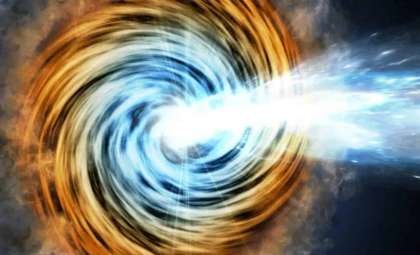
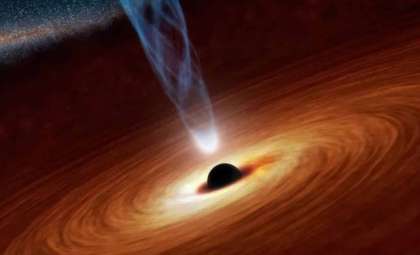
Not every supermassive black hole produces jets. Such jets are generated when a black hole actively consumes large quantities of gas and dust, creating a spinning accretion disk. While most infalling material spirals inward, some is redirected along the black hole’s spin axis by intense magnetic fields, launching outward at speeds nearly matching light. These highly focused jets can stretch hundreds of thousands of light years into space.
Although black hole jets are well-documented in the current cosmic epoch, spotting such a powerful jet in the early universe is exceedingly rare. The identification of J1601+3102’s jet indicates these structures were active and impactful far earlier than scientists once believed.
Gloudemans highlighted the significance of this find: “Our search for quasars exhibiting strong radio jets in the early cosmos helps us unravel when and how the first jets formed and the extent of their influence on galactic evolution. This object’s extreme characteristics make it visible from Earth despite its vast distance.”
This supports the idea that many undiscovered quasars with powerful jets may still lurk in the depths of the universe, awaiting discovery by next-generation observatories.
Techniques Behind Uncovering the Massive Jet
The monumental black hole jet was uncovered by combining observations from various telescopes operating across the electromagnetic spectrum. By integrating radio, infrared, and optical data, researchers detailed the jet’s structure with unprecedented precision.
- Low-Frequency Array (LOFAR) Telescope – Captured the initial radio images that exposed the jet’s massive extent.
- Gemini Near-Infrared Spectrograph (GNIRS) – Enabled measurement of the quasar’s redshift, verifying its extreme distance.
- Hobby Eberly Telescope – Aimed to detect visible light from the quasar but faced challenges because of its remoteness.
This multi-wavelength strategy underscores the importance of blending different observational methods for studying distant celestial objects. As Gloudemans put it, “This discovery exemplifies what can be achieved when merging the capabilities of telescopes operating at diverse wavelengths.”
Interestingly, the jet’s two lobes display asymmetry: the southern lobe shines brighter and extends farther than its northern counterpart, hinting at environmental factors shaping the jet’s evolution.
Frits Sweijen from Durham University noted, “Initially, we thought the southern jet was unrelated or much smaller. The LOFAR images revealing detailed, expansive radio structures were quite a surprise.”
The quasar jet’s characteristics also make it hard to spot at higher-frequency radio bands, highlighting LOFAR’s critical role. Sweijen added, “Detecting this distant source at high radio frequencies is challenging, showcasing LOFAR’s unique power and synergy with other instruments.”
Implications for Our Knowledge of the Early Universe
Discovering the colossal jet linked to J1601+3102 offers rare insights into early quasar activity and black hole phenomena. It sparks several vital questions about galaxy formation and the influence of such jets on cosmic development.
- How frequently did enormous black hole jets appear in the young universe?
- Did these jets regulate star formation and shape the earliest galaxies?
- What determines why some black holes emit colossal jets while others do not?
Answering these will demand ongoing observations, but this discovery already suggests early black holes were more dynamic than previously imagined. Understanding the interplay between jets and their surroundings could reveal new details about the growth of ancient galaxies.
Furthermore, it emphasizes the impressive advances in radio astronomy. LOFAR’s success foreshadows how future radio facilities like the Square Kilometer Array (SKA) may uncover many more hidden cosmic giants in the distant universe.
The Quest for More Cosmic Giants Advances
This groundbreaking detection likely marks just the start. With continuous enhancements in technology and observation sensitivity, astronomers expect to identify far more such jets in the furthest reaches of space.
Meanwhile, J1601+3102 stands as a landmark discovery, revealing that black holes influenced galaxy formation in surprising ways when the universe was still young. Each new revelation about these ancient giants deepens our understanding of the cosmic forces that shaped the universe we observe today.
- Categories:
- News







0 comments
Sign in to Comment