

Although light is known as the universe’s ultimate speed champion, a team of scientists has succeeded in lowering its velocity drastically—to just 61 kilometers per hour. This feat was accomplished by employing a Bose-Einstein condensate (BEC), a unique phase of quantum matter capable of dramatically slowing or even halting light entirely. This advancement offers promising avenues in quantum science, computing technologies, and data retention.
Understanding the Quantum Gel Phenomenon
In normal settings, light travels at about 299,792,458 meters per second in vacuum, with modest speed reductions when passing through substances like glass or water. However, these decreases are minimal compared to the extreme deceleration observed in a Bose-Einstein condensate, which can almost stop light in its tracks.
A Bose-Einstein condensate is an extraordinary quantum phase, theorized by Albert Einstein and Satyendra Nath Bose, formed when gases cool to temperatures near absolute zero. At this stage, atoms lose individual identities and act as a single quantum entity, exhibiting properties like superfluidity and interacting with light in wholly unconventional manners.

Revolutionizing Light Control
Breakthroughs over decades have culminated in the enhanced control of light’s speed. The initial experimental slowing of light via BECs was pioneered in the late 1990s by Lene Hau and colleagues at Harvard University (Harvard SEAS). They chilled sodium atoms to near absolute zero and transmitted laser pulses into the condensate. The photons interacting with the ultracold atoms slowed to a mere 17 meters per second, a pace comparable to brisk walking.
Later investigations demonstrated not just deceleration but also the complete cessation and storage of light within the condensate. A study published in Nature (Nature) revealed that light could be paused momentarily and then resumed with information intact. This capability to trap and release light holds promise for atomic-level optical data storage, potentially transforming quantum computing architectures.
How Bose-Einstein Condensates Slow Light
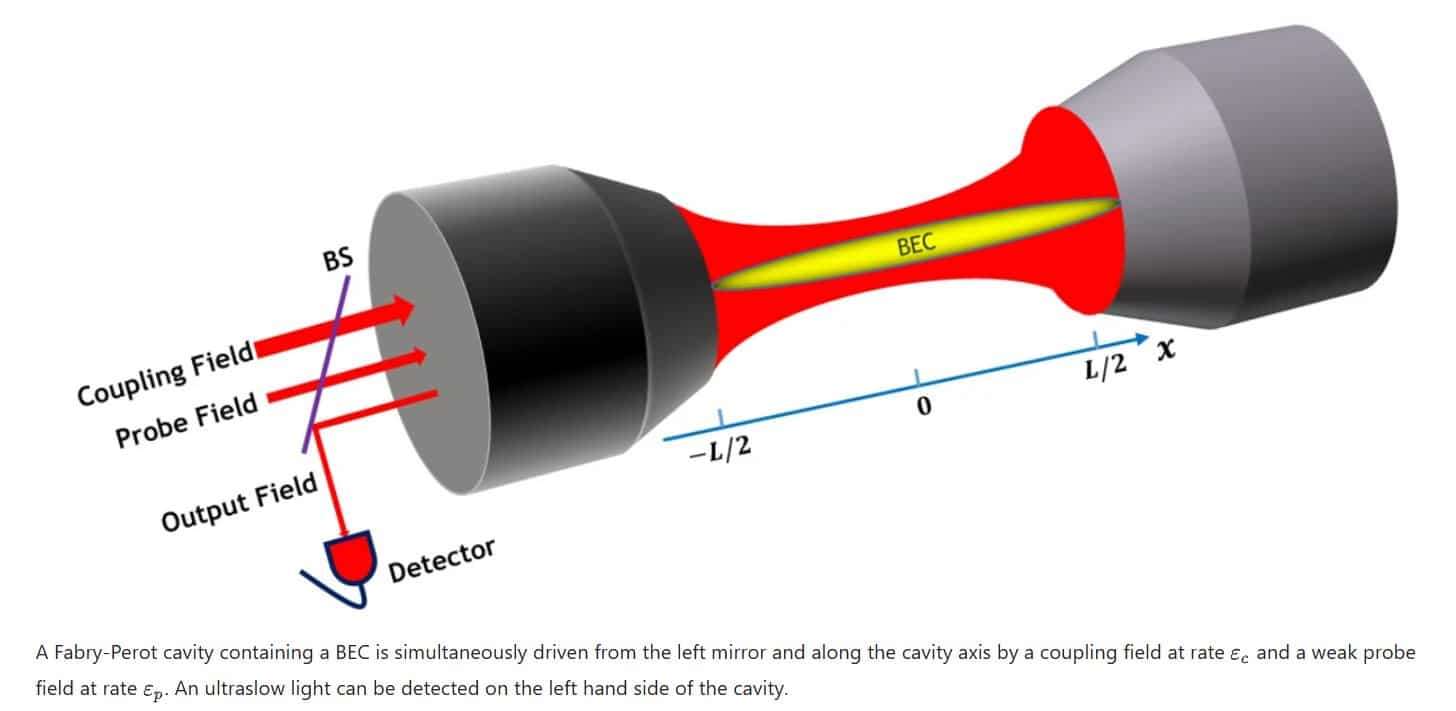
The mechanism behind light reduction in BECs is rooted in electromagnetically induced transparency (EIT). This technique alters the interaction between atoms and photons inside the condensate by using a control laser that generates a transparent window where light normally would be absorbed, allowing photons to pass through at drastically decreased speeds.
Researchers have observed that slow light pulses become compressed in the spatial dimension within the condensate without losing encoded information (Optica). This compression is essential for applications in optical information storage and quantum data processing.
Implications for Quantum Technology and Beyond
These advances open exciting paths for innovation.
- Quantum Computing – The ability to store and manipulate photons positions BECs as candidates for quantum memory, facilitating the development of photon-based quantum processors and potentially revolutionizing computational paradigms.
- Optical Storage Solutions – Leveraging the capacity to hold and release light, Bose-Einstein condensates could serve as next-generation optical memory devices, enhancing data speed and energy efficiency.
- High-Precision Sensors – The heightened sensitivity of slowed light to environmental changes makes BEC-enabled instruments attractive for quantum sensing, capable of detecting subtle external fluctuations with exceptional accuracy.
This research challenges long-held beliefs about light’s behavior and the fundamentals of quantum mechanics. Scientists continue to explore novel methods for controlling photonic information, aiming to unlock new technological possibilities once thought unattainable.
- Categories:
- Physics




0 comments
Sign in to Comment