

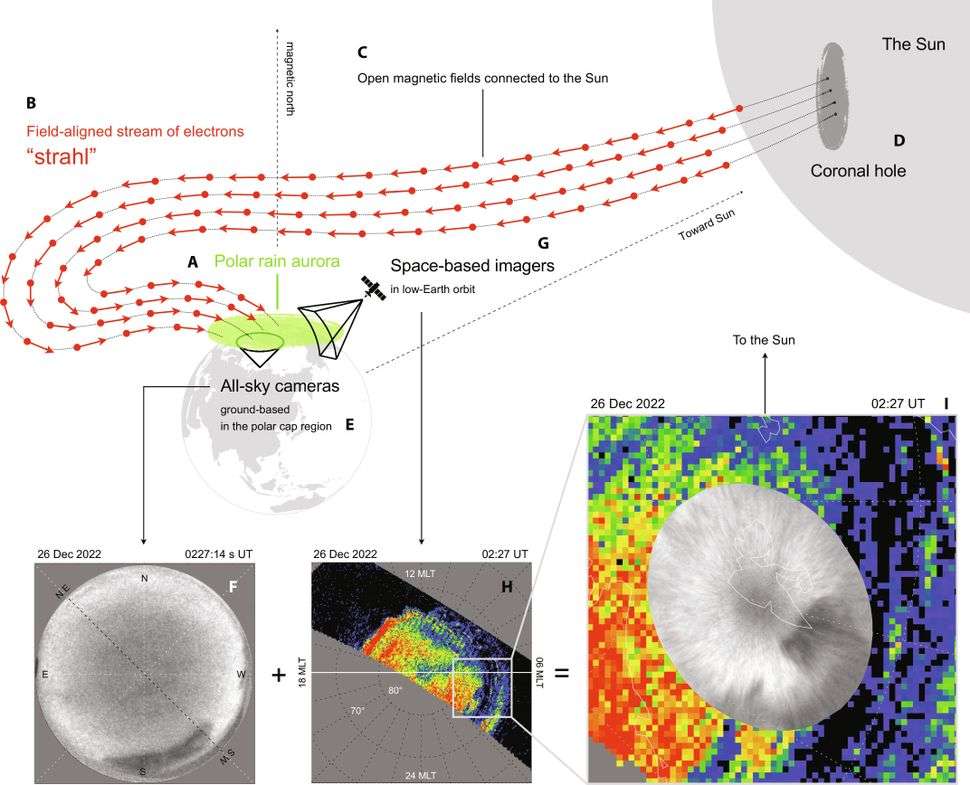
On December 25, 2022, observers witnessed an extraordinary auroral display in the Arctic that left both the public and researchers intrigued. Unlike the usual dynamic and colorful auroras, this one manifested as an even, unpatterned green radiance. This rare spectacle was identified as a “polar rain” aurora, a phenomenon never before recorded from the Earth's surface.
Decoding the 'Polar Rain' Aurora Phenomenon
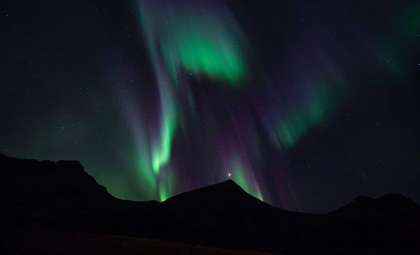
Typical auroras emerge when solar wind particles interact with Earth’s magnetosphere. These charged particles become trapped in the magnetotail and descend toward the polar regions. Their collisions with atmospheric gases generate the characteristic colorful light displays.
The aurora witnessed on this occasion differed significantly. The “polar rain” aurora lacked the familiar shifting shapes and instead produced a vast, smooth glow spanning approximately 2,485 miles (4,000 kilometers) with no visible structuring. Such a vast, featureless aurora had not been documented from terrestrial observations before.

The Mechanism Behind This Uncommon Display
A study led by Keisuke Hosokawa at the University of Electro-Communications in Tokyo explains this phenomenon. Their research traced the aurora's cause to a concentrated stream of electrons pouring directly from the Sun. These electrons originated from a coronal hole, a solar atmosphere region marked by accelerated solar wind.
At the time, the solar wind was unusually weak, creating a tranquil zone around Earth. This allowed high-energy electrons from the coronal hole to reach Earth’s north pole without being diffused as they usually are during typical solar wind conditions. This exceptional circumstance permitted the electrons to penetrate the atmosphere, generating the distinct auroral glow.
What Distinguishes This Aurora’s Characteristics?
The term “polar rain” aurora reflects how the Sun’s coronal hole electrons directly influenced Earth's atmosphere. These electrons carried far more energy than typical solar wind particles, producing the distinct green hue by ionizing oxygen molecules at lower altitudes.
Moreover, the magnetic funnel guiding the electrons was extraordinarily wide, measuring about 4,600 miles (7,500 kilometers)—larger than the Earth's polar region itself. This expansive magnetic channel caused the aurora’s even and uninterrupted appearance, in contrast to the usual patterned and pulsating light shows.
The event was documented by multiple satellites, including the Special Sensor Ultraviolet Scanning Imager (SSUSI) aboard the Defense Meteorological Satellite Program (DMSP). Data confirmed that the phenomenon occurred exclusively over Earth’s north magnetic pole, which faced the Sun during the Northern Hemisphere’s winter season.
For most viewers, auroras usually arise from standard solar wind activity. This remarkable event, however, resulted from a precise combination of conditions that made a smooth, featureless aurora visible from the ground for the first time.
- Categories:
- News










0 comments
Sign in to Comment