
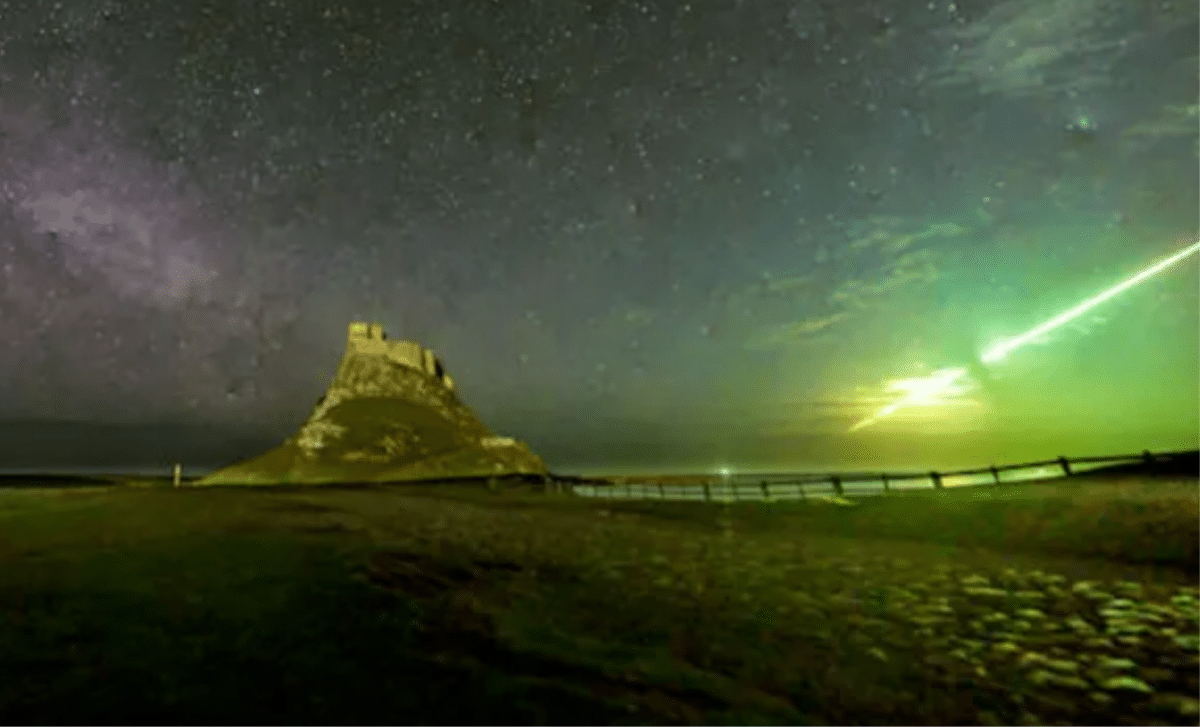
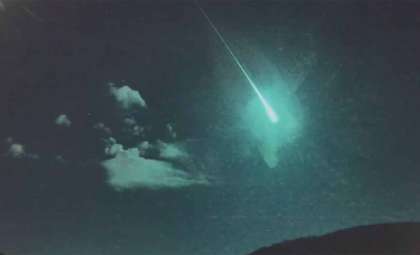
A vivid green fireball meteor lit up the sky above Lindisfarne Castle in northeast England, captivating observers and scientists alike. Captured by nearby photographers, this dazzling celestial display was unlike typical meteor events. Moving at an incredible 20,000 mph, the meteor made a dramatic impression on those watching.
A Dazzling Celestial Display Over a Historic Landmark
In the early hours of April 13, just past midnight local time, the meteor burst through the atmosphere above Lindisfarne Island, a site famous for the notorious Viking raid of 793. About the size of a common household object, this tiny space rock entered Earth’s atmosphere with extraordinary velocity. As it descended, it fragmented, releasing a bright green light that amazed spectators across the UK, Belgium, the Netherlands, and Germany.
Lindisfarne, often called “Holy Island,” has witnessed centuries of historical events, including invasions and cultural upheavals. Now, it has become the stage for an awe-inspiring natural spectacle. Though visible for only a few seconds, the meteor’s brilliance left a lasting impression on photographers, amateur astronomers, and casual viewers.

This meteor was a fireball—a type of meteor that explodes dramatically in the atmosphere, emitting intense light. The vivid green color, as explained by Spaceweather.com, typically indicates a high concentration of magnesium and nickel in the meteorite, elements that glow brightly when interacting with the gases in Earth’s atmosphere.
Eyewitness Descriptions and Public Excitement
The burst of the fireball over Lindisfarne captivated more than just photographers. Ian Sproat, a local resident who was capturing images of the Milky Way near the ancient fortress, described the shared excitement. “We all shouted when it burst,” Sproat recounted to Spaceweather.com. “It was incredible!” His enthusiasm echoed the reactions of over 230 eyewitnesses who reported the sighting to the American Meteor Society (AMS), an organization focused on global meteor tracking.
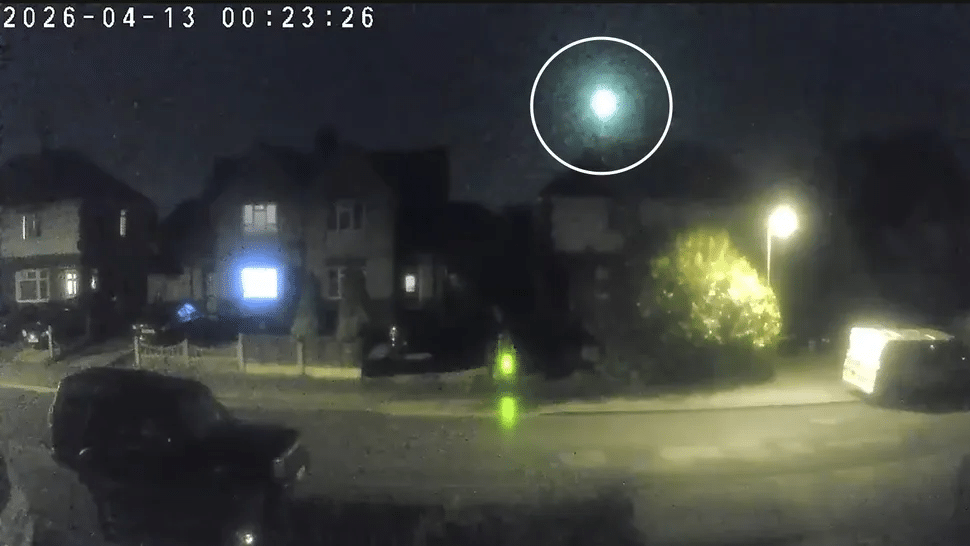
The green fireball’s vivid display was also caught on several doorbell cameras, some situated as distant as Nottinghamshire. Witnesses expressed awe and shared their experiences on social media, generating widespread interest across the UK and neighboring countries. For many, this meteor was no ordinary event—it was a unique spectacle.
This event is part of a larger pattern during the "fireball season," which spans from February through April. During this period, Earth’s orbital position relative to the sun appears to increase the frequency of spectacular meteor occurrences.
The Science Behind Fireballs’ Captivating Glow
Unlike typical meteors, fireballs create brilliant bursts of light as they enter Earth’s atmosphere, due to the friction and disintegration of the incoming space rock. The green shade seen in this meteor is caused by the specific chemical makeup—mainly magnesium and nickel—that glows when interacting with atmospheric gases.
NASA notes that fireball sightings rise between 10% and 30% during this time of year compared to other months. This uptick is likely influenced by Earth's position in its orbit and its alignment with other celestial bodies, though the exact mechanism remains under investigation. These fiery entries are more common in early spring months.
Although many fireballs burn up completely in the atmosphere, some fragments survive as meteorites. However, given that this meteor exploded above the ocean, any remnants probably sank or disintegrated long ago, making finds unlikely for collectors or scientists.
- Categories:
- News






0 comments
Sign in to Comment