
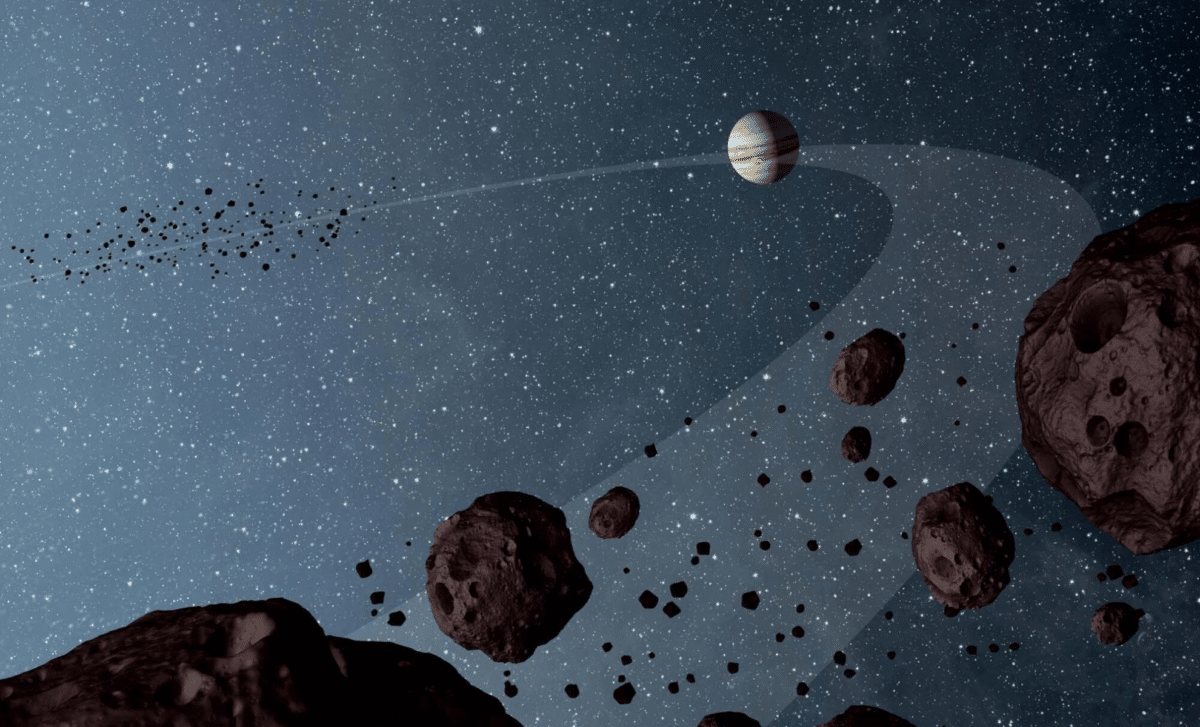
Recent research utilizing data from the Subaru Telescope has uncovered that the smaller Jupiter Trojan asteroids exhibit markedly different behaviors from their larger counterparts, overturning previous ideas about their origins and development. Featured in The Astronomical Journal as “Color And Size Distributions Of Small Jupiter Trojans,” the study sheds new light on the early solar system by analyzing subtle variations in color across these celestial objects.
An Ancient Group That Defies Expectations
The extensive populations of Jupiter Trojans—asteroids co-orbiting in stable zones ahead and behind Jupiter—have traditionally been viewed as remnants from the solar system’s formation. These asteroids are believed to carry ancient chemical signatures, giving insights into early planetary processes. Historically, larger Trojans were classified into two distinct color types: D-type (more reddish) and P-type/C-type (less reddish). This clear bifurcation hinted at diverse origins related to their formation locations and subsequent movements during the chaotic rearrangement of the giant planets.
The new investigation challenges this neat division. By concentrating on smaller asteroids, roughly kilometer-sized, researchers found that the previously observed color separation fades away. Instead, these minor Trojans show a continuous spectrum of colors without a sharp split. Although subtle, this difference has major consequences. It implies that factors such as collisions, breakups, and surface alterations might blur or erase the original compositional distinctions over time. Thus, the smallest Trojans may offer a more intricate and less structured record of the early solar system than once thought.

Insights From Smaller Asteroids
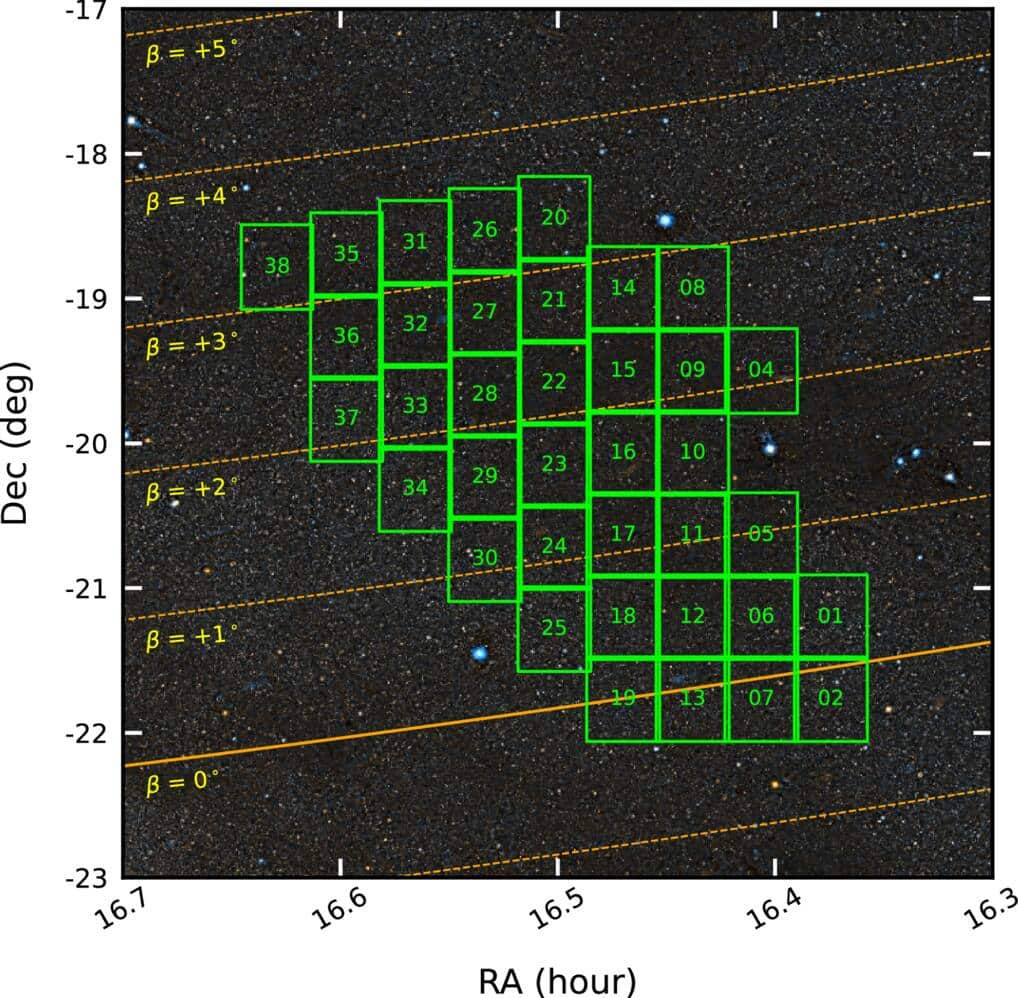
The team focused on faint objects ranging from about 3 to 16 kilometers in diameter. These smaller bodies are generally thought to be fragments resulting from collisions, potentially preserving interior compositions of larger parent asteroids. Unlike larger Trojans, whose surfaces have been altered by prolonged space weathering, these fragments could represent more unaltered material.
The study yielded two important observations. First, the clear color bimodality seen in larger Trojans disappears in the smaller population, suggesting the commonly used classification may not apply at this scale. Second, size distributions were consistent across different color groups, refuting previous ideas that redder asteroids break apart differently than less-red ones. This finding indicates both color groups likely underwent similar fragmentation histories, irrespective of their initial makeup.
These results transform the understanding of Jupiter Trojan asteroids, portraying them not as two distinct families but rather as a spectrum shaped by primordial conditions and long-term collisional evolution. This paints a more intricate and connected picture of the Trojan population.
The Critical Final Observations
Gathering these faint color signals demanded a specialized observing strategy. The researchers utilized Suprime-Cam, an earlier wide-field camera on the Subaru Telescope. Unlike the newer Hyper Suprime-Cam, which offers a broader field, Suprime-Cam’s ability to switch filters quickly was vital for accurately capturing asteroid colors before brightness changes caused by rotation could interfere.
“Suprime-Cam was essential to our research, allowing rapid multicolor observations across a wide sky area,” explained Fumi Yoshida (University of Occupational and Environmental Health/Chiba Institute of Technology), the study’s lead author. The key observations were carried out in May 2017, coinciding with Suprime-Cam’s final night of operation—a poignant and scientifically fruitful moment.
“I am deeply grateful that our research was carried out during such a special occasion. My work on small bodies in the solar system began in 2000 with test observations from Suprime-Cam. Over the following 17 years, I continued using this instrument to study the size and spatial distributions of small solar system bodies,” Yoshida reflects.
This enduring connection highlights how consistent instrumentation can lead to discoveries, particularly when investigating faint and transient asteroid populations.
Implications for Understanding Planetary Formation
Published in The Astronomical Journal under the title “Color And Size Distributions Of Small Jupiter Trojans,” the study provides critical data that could refine models of solar system evolution. The disappearance of clear color groups in smaller Trojans suggests that existing theories about their origins and planetary migrations may require revision. It implies either more efficient mixing or greater influence from surface processes than previously appreciated.
Upcoming missions will extend these findings. NASA’s Lucy mission plans to conduct flybys of multiple Jupiter Trojans, offering direct examination of their surface properties and internal structures. Simultaneously, the ESA JUICE mission continues its survey of the Jovian system, providing valuable context. By integrating spacecraft results with ground-based observations and theoretical work, astronomers are advancing toward a detailed understanding of planetary assembly.
The emerging view portrays the Trojans as more than static fossils; they are dynamic archives shaped by impacts, migration, and time. Each small asteroid contributes a vital piece to unraveling our solar system’s complex history, bringing clarity to what was once a perplexing cosmic puzzle.
- Categories:
- News





0 comments
Sign in to Comment