
A handful of countries dominate the globe's diamond production, driven by geological factors, mining scale, and resource concentration. From icy northern territories to African river deposits, these regions host the majority of diamond mining activities today.
Annually, between 24 and 36 metric tons of diamonds are mined from kimberlite and lamproite sources. As cited by Futura-Sciences, total global production hit nearly 142 million carats in 2020, though only a small portion meets gem-quality standards.
Africa has remained a cornerstone of diamond discovery for over a century, unearthing some of history’s most renowned stones. Meanwhile, countries like Russia and Canada have emerged as significant diamond producers in recent decades.

Russia – 23 Million Carats
Leading worldwide, Russia delivered 23 million carats in 2020. Key mining sites in the Sakha Republic, such as the Mir and Udachnaya mines, contribute heavily to this volume. The company Alrosa, partly government-owned, produces around 27% of the global diamond supply, with reserves estimated at 650 million carats.
Botswana – 16 Million Carats
Botswana secured the second spot by extracting 16 million carats. The Jwaneng mine, operated jointly with diamond giant De Beers, yields between 12 and 15 million carats yearly and is considered the most valuable diamond mine worldwide. Reserves here are valued at approximately 310 million carats.
Canada – 13 Million Carats
Canada produced 13 million carats in 2020, despite entering the diamond industry relatively recently, with commercial extraction beginning in 1998. Mining operations face challenges from harsh climates, remoteness, and elevated costs, which have forced closures of some sites and continue to complicate active mines.
Angola – 8.5 Million Carats
Angola produced about 8.5 million carats, predominantly from alluvial sources like the Lulo area, where diamonds are extracted from river sediments instead of deep underground mines.
According to the Futura-Sciences report, more than 16 diamonds exceeding 100 carats have been discovered here, highlighting the region’s significant potential, though political instability hampers comprehensive resource evaluation and sector growth.
South Africa – 7.7 Million Carats
South Africa's diamond production reached 7.7 million carats in 2020. Known for producing extraordinary stones historically, such as the famous Cullinan diamond, the country maintains a prominent role in the diamond sector.
Currently, mines like Finsch and Venetia dominate production after replacing older operations, ensuring South Africa remains influential in global diamond markets, despite no longer being the top producer.
Democratic Republic of the Congo – 3.7 Million Carats
The Democratic Republic of the Congo officially produced 3.7 million carats. Of these, only about 20% are gem-grade, with extensive artisanal mining complicating accurate total output measurement.
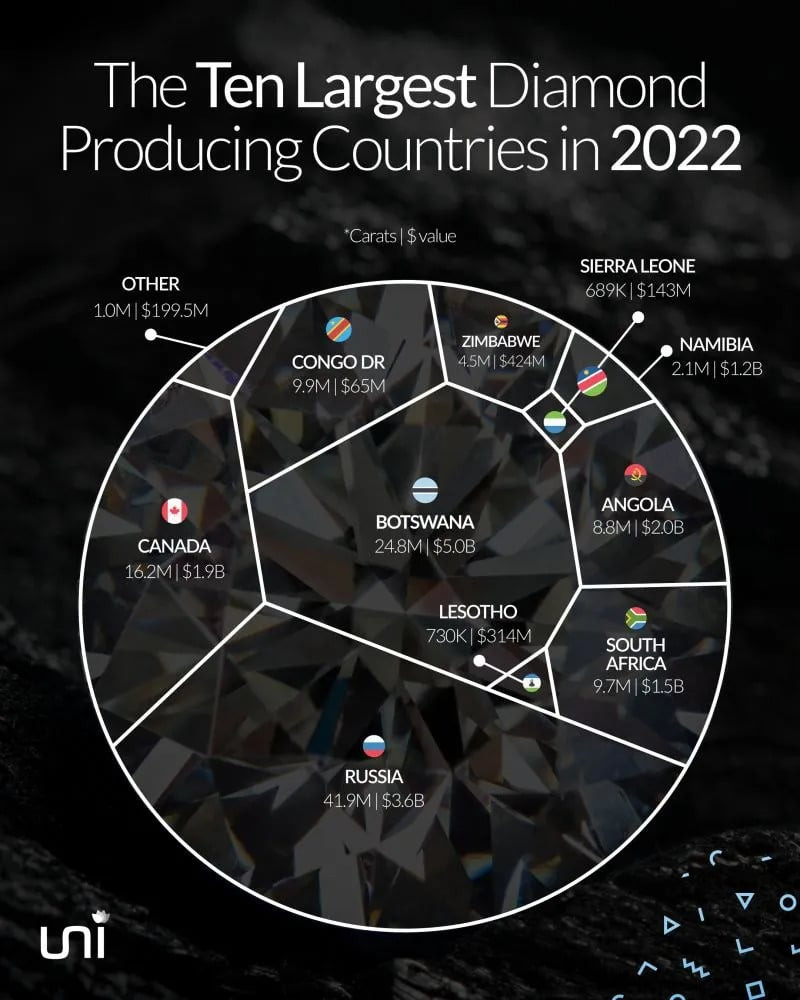
Namibia – 1.9 Million Carats
Namibia yielded 1.9 million carats, mainly from coastal alluvial deposits rather than traditional inland claims. These diamonds likely originated from adjacent regions and were transported by river systems. The government-supported company Namdeb has increased focus on offshore diamond extraction.
Lesotho – 1.1 Million Carats
Lesotho's output reached 1.1 million carats, notable for the exceptional size and quality of its diamonds. The Letšeng mine has unveiled stones larger than 300 carats, including the celebrated 910 carat Lesotho Legend and a 442 carat yellow diamond found in 2020.
Australia – 340,000 Carats
Australia produced 340,000 carats in 2020, a sharp decline after the closure of the Argyle mine. Previously a top producer, the mine was famous for its rare pink diamonds sourced from lamproite formations.
These unique stones, formed in uncommon lamproite rock, made Argyle exceptional on the global stage. Its shutdown marked a significant downturn for Australia's role in diamond mining.
Tanzania – 260,000 Carats
Tanzania completes the list with 260,000 carats. Most production comes from the Williamson mine, situated about 100 kilometers from Lake Victoria. Discovered in 1940, it remains one of the longest-operating diamond mines worldwide.
The quality and quantity of diamonds mined in these countries varies greatly. Interestingly, about 80% of diamonds extracted are designated for industrial uses, an aspect often overlooked.
- Categories:
- News











0 comments
Sign in to Comment