
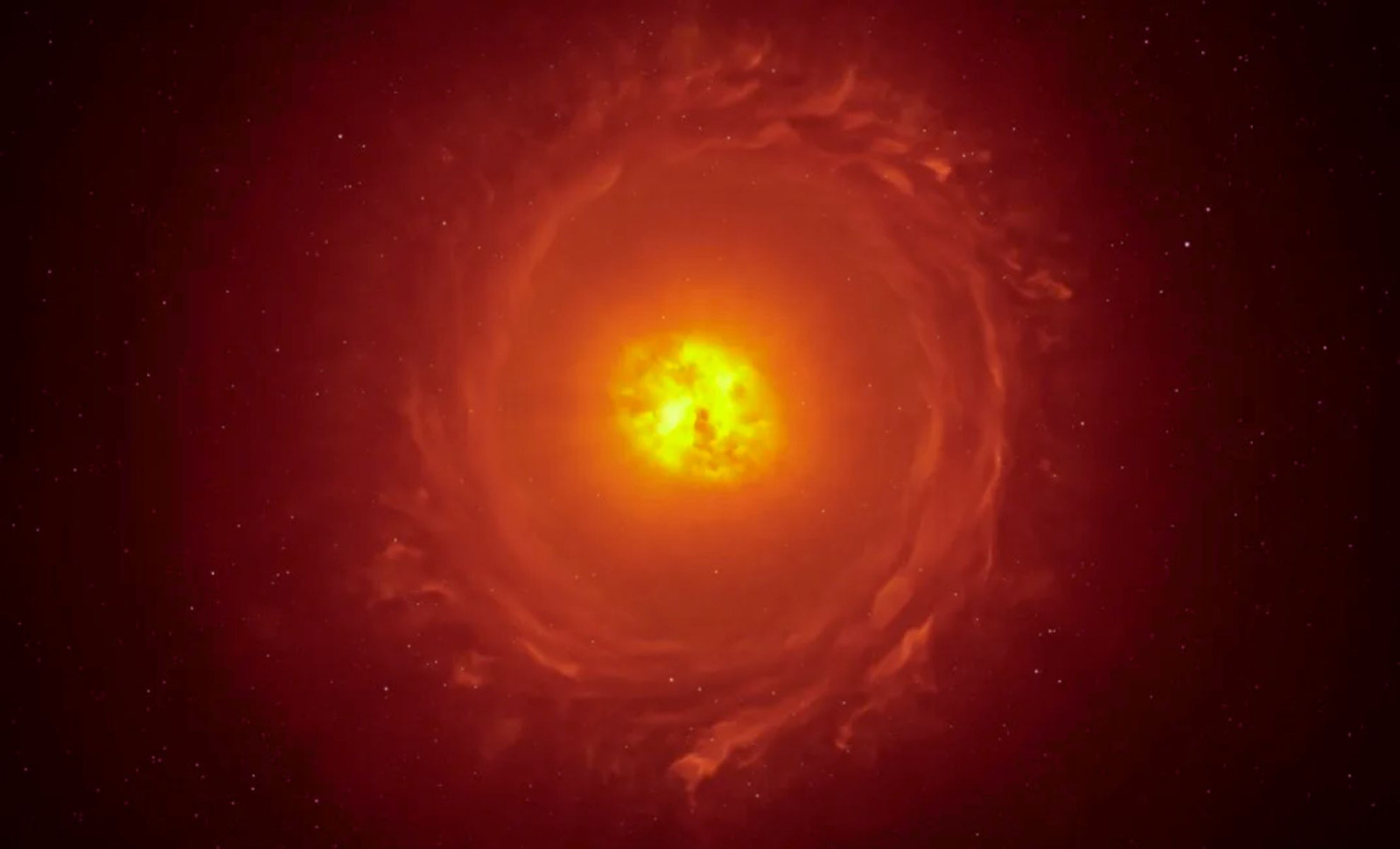
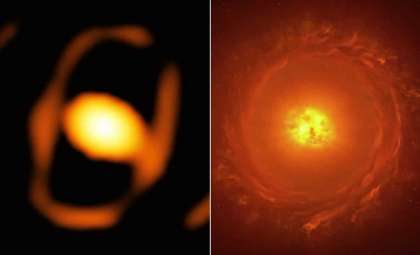
Situated within the Large Magellanic Cloud, WOH G64 is a luminous red supergiant enveloped in dense dust. Its recent fluctuations in brightness and spectral characteristics sparked theories that it was entering a rare and unstable yellow hypergiant phase, often a precursor to a star’s explosive demise.
In 2024, astronomers noticed a new dust formation surrounding the star, seemingly affirming that a dramatic event was occurring. Yet, new research led by Dr. Jacco van Loon from Keele University challenges this assumption. Rather than signaling the star’s imminent death, the updated findings indicate a more intricate scenario: WOH G64 remains a red supergiant, not on the brink of collapse.
A Closer Look at the Spectral Evidence
During observations from November 2024 to December 2025, Jacco van Loon and his team gathered extensive optical spectra of WOH G64 using the Southern African Large Telescope (SALT). Their data contradicted earlier interpretations. Instead of signs of temperature increase typical for a yellow hypergiant, the spectra revealed prominent titanium oxide absorption bands, indicating the star’s atmosphere remains relatively cool.

As explained in a statement from Keele University, these molecules cannot survive in the hotter conditions of a yellow hypergiant. This finding suggests that WOH G64 has not transitioned into the previously speculated phase. Instead, an alternate mechanism is disturbing its outer layers, resulting in the observed unusual emissions.
Discovery of WOH G64’s Hidden Companion Star
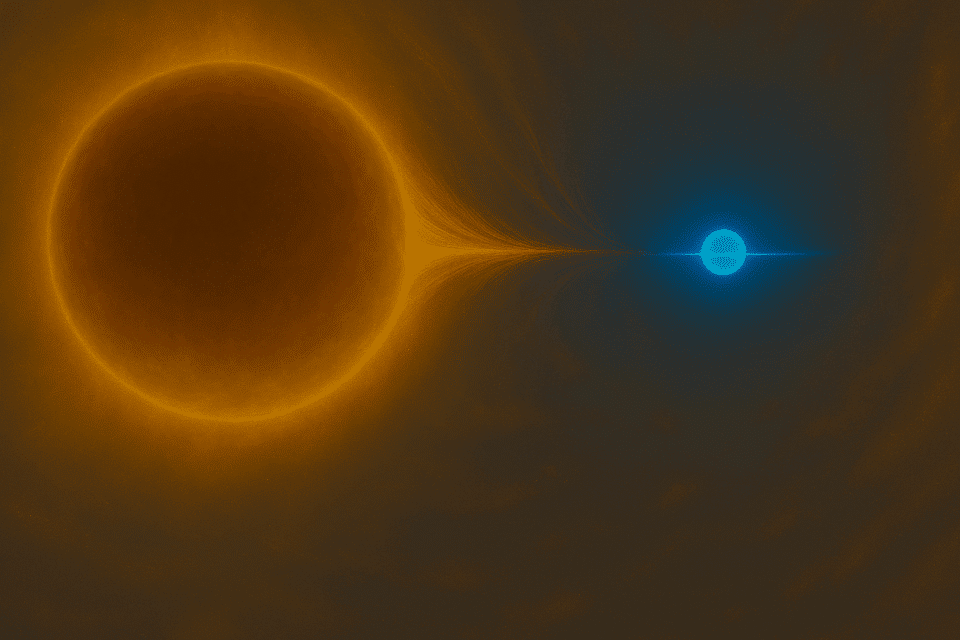
Rather than being a solitary star undergoing rapid change, WOH G64 is actually a binary system. Investigations uncovered a hotter, smaller companion star orbiting the red supergiant, with interactions between the two creating disturbances in the red supergiant’s extended atmosphere.
“The atmosphere of the red supergiant is being stretched out by the approach of the companion star, but it has not been stripped altogether. It persists,” explainedvan Loon.
The report reveals some of the displaced material forms a disc surrounding the hot companion star, which contributes to the unusual spectral signatures. The recent dust cloud, previously thought to herald an imminent stellar collapse, is now understood to be a consequence of this energetic material exchange.
How Binary Dynamics Mimic a Star’s Final Stage
This finding exemplifies how interactions within binary systems can produce signals that resemble those of a star approaching death. For WOH G64, key signs such as dimming luminosity, changing spectral lines, and dust production are actually driven by its companion star. What once appeared as a transition toward end-of-life phases is, in reality, a turbulent yet stable process.
“We are essentially witnessing a ‘phoenix’ rising from the ashes,” said van Loon, describing the ongoing transformation driven not by internal change but by external influence.
While WOH G64 is destined to explode as a supernova eventually, current evidence dismisses any immediate collapse. Careful reexamination accounting for heavy dust interference suggests that prior spectral clues misrepresented the star’s evolutionary status.
- Categories:
- Astronomy









0 comments
Sign in to Comment