
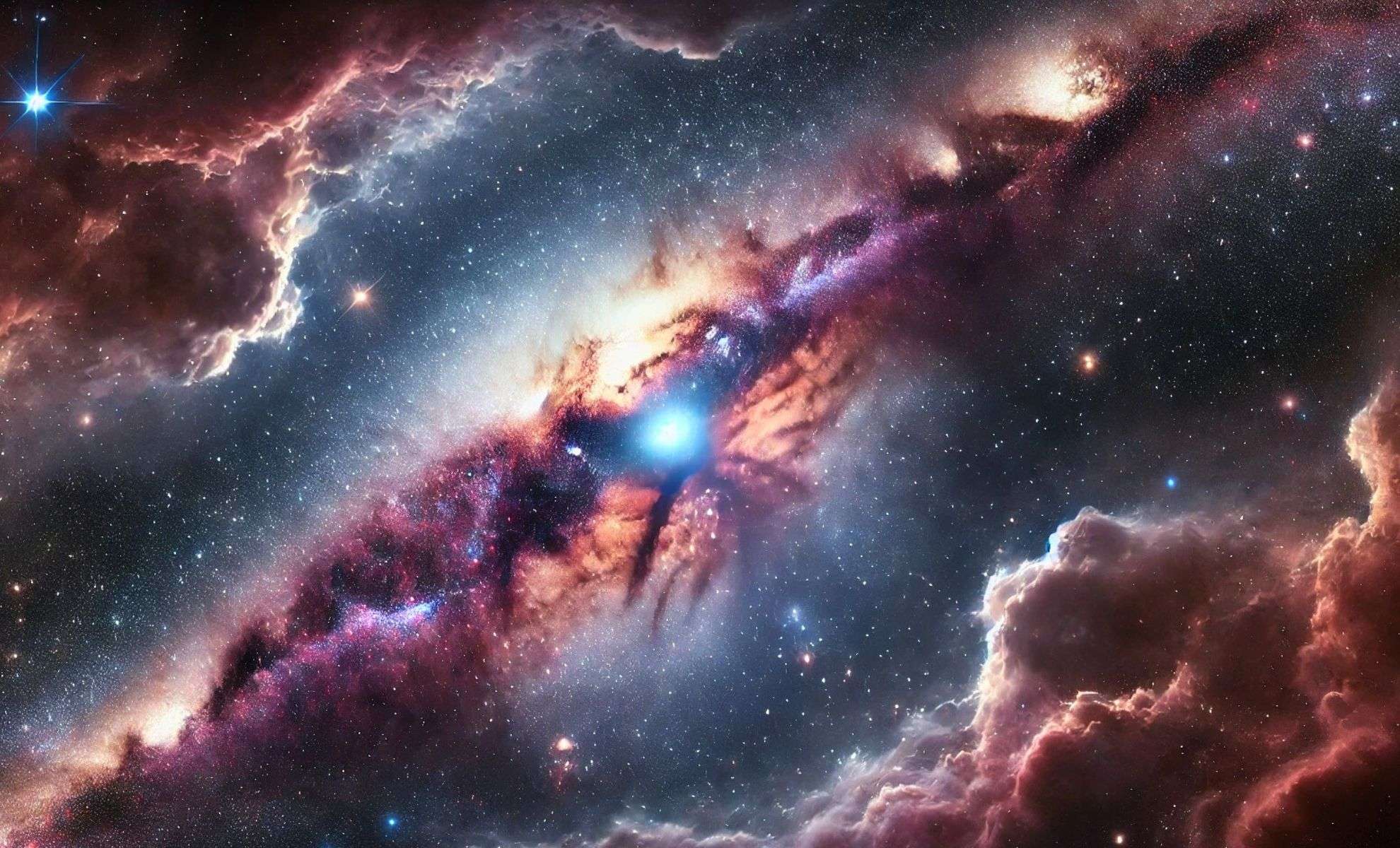
New findings propose the existence of an interstellar passage close to our solar neighborhood that might serve as a celestial corridor, connecting different areas of the galaxy. This intriguing development is based on investigations of the Local Hot Bubble (LHB), an immense, sparse region in space formed by ancient supernova explosions. Spanning more than 1,000 light-years, this bubble could illuminate how the Milky Way is woven together through elusive "pathways" linking enormous superbubbles composed of hot plasma.
Understanding the Local Hot Bubble
The Local Hot Bubble is an enormous, million-degree cavity located in the interstellar medium enveloping our solar system. This formation, unearthed by scientists at the Max Planck Institute for Extraterrestrial Physics, emerged from a series of supernova detonations.
Despite the intense temperatures, the LHB is harmless to our solar environment because its particles are so thinly dispersed that the heat barely influences nearby space objects. Its irregular shape, precisely charted by the eROSITA X-ray telescope, challenges earlier ideas by appearing elongated rather than perfectly round.

Key Features of the Local Hot Bubble
Here's a summary of the LHB’s main attributes to grasp its nature better:
- Temperature: Roughly one million degrees Celsius; however, the low particle density limits thermal effects.
- Size: Spans more than 1,000 light-years.
- Shape: Similar to a bipolar nebula rather than a simple sphere.
- Formation: Resulted from a series of supernova explosions millions of years ago.
Revelation of the Interstellar Passageway
Leveraging data from the highly sensitive eROSITA telescope orbiting over a million kilometers from Earth, astrophysicists Michael Yeung and Michael Freyberg uncovered an unusual formation within the LHB. They detected what they describe as an interstellar tunnel heading toward the constellation Centaurus. This passageway seems to navigate through cooler zones in space, linking the LHB with another superbubble or possibly the Gum Nebula, another vast hot gas region in the Milky Way.
Galactic Network of Tunnels and Bubbles
This discovery revives a concept from 1974 proposing that the Milky Way is comprised of interconnected hot bubbles and tunnels, suggesting a networked galactic framework. Though unproven for decades, the tunnel near Centaurus might serve as concrete evidence.
Researchers theorize this web was sculpted by ancient supernovae, continuously reheating and reshaping parts of the LHB.
Exploring the Interstellar Connections
Implications for Future Space Studies
Though the practical application of this interstellar tunnel remains theoretical, it opens intriguing possibilities for cosmic navigation or, at the minimum, deeper comprehension of the Milky Way’s architecture and its dynamic past. These insights could facilitate more precise explorations of our galaxy’s evolution and the ongoing impact of supernova explosions in shaping its vast cosmic web.
- Categories:
- Space






0 comments
Sign in to Comment