
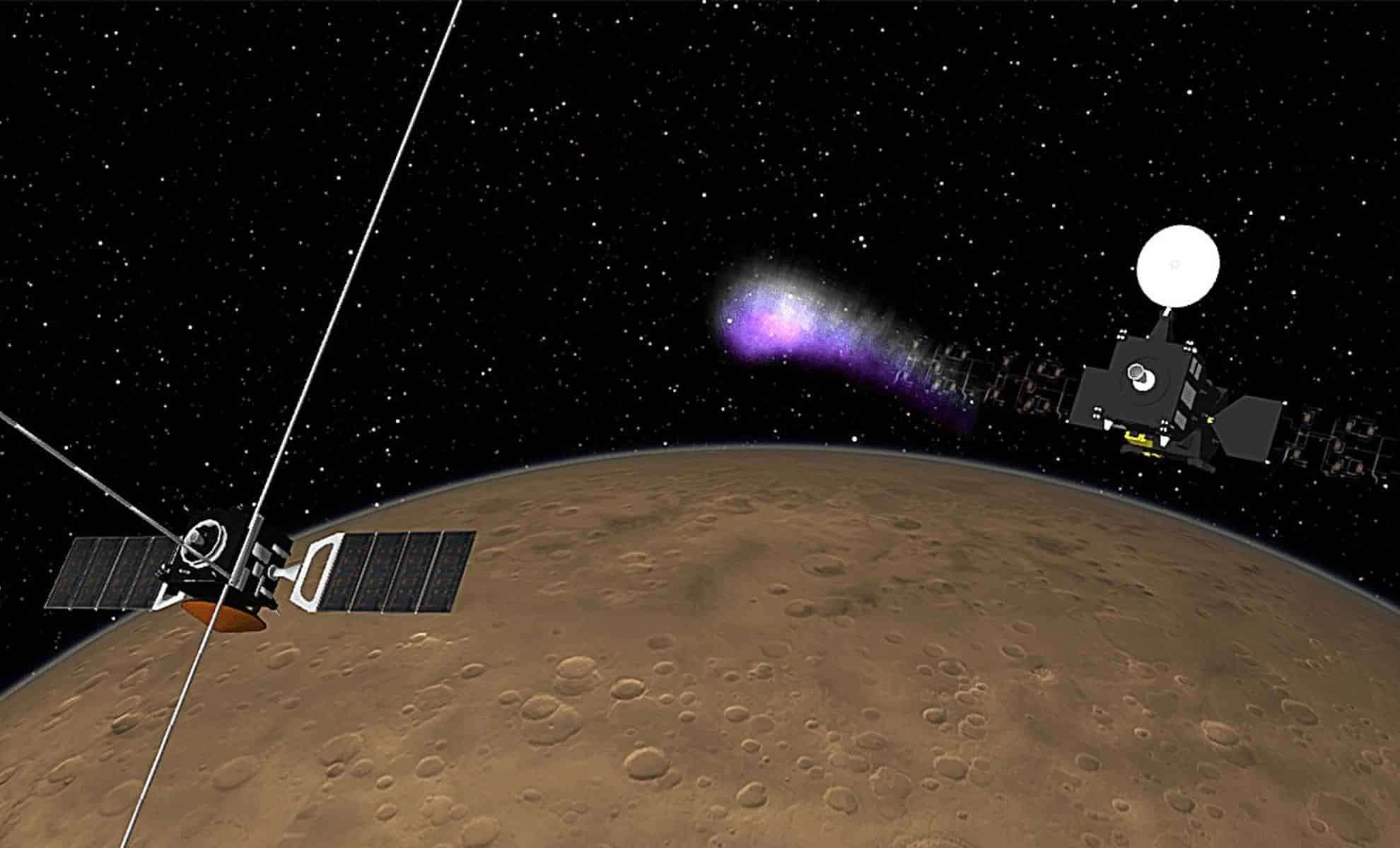
On November 13, 2020, two spacecraft from the European Space Agency, the Mars Express and the ExoMars Trace Gas Orbiter, embarked on a mission to deepen our understanding of the ionospheric layer of Mars. Utilizing an innovative approach called mutual radio occultation, the orbiters transmitted signals to each other while passing behind the Red Planet. This method yielded data that greatly broadened our comprehension of Mars’ ionosphere, an atmospheric region vital for interactions with solar radiation, atmospheric phenomena, and radio wave propagation, similar to Earth’s ionosphere.
Published in the Journal of Geophysical Research: Planets, these results shed light on electron densities, temperature shifts, and the structural layers within Mars’ ionosphere, overturning past theories and paving the way for more precise exploration missions. This research is a significant step toward improving our grasp of Martian atmospheric processes and their effects on scientific observations and communication technologies.
Advancing Martian Ionospheric Research with Radio Occultation
Radio occultation is a well-established technique in atmospheric science, involving the transmission of radio waves between a spacecraft and a receiver, usually on Earth, to analyze signal bending as it traverses an atmosphere. This bending, known as refraction, provides key information about electron density and the temperature of the ionosphere.

Traditional radio occultation methods encounter challenges when measuring Mars’ ionosphere during specific periods, especially near midday. The geometry involving Mars, Earth, and the Sun limits radio wave penetration, hindering accurate atmospheric data collection during these times. To overcome this, researchers implemented mutual radio occultation, involving two spacecraft orbiting Mars to gather data even during previously inaccessible windows.
In this study, the combined efforts of Mars Express and the ExoMars Trace Gas Orbiter collected 71 data points, including 35 measurements nearer to midday than ever before. This achievement represents a breakthrough in accessing elusive ionospheric information, offering new perspectives on Martian atmospheric science.
Revolutionizing Our Understanding of Mars’ Ionosphere
Insights gained from the orbiter duo unveiled surprising aspects of Mars’ ionosphere, challenging earlier assumptions. Notably, electron density fluctuations in the principal ionospheric layers, M1 and M2, were found to be less pronounced than previously modeled, particularly in the M2 layer throughout the Martian day.
Furthermore, contrary to earlier beliefs that the M1 layer vanishes by midday, observations revealed it persists longer, providing updated knowledge on its diurnal behavior. These findings refine models of Martian atmospheric dynamics, equipping scientists with better tools to predict ionospheric conditions.
Because the ionosphere influences radio wave transmission, grasping its behavior is vital for communication systems on Mars. This improved understanding promises to enhance communication reliability for future explorers and orbiting devices, facilitating more effective Mars missions.
Temperature Patterns in Mars’ Ionosphere Upend Previous Forecasts
Among the study’s most fascinating outcomes is the discovery regarding ionospheric temperature variations. Contrary to expectations that the ionosphere reaches peak temperatures at midday, data indicate the highest temperatures occur just before sunset on Mars.
A Mars climate simulation corroborated these observations, highlighting atmospheric winds as the primary driver of temperature changes rather than direct solar heating. This revelation reshapes how scientists view Martian atmospheric behavior and may impact subsequent research into the planet’s weather systems.
These findings could extend beyond Mars, hinting that wind-driven processes influencing ionospheres may exist on other planets. Understanding wind-ionosphere interactions is crucial for developing future space instruments capable of probing atmospheric phenomena across the solar system.
- Categories:
- News











0 comments
Sign in to Comment