
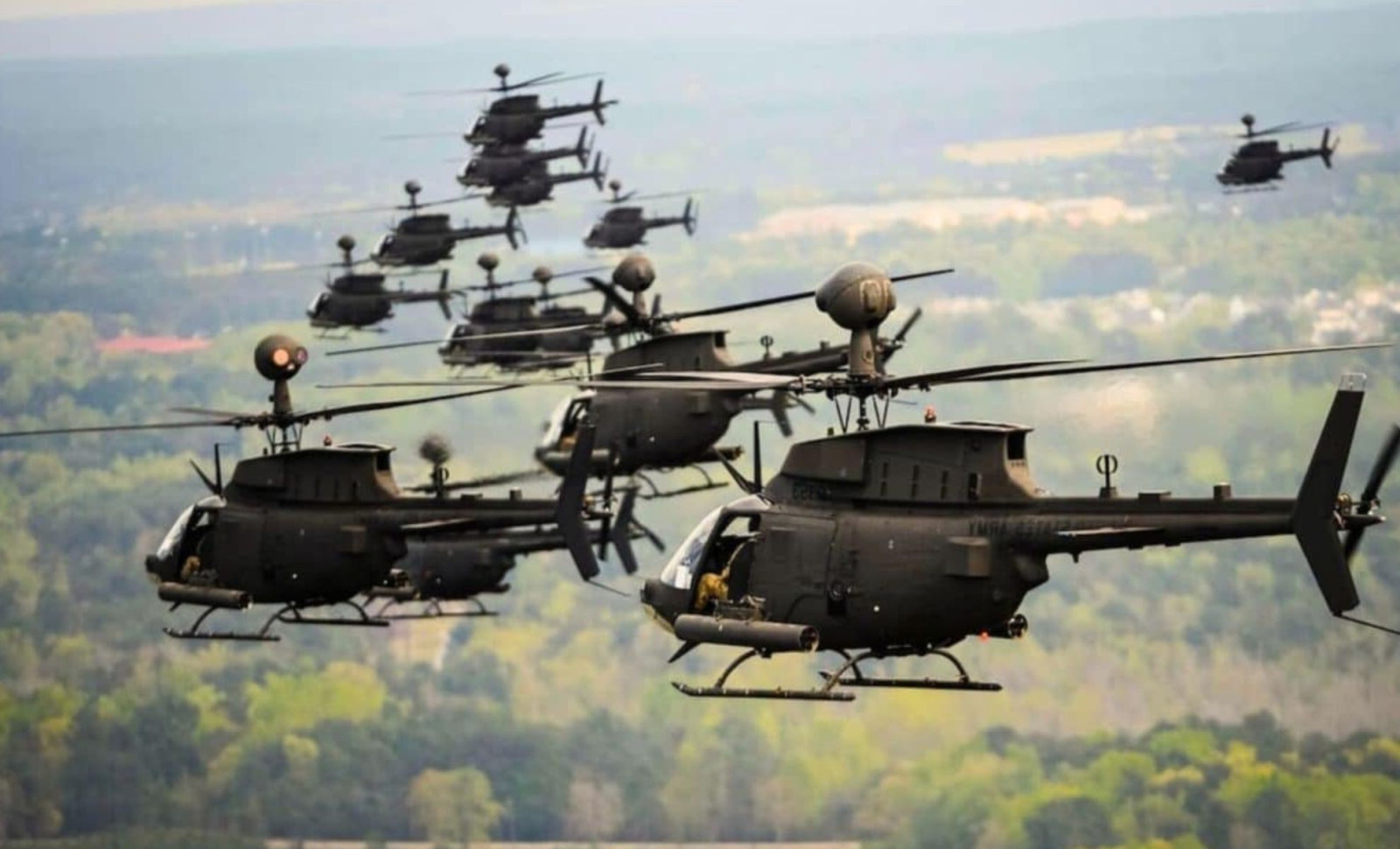
Back in 2016, a stunning display of military helicopter coordination took place over North Carolina, marking an unforgettable milestone in U.S. Army aviation. This aerial feat, performed as a send-off, remains unmatched even after nearly ten years.
As of 2026, this remarkable formation flight continues to be an essential case study in Army pilot training and leadership development. The specific conditions that made the expedition possible are now absent due to changes in the current Army helicopter lineup, with no active aircraft matching the retired model’s capabilities.
This flight’s importance has grown amid ongoing delays in the replacement program for the retired helicopters. Testing of new platforms has yet to yield an official successor, pushing timelines for deployment further into the future.

Record-Setting Helicopter Formation Officially Confirmed
On April 15, 2016, the 1st Squadron, 17th Cavalry Regiment within the 82nd Combat Aviation Brigade maneuvered a fleet of 32 OH-58D Kiowa Warrior helicopters in a tightly coordinated flight beginning at Simmons Army Airfield, spanning over Fort Bragg and the adjacent Fayetteville region.
This operation earned formal recognition from Guinness World Records as the largest helicopter formation flight ever recorded, confirming the total aircraft count, unit involved, and flight location. The Army has neither disputed nor updated this record since.
Documents from the Department of Defense and coverage by Military Times describe the flight as a coordinated farewell operation marking the retirement of the Kiowa Warrior from Army service. The formation was witnessed by civilians and occurred within both military and civil airspace.
Kiowa Warrior Phased Out Without Immediate Successor
The OH-58D Kiowa Warrior, designed primarily for armed reconnaissance, left active Army service in 2016 following the Army Aviation Restructure Initiative (ARI). Introduced in the 1980s, the helicopter specialized in low-level target acquisition, aerial patrol, and forward observation duties.
The restructuring reassigned these roles to the heavier AH-64 Apache attack helicopter and several unmanned aerial vehicles (UAVs), including the RQ-7B Shadow. This resulted in the Army phasing out light scout helicopters entirely.
Currently, no aircraft in the Army’s inventory combines the Kiowa’s compact size, maneuverability, and pilot-operated visual targeting system. An analysis from Indian Defence Review highlights that neither the Apache nor drone systems match the OH-58D’s versatility, particularly in challenging terrain.
Delays Impact Introduction of Replacement Helicopters
The Army initiated the Future Attack Reconnaissance Aircraft (FARA) program in 2018 to develop a new light rotary-wing aircraft to reestablish reconnaissance capabilities. Competing prototypes by Bell (360 Invictus) and Sikorsky (Raider X) entered the development phase in 2020.
Public acquisition documents and Army budget reports anticipate full operational deployment no earlier than fiscal year 2029. In a 2025 acquisition briefing, the Army reaffirmed that both models remain under engineering and production testing.
As of early 2026, no prototype has been granted production approval. Extended flight test programs and ongoing assessments of weapons and navigation integration are delaying progress, with no temporary solution for light armed reconnaissance currently in place.
2016 Flight Continues as a Standard in Army Aviation Training
The 2016 flight of 32 helicopters remains a key example in military aviation courses, demonstrating the precision required for managing multiple rotary-wing aircraft in constrained airspace. Success depended on detailed altitude control, continuous communication, and close formation flying at low altitude.
Official imagery published by the Department of Defense and featured in Military Times depicts the helicopters arranged in staggered formations crossing both civilian zones and military installations. Such an operation demanded tight coordination between military pilots and air traffic management.
Since this historic event, no Army helicopter flight has matched or surpassed the scale of the 2016 formation under similar conditions. The OH-58D Kiowa Warrior fleet was completely retired and removed from the Army's active roster by 2026.
- Categories:
- News









0 comments
Sign in to Comment