
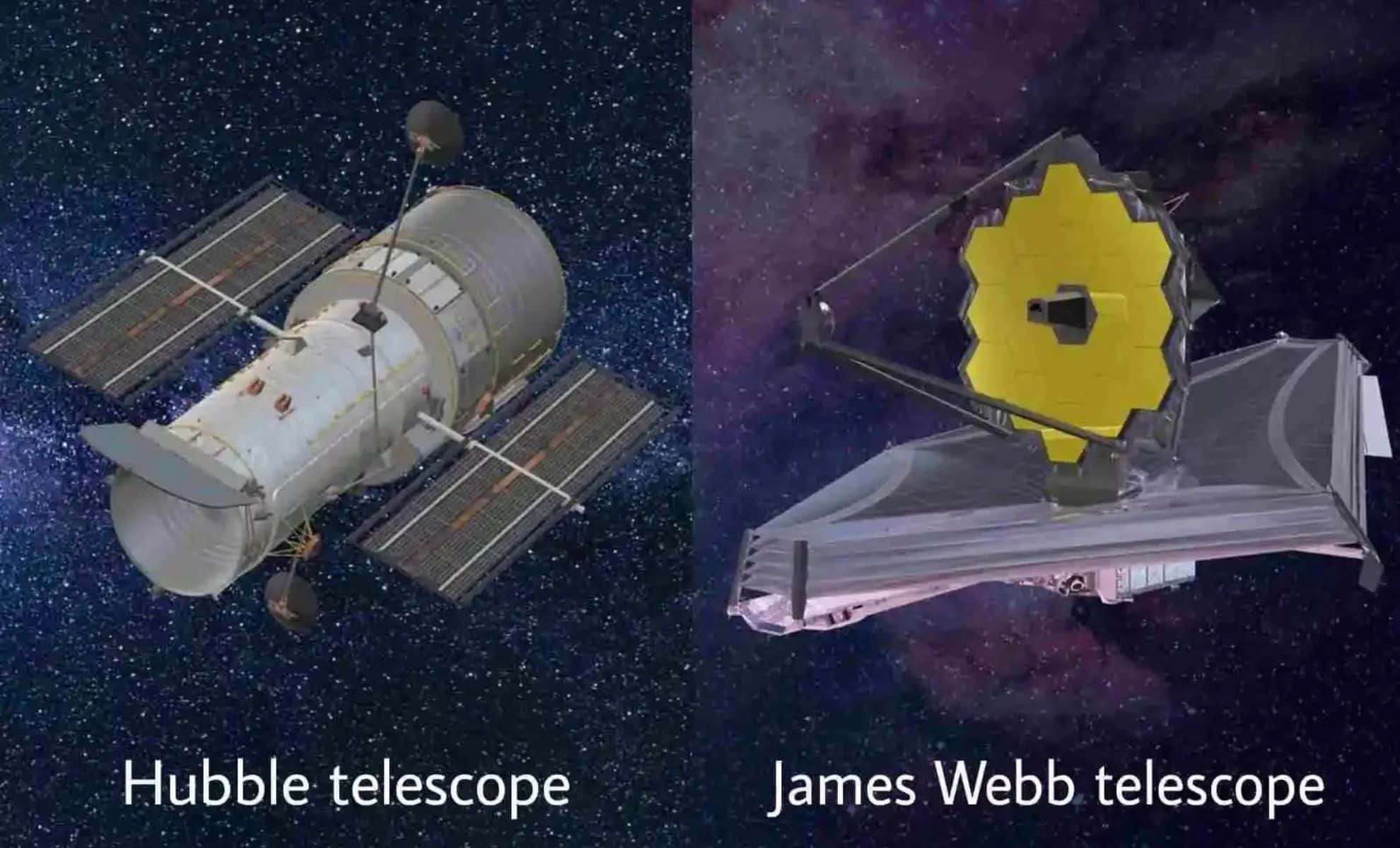
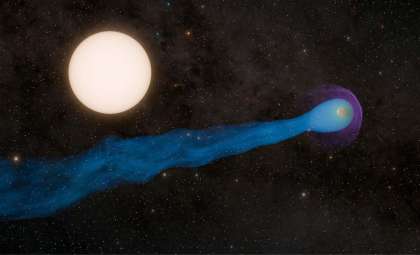
For years, scientists assumed that the formation of planets in the early cosmos was impossible due to the scarcity of heavy elements like carbon and iron, which are crucial for creating planetary systems. However, in 2003, the Hubble Space Telescope challenged this theory by discovering an exoplanet orbiting a 13-billion-year-old star within the M4 globular cluster. This implied that planetary birth may have occurred much earlier than previously believed, leaving researchers puzzled about the mechanisms behind planet formation in such primordial environments.
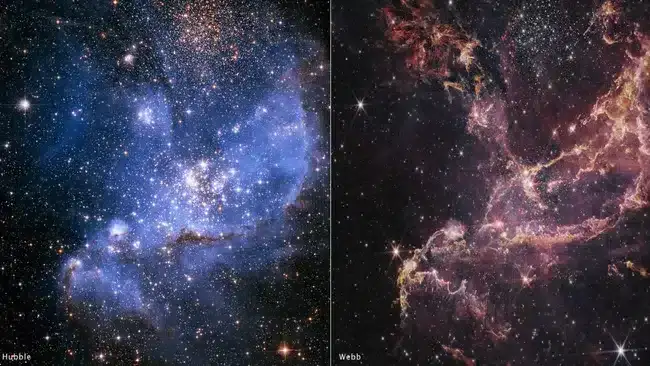
Now, combined observations from the Hubble and James Webb Space Telescopes (JWST) have shed light on this mystery. By examining NGC 346, a star cluster in the Small Magellanic Cloud—a satellite dwarf galaxy of the Milky Way with conditions akin to those of early galaxies—the team discovered that planet-forming disks can endure in metal-poor surroundings for up to 30 million years, a duration ten times longer than previously assumed.
This revelation suggests planet formation had a far larger window in the early universe than scientists ever imagined, transforming how we understand the timing and conditions needed for planetary systems to arise. How did researchers arrive at this conclusion, and what implications does it hold for future exoplanet exploration? Here’s a detailed overview of these groundbreaking findings.

NGC 346: A Galactic Laboratory for Early Planet Formation
Studying the universe’s earliest galaxies poses major challenges due to their extreme distance—billions of light-years away—and the faintness of their light. To circumvent this, scientists investigate contemporary analogs called proxies—nearby regions that mirror the environmental conditions of the early cosmos.
NGC 346, located roughly 210,000 light-years away within the Small Magellanic Cloud, serves as one such proxy. This cluster is deficient in heavy elements, resembling the chemical makeup of the embryonic universe, making it an ideal setting to explore how planets might have formed in those ancient times.
Initial Hubble observations of NGC 346 revealed subtle indications of planet-forming disks, but these hints lacked definitive proof. Since such disks were expected to dissipate rapidly in metal-poor environments, more advanced, sensitive instruments were necessary to validate the observations.
Enter JWST.
JWST’s Revelations: Extended Lifespan of Planet-Forming Disks
With its exceptional sensitivity to infrared light, the James Webb Space Telescope provided conclusive evidence. Utilizing the Near Infrared Spectrograph (NIRSpec) and Mid-Infrared Instrument (MIRI), JWST performed an in-depth analysis of NGC 346, confirming that protoplanetary disks in metal-deficient areas can exist for as long as 30 million years, far exceeding earlier theoretical estimates.
This insight elucidates how planet formation was feasible in the universe’s infancy despite the paucity of heavy metals. Researchers propose two key factors contributing to this phenomenon:
- The lack of metals slows down the dispersal of gas and dust surrounding nascent stars, resulting in disks that persist longer.
- The primordial star-forming clouds in metal-poor settings may be more massive, generating larger disks that evaporate at a slower rate.
By demonstrating the prolonged survival of these disks, JWST has fundamentally altered our comprehension of how planets form, broadening the spectrum of environments and eras where planetary systems may develop.
Summary of Key Discoveries from Hubble and JWST
Implications for Exoplanet Exploration
This breakthrough not only revises our grasp of early cosmic history but also widens the scope of potential exoplanet-hosting environments. If planets can arise in metal-poor conditions, it implies the possible existence of many more exoplanets than we’ve previously accounted for—including those orbiting stars dating back billions of years.
Several intriguing questions arise from these discoveries:
- Could ancient planets still orbit stars born in the universe’s first billion years?
- How do these ancient planetary systems differ from those found today?
- Is it possible that life began much earlier than currently believed?
As JWST continues to peer deeper into the universe with unmatched detail, astronomers anticipate uncovering further insights into the origins and evolution of planetary systems. The findings from NGC 346 mark just the start of an exciting new chapter in the study of planets beyond our solar system.
- Categories:
- News





0 comments
Sign in to Comment