
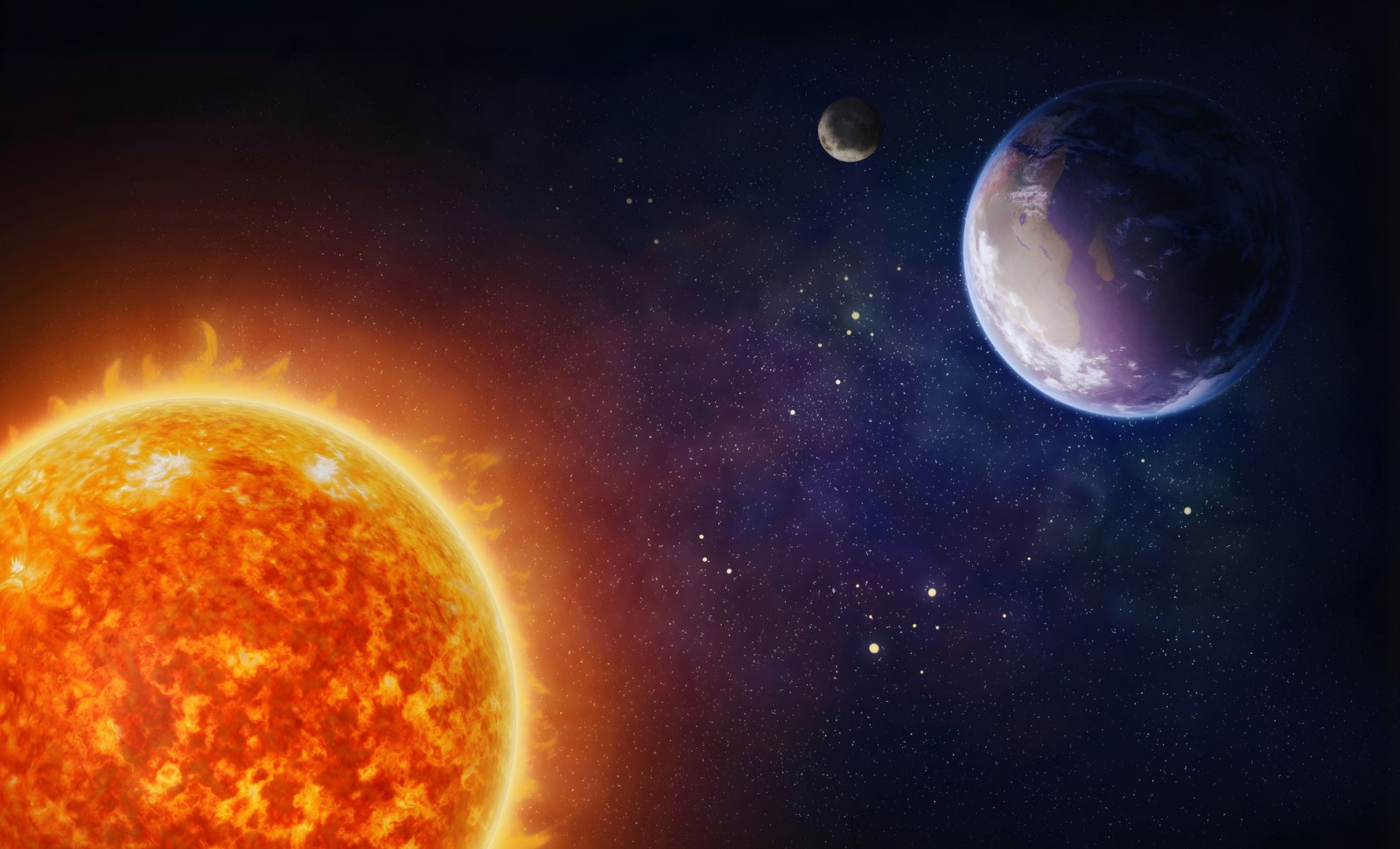
Every year in early January, Earth arrives at its nearest position to the sun, known as perihelion. In 2026, this event took place on January 3 at 12:15 p.m. EST, with our planet approximately 91.4 million miles away from the sun. Although this sounds like a significant occurrence, it barely influences the seasons we experience.
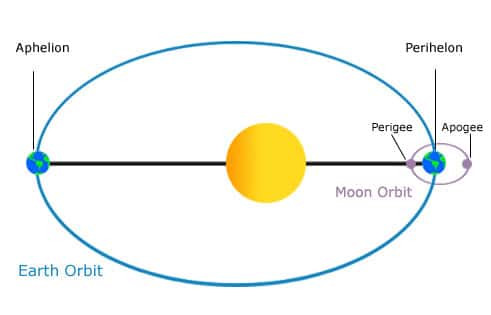
Earth’s orbit around the sun isn’t a perfect circle but rather a slightly elliptical path, causing small variations in distance throughout the year. Despite the roughly 3% difference in distance, scientists stress that this change has minimal impact on global climate. According to Space.com, the tilt of Earth's axis is the true driver of seasonal changes, not how close Earth is to the sun.
Understanding Perihelion
The term perihelion originates from the Greek words peri (near) and helios (sun), describing the point at which an object in orbit comes closest to the sun. EarthSky notes that Earth reached perihelion in 2026 at about 147,099,894 kilometers from the sun. This is nearly 5 million kilometers closer than aphelion, the most distant point in Earth’s orbit, which occurs in early July.

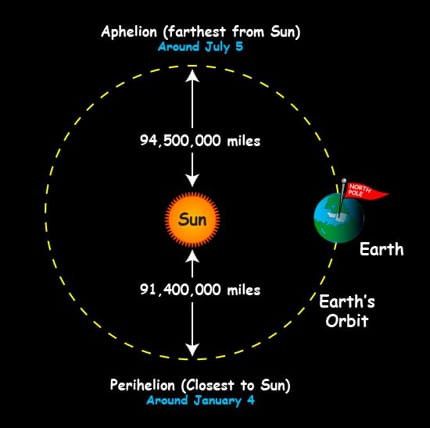
Though this distance difference sounds substantial, it only represents about 3% of the average Earth-sun span, one astronomical unit (AU), which equals roughly 149.6 million kilometers. This low orbital eccentricity ensures that the solar energy hitting Earth during perihelion and aphelion is almost identical.
“The effect of this seasonal variation on the planet’s climate is negligible,” according to data cited from Space.com.
Perihelion gains greater importance for celestial bodies with highly elongated orbits, such as comets or spacecraft including NASA’s Parker Solar Probe.
Historic Insights Into Orbital Mechanics
In 1604, astronomer Johannes Kepler introduced his first planetary motion law, revealing that planets orbit the sun along elliptical trajectories with the sun situated at one ellipse focus. His findings were based on accurate measurements of Mars’s orbit.
In subsequent years, early astronomers were puzzled by variations in solar time. As described by Edward Bloomer from the Royal Observatory Greenwich, medieval scholars observed discrepancies between solar days and idealized timekeeping.
“They were already talking about the difference between the solar day and the ideal day, the average value of that,” he explained. “Things were running behind and ahead, which, as we later learned, is because of the changes of the speed at which Earth orbits the sun due to the elliptical nature of its orbit.”
The analemma, a yearlong chart of the sun’s position at the same time and place daily, further clarified these orbital nuances. Its characteristic figure-eight pattern allowed early observers to deduce Earth’s orbital eccentricity and pinpoint perihelion.
Perihelion in Other Solar System Bodies
All planets orbit the sun and experience perihelion, though the effects vary. Venus and Neptune follow almost circular orbits, whereas Mercury, the sun’s closest planet, has the most elongated orbital path. Data from the Royal Greenwich Observatory shows Mercury’s difference between perihelion and aphelion is about 0.17 AU, a substantial variation for a planet averaging only 0.39 AU from the sun.
One notable enigma related to perihelion involves Mercury’s perihelion precession. Classical Newtonian physics could not fully explain the slight but measurable shift in Mercury’s closest orbital point, about 43 arcseconds per century beyond expectations. This puzzle was resolved by Albert Einstein’s theory of general relativity. “It was one of the three big tests of general relativity,” Bloomer remarked.
Comets and asteroids exhibit much more pronounced perihelion effects due to their highly elliptical orbits. As noted earlier, their orbits can drastically change between passes, sometimes even leading to ejection from the solar system caused by gravitational influences of giant planets like Jupiter.
- Categories:
- Science









0 comments
Sign in to Comment