
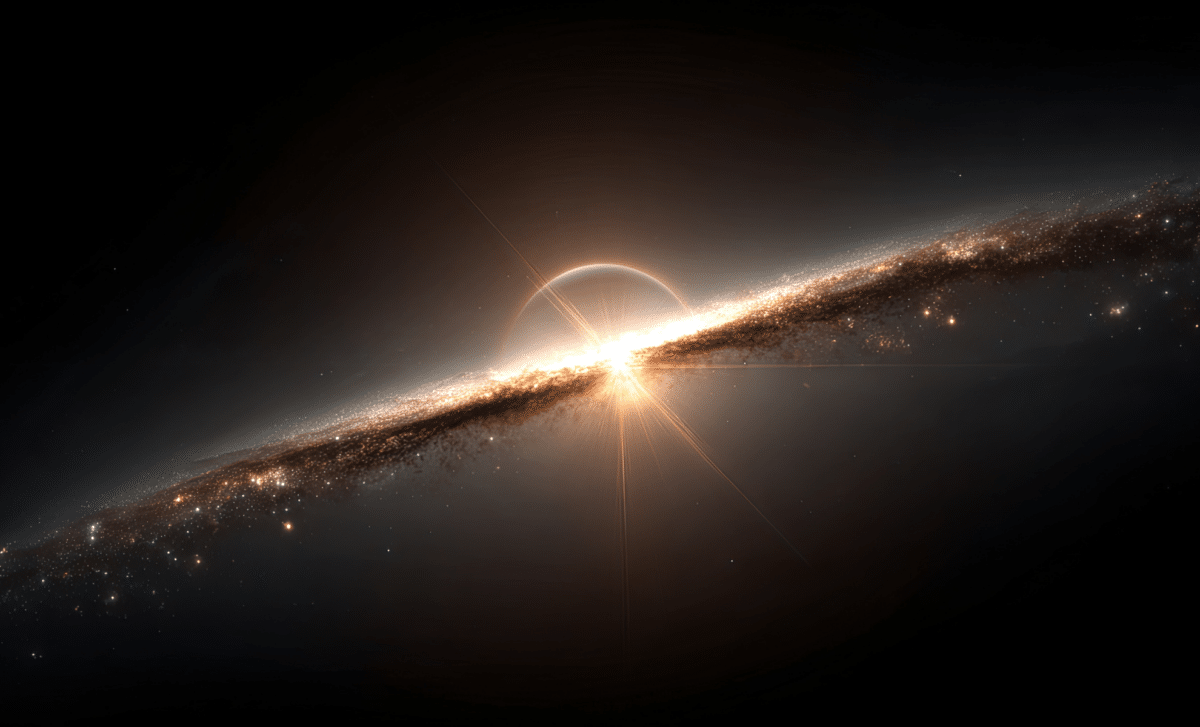
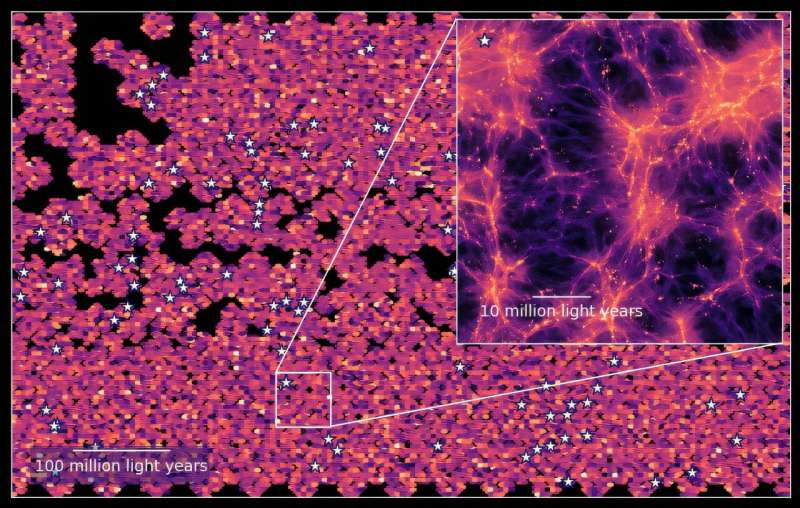
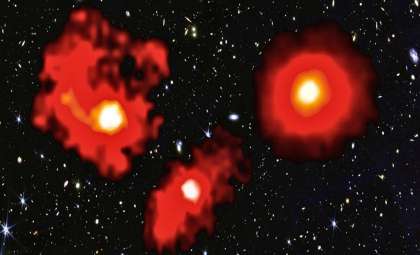
Astronomers have long faced the challenge of visualizing the universe's infancy when galaxies first emerged and cosmic frameworks formed. Although the brightest galaxies can be observed across immense distances, much of the faint matter bridging them remains elusive. A recent investigation in The Astrophysical Journal illustrates that these vast, seemingly vacant spaces are permeated by an expansive "sea of light" emitted by excited hydrogen atoms. Leveraging observations from the Hobby-Eberly Telescope Dark Energy Experiment (HETDEX), scientists have compiled the most intricate 3D representation to date of this faint cosmic illumination, revealing dim galaxies and intergalactic gases dating back 9 to 11 billion years.
Illuminating the Universe’s Formative Years
“Studying the early cosmos lets us trace how galaxies transformed over time and understand the influence of intergalactic gas during their growth,” explains Maja Lujan Niemeyer, a HETDEX researcher and recent Max Planck Institute for Astrophysics graduate who spearheaded the new mapping effort. She points out the difficulty in directly observing these distant objects due to their faint signals. This fresh map, however, capitalizes on the subtle yet vital glow from hydrogen in an excited state, offering a critical window into the gas enveloping these remote galaxies.
This ground-breaking map focuses on an era characterized by intense star formation, marking the universe’s transition from a turbulent youth to a more settled phase. The HETDEX data exposes not just the distant galaxies but also surrounding clouds of gas, which were largely undetected in prior research. Such insights promise to deepen our comprehension of early galaxy assembly and the role of cosmic gas in sculpting the cosmos.

Line Intensity Mapping: A Breakthrough for Cosmic Surveys
Central to this study, detailed in The Astrophysical Journal, is the innovative Line Intensity Mapping technique. This method enables astronomers to chart the distribution of key elements like hydrogen across vast sky expanses without isolating individual galaxies. Julian Muñoz, a HETDEX collaborator and assistant professor at The University of Texas at Austin, compares it to aerial observation: “Traditional galaxy surveys map the major cities, ignoring suburbs and small towns. Intensity mapping captures the whole light distribution, revealing the complete cosmic landscape.”
Tracking Lyman alpha emissions allows HETDEX to identify both luminous galaxies and the faint structures in between. These dimmer features, often neglected in previous studies, are vital for unraveling how galaxies and surrounding gas interacted during this pivotal period. HETDEX’s findings provide a more comprehensive perspective on the early universe, exposing hidden networks and relations previously unseen.
Harnessing HETDEX’s Vast Dataset for Future Discoveries
Although HETDEX has gathered an enormous amount of data, only a fraction has been thoroughly examined. “So far, we’ve analyzed just around 5% of the collected information,” notes Karl Gebhardt, principal investigator of HETDEX and head of UT Austin’s astronomy department. This untapped 95% holds immense promise for uncovering more about the universe’s earliest epochs.
Niemeyer emphasizes that while HETDEX surveys entire sky patches, only the brightest galaxies have been scrutinized to date. “Those glowing galaxies represent just the surface,” she says. “Beneath lies a vast sea of light across the seemingly void spaces, holding crucial data about faint galaxies and diffuse gas.”
Supercomputers Decode Half a Petabyte of Cosmic Data
Generating this detailed cosmic map demanded extraordinary computing capabilities. Custom algorithms and supercomputers at the Texas Advanced Computing Center processed over half a petabyte of data from the Hobby-Eberly Telescope, encompassing more than 600 million spectra that pinpoint upwards of one million bright galaxies. By integrating this with existing galaxy knowledge, researchers inferred the presence of fainter galaxies and gas clouds, producing a richer, more accurate cosmic portrayal.
Eiichiro Komatsu, a HETDEX scientist and scientific director at the Max Planck Institute for Astrophysics, explains, “Known galaxy locations serve as markers to estimate distances of dimmer objects.” This approach sharpens the image of regions near luminous galaxies and clarifies the otherwise empty cosmic stretches.
- Categories:
- Astronomy

0 comments
Sign in to Comment