

New archaeological research near Tel Aviv highlights how humans from 400,000 years ago adjusted their technology to shifting environmental conditions. Published in the journal Archaeologies, the study explores changes in stone tool technology and cultural practices, focusing on the distinctive Quina scraper.
These revelations provide insight into how early humans re-engineered their hunting tools and strategies in response to the decline of large megafauna, innovations that resonate with patterns in human history.
Adapting to Changing Prey and Its Effects on Early Societies
For nearly a million years, the Levant’s early hunters mainly pursued large animals, including elephants roaming from Africa through Eurasia. As elephant numbers diminished, early humans shifted their focus to smaller, quicker game like fallow deer, a transition that required fresh hunting techniques and improved tool designs.

Fallow deer inhabited mixed woodland regions of the Samarian highlands, and extensive remains have been uncovered at sites like Jaljulia and Qesem Cave. Processing many smaller creatures to meet dietary needs once supplied by a single elephant involved tools with more precise, efficient edges.
The Quina Scraper: The Stone Age Equivalent of a Game-Changing Device
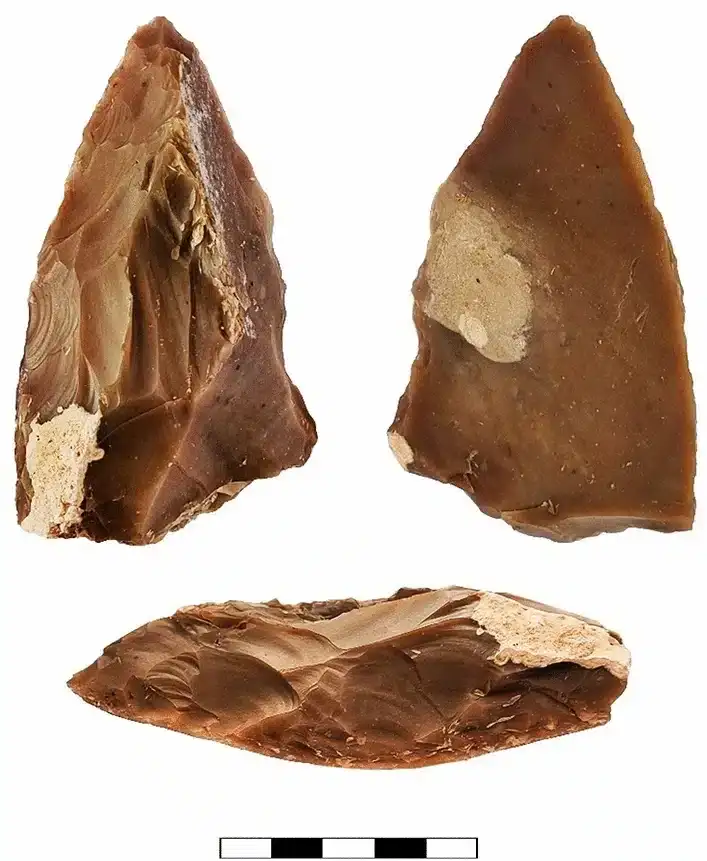
The Quina scraper, a specialized flint implement, features a finely notched and razor-sharp edge optimized for skinning and butchering activities. Microscopic wear patterns reveal repeated motions ideal for swiftly removing hides and sinews, minimizing time exposed to scavengers or rivals at kill sites.
“The Quina scrapers represent an advancement with edges that are better shaped, sharper, and more consistent compared to earlier, simpler scrapers,” explains Vlad Litov, the lead researcher on the project.
Distinguished by a stepped, scale-like cutting edge with a sharpened bevel, the Quina scraper could be resharpened repeatedly, proving its reliability during extended hunting trips. Experimental archaeology has demonstrated its effectiveness in creating long strips of hide usable for constructing shelters, wrapping meat, or even early clothing production.
Why Did Hunters Carry Flint from Distant Sources?
A notable aspect uncovered by the study is that early humans sourced flint about 12.4 miles away from the western slopes of the Samarian mountains for making these scrapers, rather than using closer flint deposits. Interestingly, these upland areas were also key habitats for fallow deer during calving season.
This intentional sourcing pattern points to an intricate understanding of the environment, linking the location of tool materials with that of their prey, possibly reflecting not only practical needs but also symbolic or cultural connections.
Researchers Vlad Litov and Prof. Ran Barkai of Tel Aviv University suggest this behavior may indicate a rudimentary form of landscape attachment, potentially carrying a sacred significance that influenced both utilitarian and perceptual dimensions of prehistoric life.
What These Ancient Tools Reveal About Early Human Culture
The relationship between the origin of the tool’s raw material and the hunting grounds highlights a cultural depth beyond mere survival. This pattern of associating resources with specific places parallels later human practices, such as obsidian usage in the American Southwest and jade procurement in ancient China.
These insights significantly extend the timeline of symbolic and cultural behaviors, illustrating that early humans not only innovated technologically to meet environmental challenges but also cultivated complex bonds with their habitats.
- Categories:
- News













0 comments
Sign in to Comment