

A team of astronomers has uncovered a planet that defies traditional planetary formation models by orbiting in a reverse direction relative to its binary stars. This remarkable planet, orbiting in the nu Octantis system contrary to the stars’ rotation, was confirmed through detailed analysis using data from the European Southern Observatory’s HARPS instrument. Published in Nature on May 21, 2025, this finding challenges long-held assumptions and offers fresh insights into planet formation in binary star environments. Led by Professor Man Hoi Lee from the University of Hong Kong, the team utilized precise radial velocity measurements to validate this rare orbital configuration.
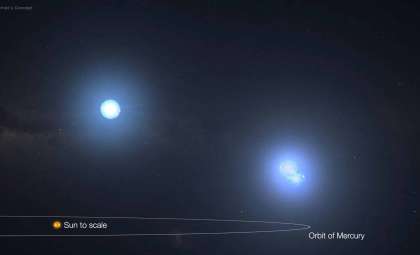
The nu Octantis system, roughly 2.9 billion years old, consists of two stars: nu Oct A, a subgiant star with about 1.6 solar masses, and nu Oct B, a smaller star at roughly half the Sun’s mass. They circle each other every 1,050 days. While signs of a planet in this system were first spotted in 2004, only recent high-precision data have confirmed its presence and distinctive retrograde orbit.
Decoding Retrograde Orbits in Binary Star Systems
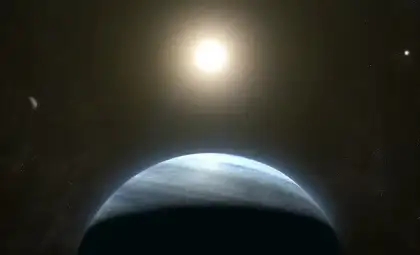
Typically, planets orbit in the same direction that their host stars rotate, a product of the shared rotational dynamics during system formation. However, the retrograde orbit of the nu Octantis planet — moving opposite to its stars’ orbital motion — is a rare exception that challenges planetary scientists. The intense gravitational forces present in binary star systems tend to make stable, reverse orbits highly unlikely, making this planet an extraordinary object of study.

The researchers validated the retrograde orbit by thoroughly analyzing both archival and newly obtained radial velocity data spanning 18 years. This method tracks star movements relative to Earth, confirming the planet’s orbit runs counter to the stars’ trajectory while remaining nearly coplanar with their orbital plane. Further validation came from additional HARPS spectrograph observations.
These findings broaden the understanding that retrograde planets might be less uncommon than believed, especially around evolved stars such as white dwarfs. The nu Octantis discovery provides a unique laboratory for exploring how planets can form or survive in dynamically complex systems.
Tracing the Origins of nu Octantis: A White Dwarf Companion and Its Unusual Planet
Reconstructing the history of the nu Octantis system helps explain the presence of this extraordinary planet. The secondary star, nu Oct B, has evolved significantly, initially possessing about 2.4 times the mass of the Sun before ultimately becoming a white dwarf. This transformation left it with just around 25% of its original mass.
Researchers propose that the material expelled during nu Oct B’s evolution into a white dwarf may have contributed to the planet’s formation. One hypothesis posits that the planet originated within a retrograde disk of material released by nu Oct B, while an alternative suggests it was captured into its current orbit around nu Oct A after initially orbiting differently.
By simulating the system’s initial star arrangements and evolutionary timeline, the scientists concluded the planet could not have formed in tandem with the stars around nu Oct A. The white dwarf transformation of nu Oct B significantly shaped the system’s architecture. As Ho Wan Cheng, the study’s lead author, noted: “The nu Octantis system is about 2.9 billion years old, with nu Oct B originally more massive and evolving into a white dwarf roughly 2 billion years ago. Our data show that the planet did not form concurrently with the stars around nu Oct A.”
Insights Into Second-Generation Planet Formation
This study raises the intriguing possibility that the nu Octantis planet is a second-generation planet. Co-author Dr. Trifon Trifonov explains that the planet might have either been captured from a normal prograde orbit or formed from material shed by nu Oct B post-mass loss. He remarked, “This might represent the first strong evidence of a second-generation planet — formed or captured following nu Oct B’s transformation into a white dwarf after losing much of its mass.” Such a discovery could revolutionize the understanding of how planets form in unconventional settings.
The existence of a retrograde planet presents a challenge to standard planet formation theories, which expect all planets to orbit in coordination with their stars’ angular momentum. Finding a planet with an opposing trajectory in a closely bound binary system suggests the potential for extraordinary planetary dynamics. This could provide vital clues about planetary migration, capture processes, and secondary planet formation mechanisms.
- Categories:
- News









0 comments
Sign in to Comment