
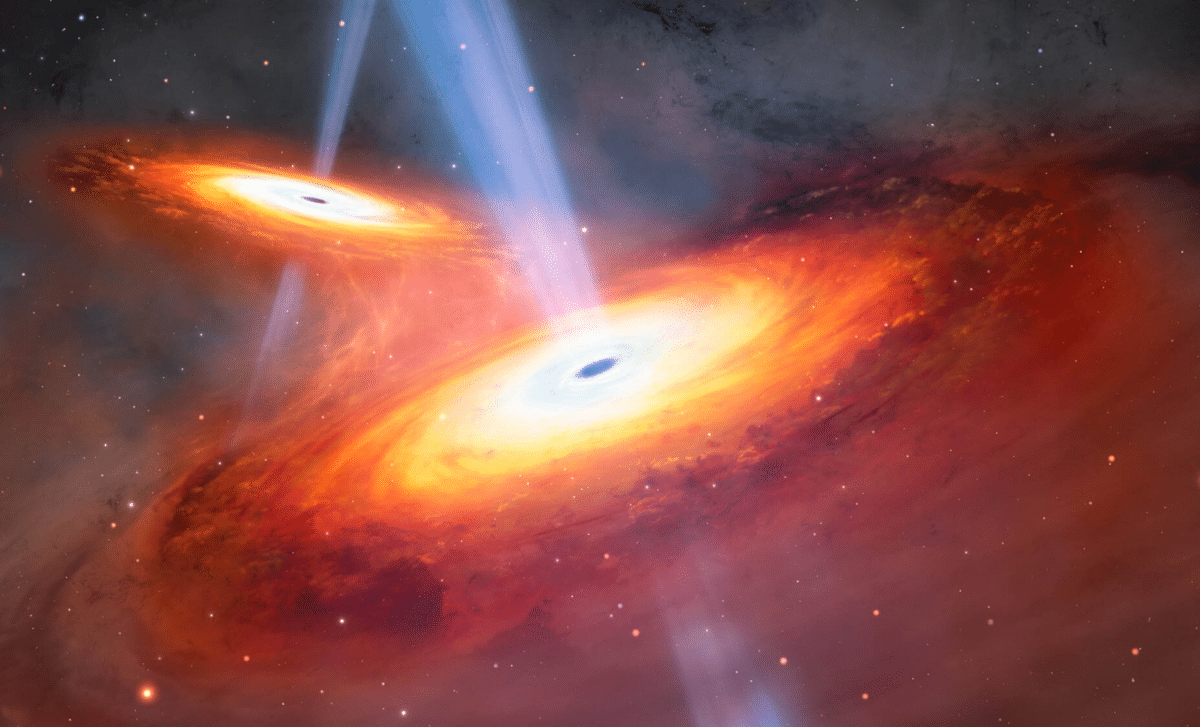
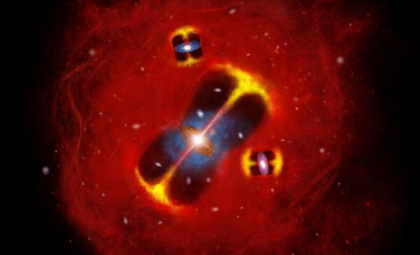
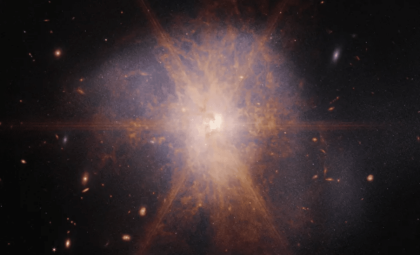
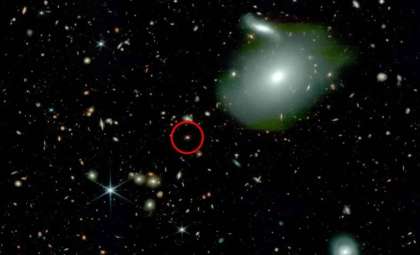
A groundbreaking detection has unveiled two quasars in the process of merging during the universe’s formative years, providing critical insight into the emergence and growth of supermassive black holes roughly one billion years after the Big Bang. This extraordinary pair, designated J2037–4537, is confirmed through detailed high-resolution imaging and documented in a recent arXiv publication, representing one of the only two known quasar pairs at such an astounding distance and challenging prevailing theories about early cosmic development.
Unveiling Early-Universe Galaxy Interactions
Located at a redshift of z = 5.7, this system hails from an epoch when the cosmos was still highly youthful. Quasars, which are intensely bright beacons powered by voraciously feeding supermassive black holes, are exceedingly rare to find in pairs within interacting galaxies at such an early time. Utilizing the Atacama Large Millimeter/submillimeter Array (ALMA), researchers captured unprecedented detail of the pair, uncovering not only their luminous nuclei but also the surrounding medium intertwining them.
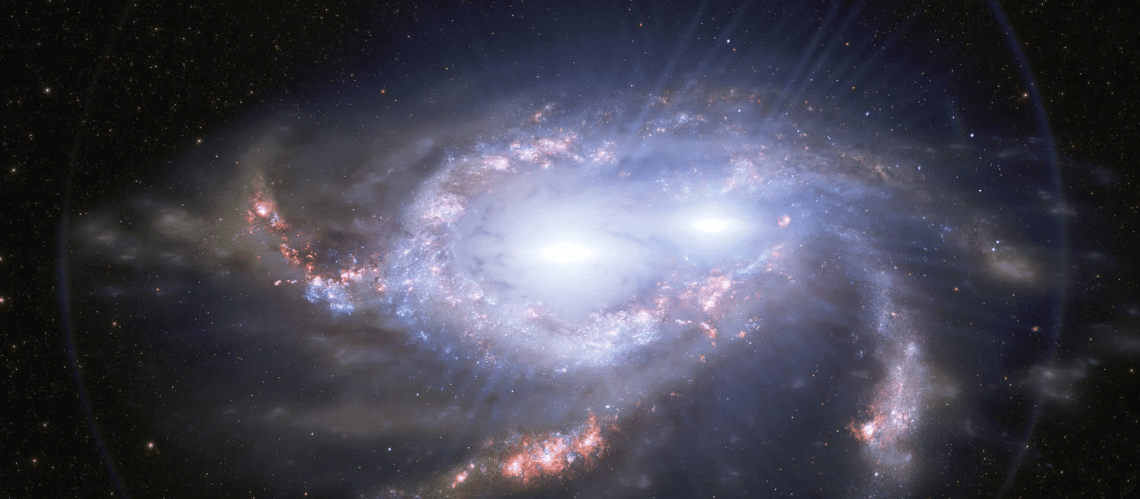
According to the study on arXiv, both host galaxies are experiencing vigorous starburst activity while actively feeding their central black holes. Each galaxy holds upwards of 10 billion solar masses and forms stars at an astonishing rate exceeding 500 solar masses annually. These observations illustrate a vigorous era in galactic evolution wherein mergers amplify both star formation and black hole accretion on immense scales.

Discovery of the Connecting Tidal Bridge Resolves the Puzzle
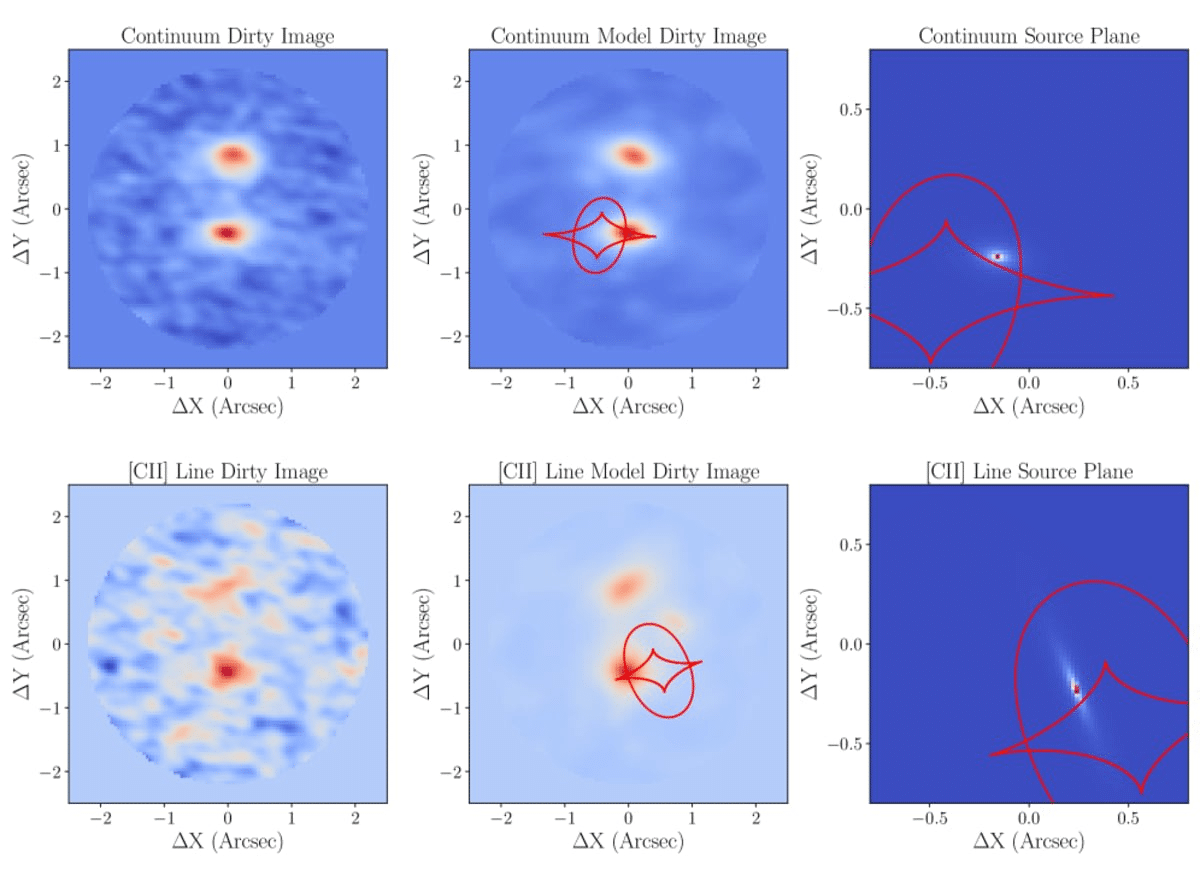
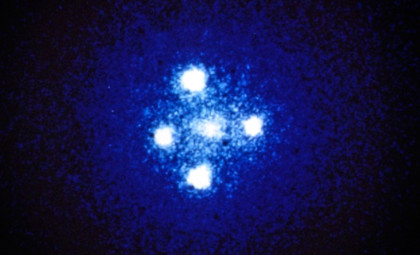
First identified in 2021, the nature of J2037–4537 sparked debate: was it truly a duo of quasars, or a single quasar split into two images by gravitational lensing? This uncertainty remained unresolved until ALMA’s observations traced the spatial distribution of [CII] emission, a vital indicator of cold gas linked to star-forming regions.
The results were conclusive. A continuous filament of gas bridges the two quasars, forming a tidal bridge created by gravitational interactions between the host galaxies pulling material from one another. Such a physical link cannot be mimicked by gravitational lensing, which only produces replicated images without any connecting matter.
“The dust continuum and [CII] line emissions clearly reveal the tidal bridge between the two quasars,” the team stated in their publication.
This crucial evidence confirms the existence of two separate quasars in the midst of a merger, marking one of the universe’s rarest observable phenomena.
Insights Into Black Hole Mergers and Cosmic Progression
Although closely situated, the supermassive black holes powering J2037–4537 remain thousands of light-years apart and have yet to form a gravitationally bound binary. Simulations estimate it will take about 2.1 billion years for these black holes to coalesce into a single, more massive entity.
This gradual merger process has ramifications beyond galaxy formation alone. The union of such colossal black holes generates low-frequency gravitational waves, distortions in space-time monitored by Pulsar Timing Arrays (PTAs). Recent PTA findings indicate a stronger gravitational wave background than anticipated, prompting questions surrounding the frequency of black hole mergers throughout cosmic history.
Studying systems like J2037–4537 may shed light on this puzzle. If binary quasars were more prevalent in the universe’s early epochs than previously recognized, they could explain some of the unexpected gravitational wave detections occurring today.
A Landmark Discovery Reshaping Cosmic Evolution Studies
The identification of J2037–4537 adds a vital piece to understanding early cosmic structure formation, directly illustrating how galactic mergers can ignite concurrent quasar activity. It also showcases ALMA’s remarkable capability to scrutinize the distant universe, unveiling phenomena once beyond observational reach.
As the search for similar rare systems advances, this merging quasar pair provides a key reference point for unraveling how the universe’s largest gravitational powerhouses emerged, interacted, and ultimately influenced the cosmos we see today.
- Categories:
- Astronomy


0 comments
Sign in to Comment