
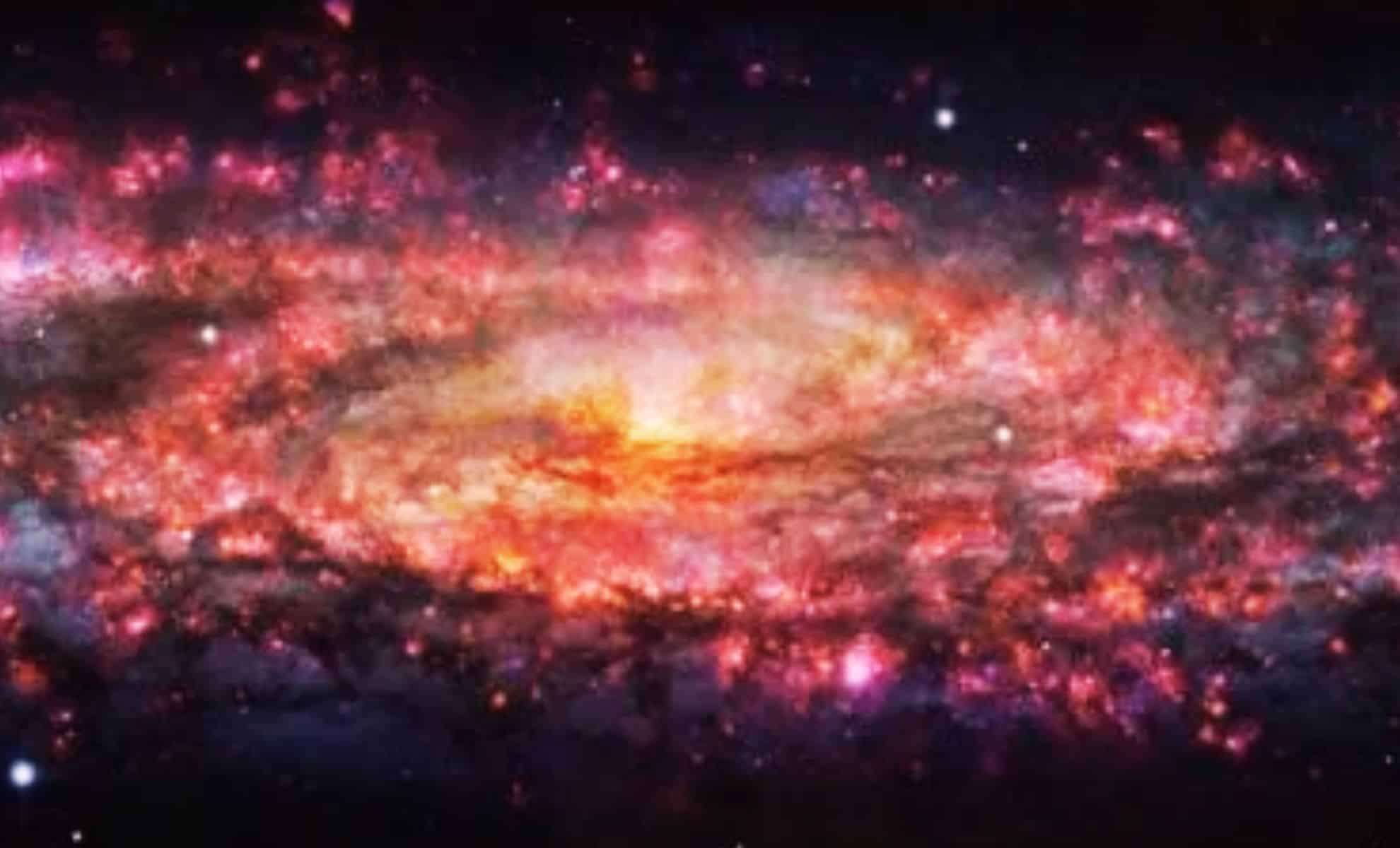
A team of astronomers has captured an exceptional image of the Sculptor Galaxy, also known as Caldwell 65, showcasing this cosmic marvel in an extraordinary spectrum of colors. Situated approximately 11 million light-years from Earth, the Sculptor Galaxy has long attracted interest for its detailed galactic structures and star-forming regions. Utilizing the powerful Very Large Telescope (VLT), experts from the European Southern Observatory (ESO) compiled a high-resolution composite image extending over 65,000 light-years, revealing intricate patterns of stellar formation and dynamic galactic evolution.
This vivid depiction presents the galaxy through thousands of color shades that correspond to key elements such as hydrogen, nitrogen, sulfur, and oxygen, vital to decoding the galaxy's internal environment. By fusing over 100 individual exposures, researchers have generated a comprehensive map detailing regions rich in star birth and gas movement, shedding light on areas previously less explored. This breakthrough could unravel vital mysteries about how galaxies form, evolve, and nurture stars.
Delving Into the Intricacies of the Sculptor Galaxy
Galaxies represent some of the universe’s most complex phenomena, posing challenges for researchers eager to understand their inner mechanisms. According to Enrico Congiu, who led the project, “Galaxies are incredibly complex systems that we are still struggling to understand.” Positioned advantageously close to our planet, the Sculptor Galaxy offers an unparalleled opportunity to study fine structural details while still appearing as a unified system in the night sky.

The Sculptor Galaxy serves as a prime target to examine interactions among stars, gas, and dust. The new image reveals ongoing star formation alongside remnants of older star clusters, offering a rare glimpse into multiple phases of galactic development. It also highlights structures like planetary nebulae, glowing gas shells from dying stars, providing valuable clues about stellar life cycles within the galaxy. Astronomers have utilized these keys to further unravel the galaxy's stellar history.
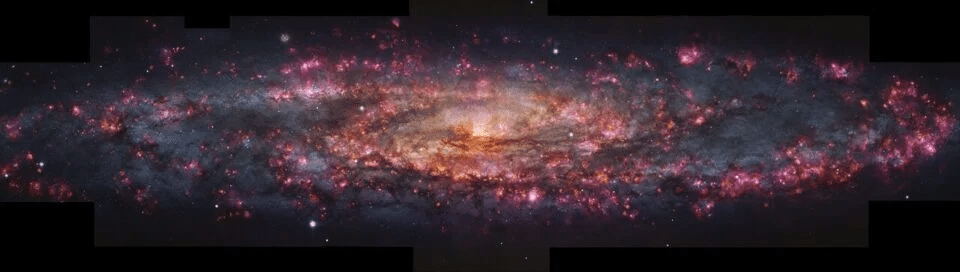
Advanced tools like the VLT’s Multi Unit Spectroscopic Explorer enable unprecedented studies of galaxies by detecting light emissions from elements like hydrogen. This capability exposes regions of newly formed stars glowing vividly amid ionized hydrogen gas visible in pink. Such detailed observations clarify the influence of these starburst zones on the overall evolutionary path of the galaxy.
Gas Dynamics and Star Formation Within the Sculptor Galaxy
A standout feature of this image is its illumination of the interplay between gas movement and star creation. As Kathryn Kreckel from Heidelberg University comments, “We can zoom in to study individual regions where stars form at nearly the scale of individual stars, but we can also zoom out to study the galaxy as a whole.” This ability to explore both microscopic and macroscopic levels offers a richer understanding of the processes fueling galactic growth.
The galaxy’s gas content acts as a critical ingredient for new stars and shapes the galaxy’s architecture. A striking phenomenon captured in the image is the white cone of light emanating from the central black hole, addressing the role of active galactic nuclei (AGN) in shaping their host galaxies. This gas outflow can modulate star formation by depleting or redistributing star-forming materials throughout the galaxy.
Scientists believe that understanding these gaseous flows will unveil how galaxies control star production across cosmic timescales. The interaction of gas with stellar processes is pivotal to mapping a galaxy’s transformation over billions of years — a major focus in current research using this unique Sculptor Galaxy data.
An Unparalleled View of Galactic Evolution
What distinguishes this picture of the Sculptor Galaxy is its extraordinary level of detail. The research team dedicated over 50 hours to observations using the VLT, accumulating more than 100 exposures to create a thorough representation of the galaxy’s internal architecture. By capturing emissions across multiple wavelengths, researchers have painted a holistic portrait covering the entire galactic system.
As one of our nearest galactic neighbors, the Sculptor Galaxy provides an ideal laboratory to investigate the subtleties of galactic formation. Unlike more distant galaxies where fewer than 100 planetary nebulae are typically detected, here the team identified hundreds, indicating numerous dying stars shedding their outer layers. These insights promise to deepen our knowledge of stellar evolution beyond the Milky Way.
Fabian Scheuermann, a doctoral candidate at Heidelberg University, emphasizes the rarity of such detections: “Beyond our galactic neighborhood, we usually deal with fewer than 100 detections per galaxy.” This outstanding access to the Sculptor Galaxy uniquely positions astronomers to study galaxies at multiple stages of their maturation.
- Categories:
- News




0 comments
Sign in to Comment