

Scientists have recently discovered a colossal ring-shaped galaxy formation spanning an extraordinary 1.3 billion light-years across, challenging established cosmological frameworks. This immense structure, dubbed the Big Ring, was uncovered by Alexia Lopez from the University of Central Lancashire through a detailed study of quasar absorption signatures, with the results undergoing thorough peer review.
Encircling space with a circumference close to 4.1 billion light-years and positioned roughly 9.2 billion light-years away, the Big Ring’s presence deviates from random distribution predictions by about 5.2 sigma, denoting a highly unlikely chance occurrence. Unlike a simple flat ring, it reveals a spiral-shaped assembly when viewed from a near face-on angle.
This discovery is remarkable not only for its gigantic dimensions but also for its location. The Big Ring overlaps the same section of the sky and cosmic distance range as another massive structure previously recognized by Lopez: the Giant Arc. The coexistence of two ultra-large formations in close proximity deepens the puzzle of their origins within the current understanding of the universe.

Why Existing Theories Fall Short
The foundations of contemporary cosmology rest on the assumption that matter tends to be evenly spread when observed over vast scales. Conventionally, the largest expected size for coherent structures is about 1.2 billion light-years—significantly smaller than the Big Ring.
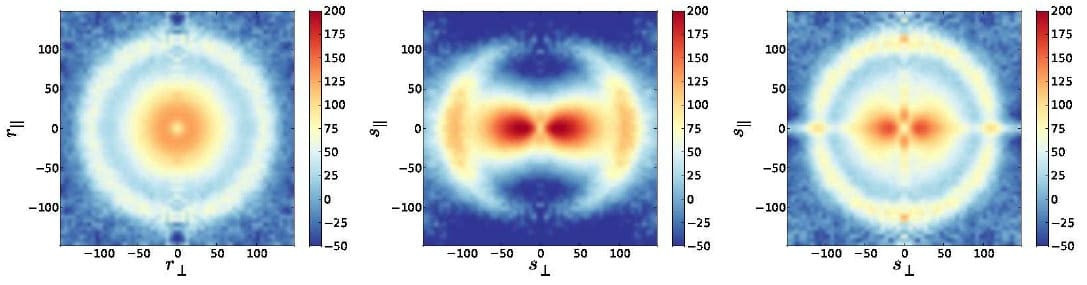
A common explanation for large-scale clustering is linked to baryon acoustic oscillations (BAO), imprints of pressure waves from the early universe. These oscillations serve as a cosmic measuring stick about 490 million light-years across, forming spherical shells in matter distribution. However, the Big Ring’s scale surpasses the BAO and lacks its spherical shape, making the BAO explanation unlikely.
Lopez highlighted the significance: “Current cosmological models did not predict structures of this magnitude. We expected possibly a single rare structure within the observable universe. The presence of two enormous formations in the same region challenges our prevailing cosmic theories.”
Cosmic Strings as a Potential Explanation
One intriguing hypothesis involves cosmic strings, which are theoretical thin defects formed during phase transitions in the universe’s infancy. Unlike conventional dark matter halos that cluster matter gravitationally, cosmic strings could create extraordinary geometric patterns across immense distances.
Though promising, this idea is still speculative. Direct evidence of cosmic strings remains elusive, and confirming structures like the Big Ring across broader, deeper astronomical surveys is essential. Experts have warned that statistical anomalies in limited datasets may not persist as observations expand.
Detection of the Big Ring relies on quasar absorption signatures, which probe intergalactic material between Earth and distant quasars. While this method provides valuable insight, it requires careful analysis due to its indirect nature.
Our Galaxy’s Place in the Cosmic Web
In separate work published in Nature Astronomy in September 2024, researchers revisited the cosmic neighborhood of the Milky Way. Utilizing the Cosmicflows-4 database, containing data for nearly 38,000 galaxy clusters, A. Valade and colleagues employed probabilistic methods to map gravitational attraction basins extending out to redshifts equivalent to roughly 30,000 km/s.
The findings suggest our home supercluster, Laniakea, is more likely part of the broader Shapley basin of attraction, rather than existing as an independent gravitational entity. This implies the Milky Way lies within a larger cosmic catchment area than previously recognized in the original 2014 Laniakea model.
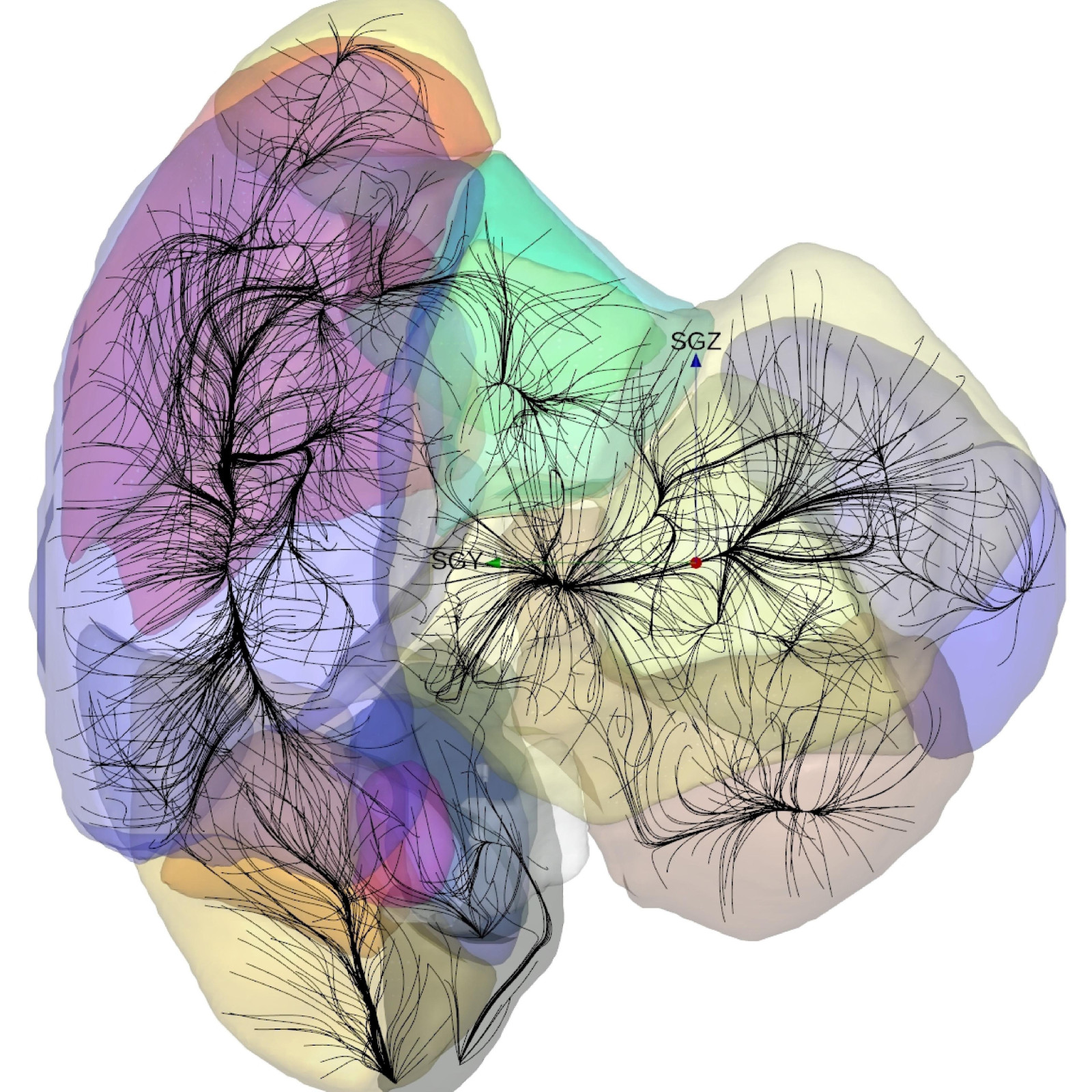
The largest basin identified by Cosmicflows-4 aligns with the Sloan Great Wall, an extensively documented structure extending about a billion light-years, with a volume more than double that of Shapley’s secondary basin. This confirms that many of the universe’s biggest known formations have been cataloged, even as fresh discoveries continue.
Examining the Foundations of Cosmic Uniformity
The discoveries surrounding the Big Ring, Giant Arc, and the updated view of Laniakea raise fundamental questions about the scale at which the universe is truly homogeneous.
The cosmological principle, which posits that on large scales the universe is uniform and no place is special, has underpinned cosmology for decades. Though supported by much evidence, it remains a testable assumption rather than an absolute fact. The existence of structures surpassing expected size boundaries does not immediately invalidate this principle but prompts reconsideration of its limits or the mechanisms behind such vast formations.
Peer-reviewed analyses emphasize that the Big Ring’s unusual size and shape present the greatest tension with current standard models. To clarify whether it represents a rare anomaly or signals a broader pattern, astronomers will need to conduct more extensive surveys leveraging quasar absorption measurements at greater depths and broader sky coverage.
- Categories:
- Science











0 comments
Sign in to Comment