
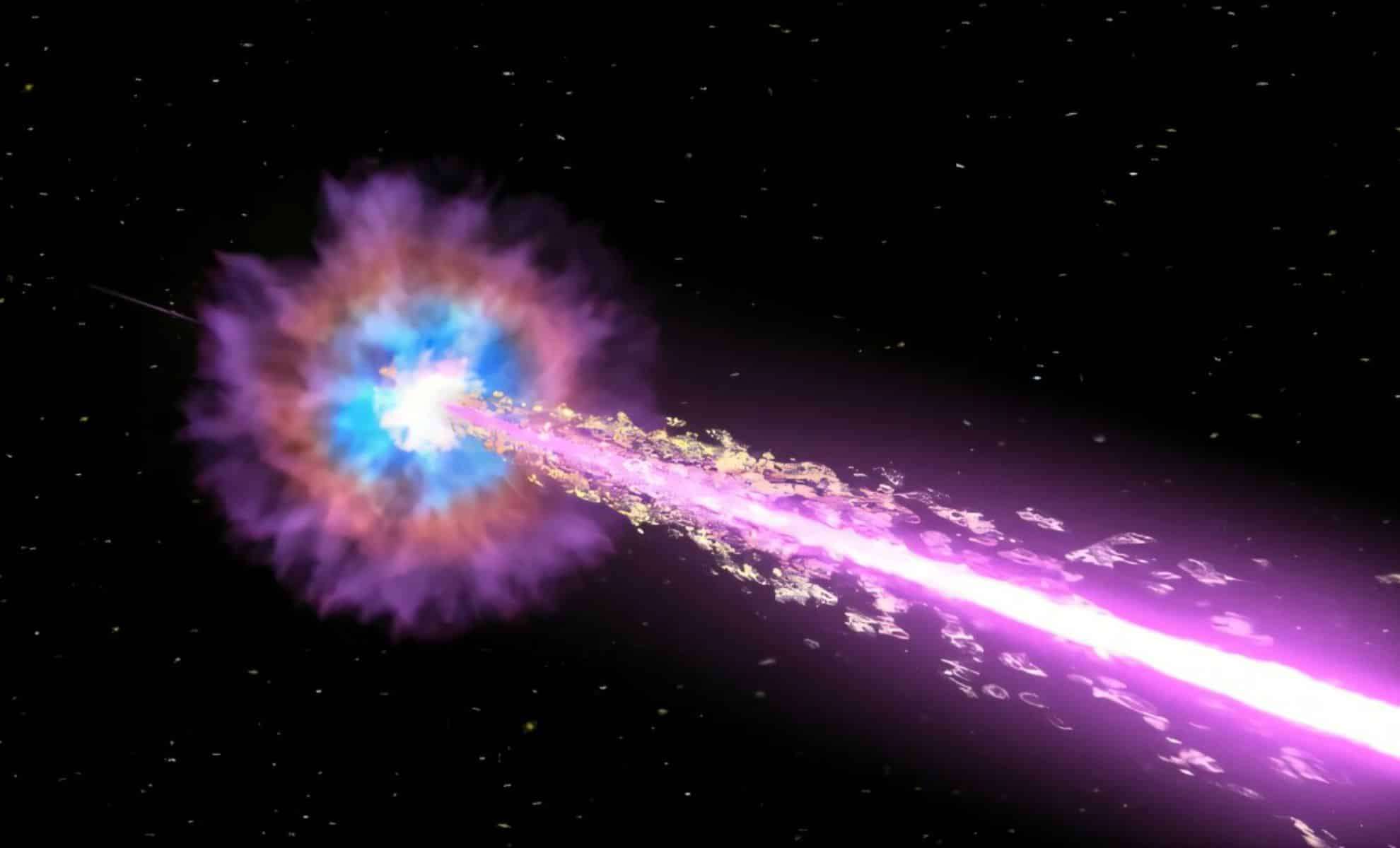
Astronomers have pinpointed one of the most intense cosmic explosions recorded to date, known as a Fast X-ray Transient, dating back to when the universe was a mere 1.8 billion years old.
Designated EP240315A, this event was discovered by the Einstein Probe satellite and studied extensively with help from several premier global observatories. The detailed results, published on August 19 in Nature Astronomy, shed light on the final stages of stellar evolution and the universe’s reionization period.
The Einstein Probe Detects a Rare Cosmic Flash
Launched in January 2024, the Einstein Probe has revolutionized high-energy astrophysics by capturing swift transient events previously missed. Shortly after its deployment, it recorded a powerful X-ray burst lasting only a few minutes. This event—named EP240315A—was tracked almost instantaneously, marking a milestone for real-time transient astronomy.

Fast X-ray Transients (FXTs) have emerged as a fascinating class of cosmic explosions, previously identified mostly in archival data too late for detailed multi-spectral follow-up. “Though we’ve suspected these phenomena for some time, it’s only now, with the Einstein Probe, that we’re able to observe them live,” explained Peter Jonker from Radboud University.
Tracing an Ancient Explosion Across the Universe
Using data collected from the Very Large Telescope in Chile, the Gran Telescopio Canarias in Spain, and the ATLAS optical survey array, scientists were able to pinpoint the origin of this FXT. Their analysis confirmed the explosion took place over 12 billion years ago, a snapshot from a time when the universe was younger than 10% of its present age.
Andrew Levan, also at Radboud University, remarked, “This explosion unleashed more energy in several seconds than our sun will emit over its entire lifetime.”
During that epoch, vigorous star formation was ongoing, and galaxies were considerably more dynamic than they are today. FXTs like EP240315A potentially act as cosmic beacons, unveiling the nature of early galactic evolution and star death.
Exploring Connections Between FXTs and Gamma-Ray Bursts
Although FXTs are a relatively new class, their similarities with the well-studied Gamma-Ray Bursts (GRBs) have triggered ongoing investigations. GRBs represent some of the universe’s most energetic events, often signaling the collapse of massive stars into black holes.
Jonker emphasized, “Our research indicates that many FXTs might actually be gamma-ray bursts, but there is still much to uncover.”
The researchers observed that the surroundings of EP240315A had a low hydrogen density, portraying a cleaner environment than is commonly found near typical GRB sources.
Illuminating the Early Universe
A key discovery centers on the light escaping from the region around EP240315A. Astronomers recorded ultraviolet radiation leaking from the host galaxy, a rare window into the processes at work in the early cosmos.
“This is the most distant event where we’ve been able to observe escaping starlight directly,” said Andrea Saccardi of the French Alternative Energies and Atomic Energy Commission. He highlighted that galaxies like this one might have been crucial contributors to cosmic reionization—the transformation that allowed light to freely travel through the universe after its foggy dawn.
Research indicates approximately 10% of the ultraviolet light from the FXT’s galaxy was able to penetrate into intergalactic space, ionizing hydrogen and helping to clear the universe’s primordial haze.
Advancing High-Energy Astronomy
For years, gamma-ray bursts and supernovae have been the main focus for studying stellar deaths. However, the Einstein Probe’s ability to capture these events live introduces a powerful new tool.
Levan shared, “Since detecting EP240315A, we've observed and analyzed over 20 similar bursts, confirming their potential to examine star deaths and conditions in the young universe.”
Looking ahead, researchers aim to better understand the wide variety of FXTs. Samantha Oates of Lancaster University noted, “This is a pivotal moment, likely heralding a revolution in our comprehension of the early cosmos.”
- Categories:
- News




0 comments
Sign in to Comment