
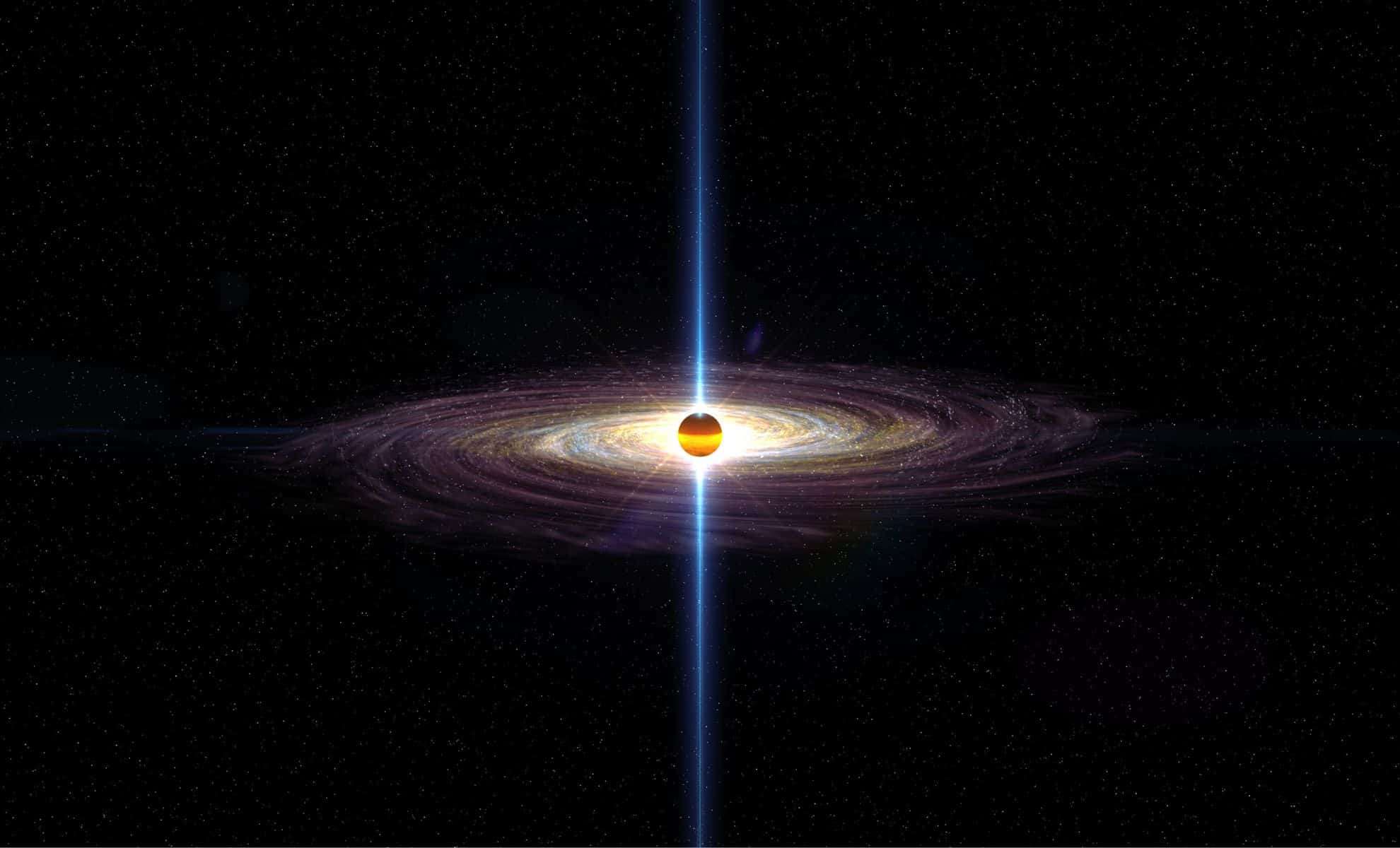
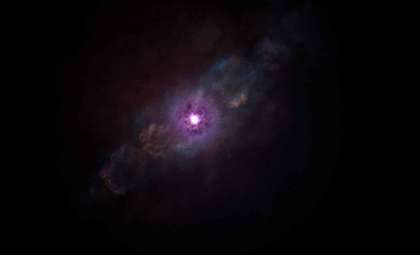
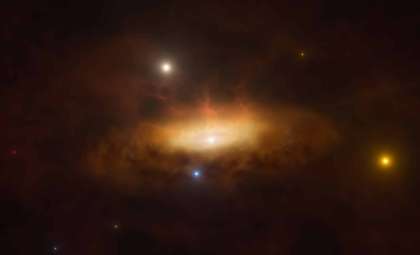
A groundbreaking discovery has emerged in the realm of tidal disruption events (TDEs) with astronomers documenting an extraordinary and swift increase in brightness from AT2018hyz, positioned 665 million light-years away. This new finding, detailed in a recent study available on the arXiv preprint repository, offers vital clues into the powerful emissions caused when a star is shredded by the immense gravity of a supermassive black hole. Utilizing a global network of telescopes such as MeerKAT and ALMA, researchers effectively monitored radio waves from AT2018hyz, uncovering a distinctive brightness increase that defies earlier theoretical models of TDEs.
Exploring Tidal Disruption Events
A Tidal Disruption Event happens when a star ventures too near a supermassive black hole’s tidal forces and is torn apart. The stellar material then forms an accretion disk around the black hole, producing intense high-energy emissions. These emissions serve as hallmark indicators of TDEs and have been closely examined in a variety of explosive cosmic incidents. AT2018hyz, found within a post-starburst galaxy named 2MASS J10065085+0141342, was first identified in 2018 by the All Sky Automated Survey for SuperNovae (ASAS-SN), representing an important milestone in appreciating the complex aftermath of such cataclysmic events.
Although TDEs are frequently detected, the radio signals originating from AT2018hyz stand out with unprecedented characteristics, prompting scientists to revisit existing theories about the physical mechanisms influencing these phenomena and gaining fresh insights about matter in extreme environments.

Explosive Radio Luminosity Growth
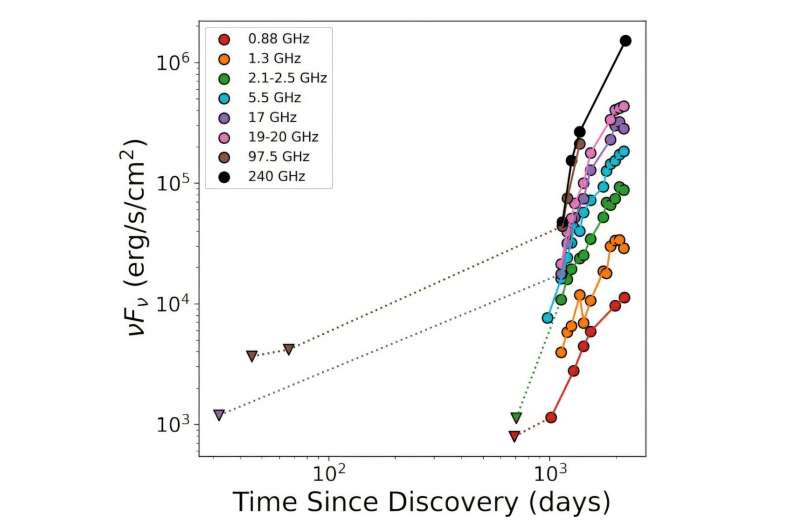
Over a two-year observation period, a phenomenal rapid escalation in the radio luminosity of AT2018hyz was recorded. The radio waves intensified dramatically across multiple frequency ranges, eclipsing the brightness of previously documented non-relativistic TDEs. The study reports this surge reached a peak power near 10 duodecillion erg/s, comparable to the intense relativistic TDE known as Sw 1644+57.
This remarkable feat establishes AT2018hyz as one of the brightest non-relativistic tidal disruption events observed to date. The researchers emphasize that this discovery overturns earlier expectations regarding TDE radio emissions. They propose two potential explanations: (i) a delayed spherical outflow initiated roughly 620 days after the star's destruction, traveling at about 0.3 times the speed of light with an energy near 1050 erg; or (ii) a narrowly angled relativistic jet viewed almost edge-on, possessing a Lorentz factor around 8 and energy close to 1052 erg.
Decoding the Source of Radio Brightness
The precise origin of the radio signals from AT2018hyz remains a topic of active investigation. The two leading hypotheses propose distinct causative processes behind the rapid luminous flare. The first involves a spherical outflow launched approximately 620 days post-disruption, moving at about 0.3c—or 30% the speed of light—with an energy near 1050 erg. This model suggests that the sudden luminosity spike stems from energy being distributed over a vast region due to delayed expulsion of debris from the destroyed star.
In contrast, the second possibility considers a relativistic jet oriented far off our direct line of sight, with a Lorentz factor of roughly 8 and an energy around 1052 erg. Such an ultra-fast jet moving at relativistic speeds could be responsible for the intense radio brightening observed in AT2018hyz.
- Categories:
- News






0 comments
Sign in to Comment