
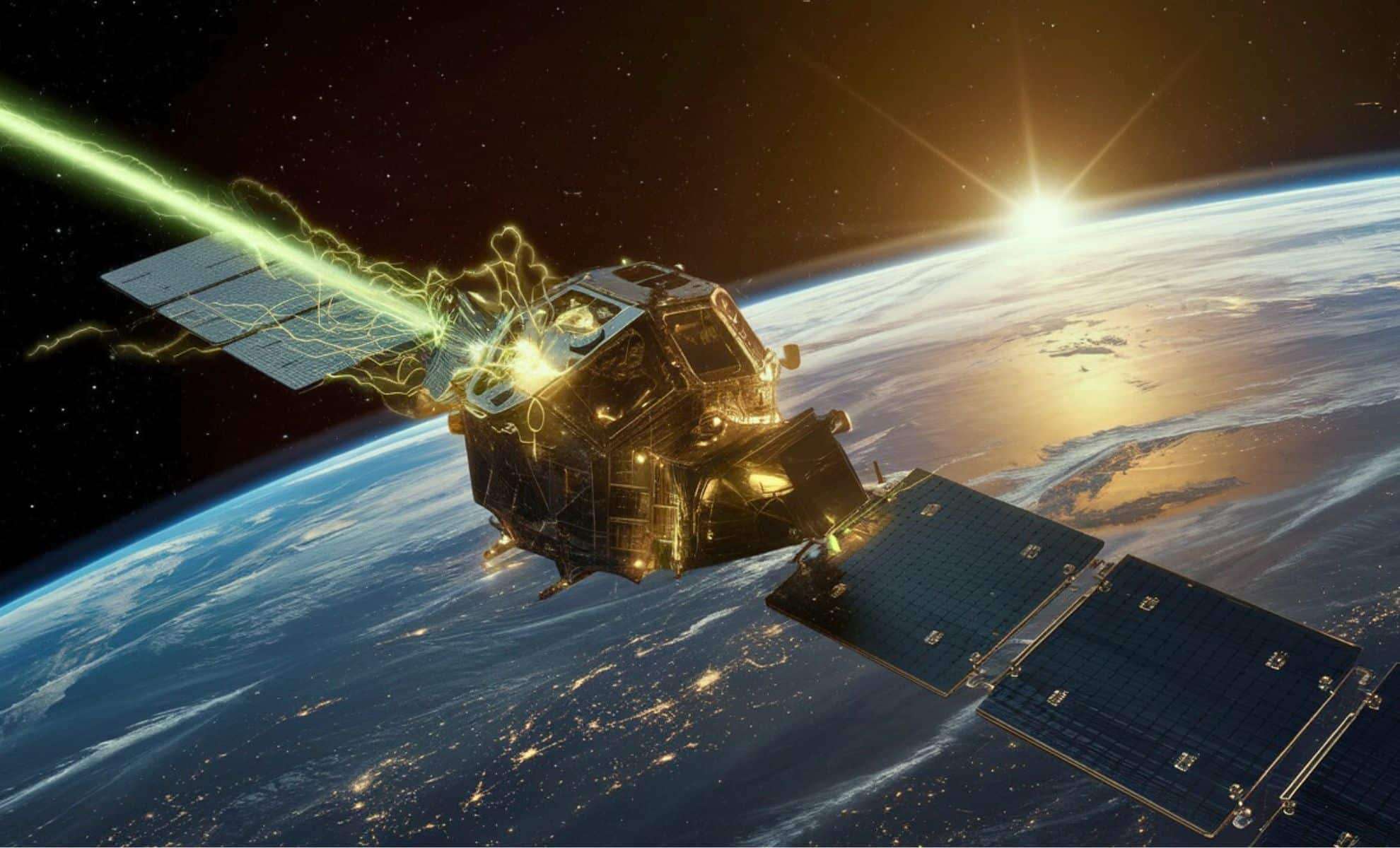
Scientists in China have recently showcased a revolutionary weapon system that could dramatically shift the dynamics of space conflict. Utilizing a synchronized network of high-powered microwave (HPM) emitters, they were able to generate a concentrated, powerful beam capable of rendering satellites inoperative without causing any physical debris. This stealthy and invisible technology introduces new complexities in space security and military strategy.
A Weapon Reminiscent of Science Fiction
In 2024, a series of experiments took place in China’s western region, featuring seven mobile transmitters each emitting high-frequency microwave energy. These signals were synchronized with fiber-optic technology to achieve a timing precision of 170 picoseconds, surpassing even the accuracy of atomic clocks used in GPS satellite systems.
The objective was to combine these beams into a single, intense super-beam powerful enough to disrupt or destroy satellites. Unlike conventional anti-satellite missiles that generate dangerous orbital debris, HPM attacks leave no physical evidence, making it hard to trace the source of the assault.

As noted by the South China Morning Post, this technology shares characteristics with the ion cannon from the Star Wars series—a device capable of disabling electronics without physical damage.
The Next-Level Tool for Space Control
This advanced weapon intends to disable satellites that are essential for communication, military reconnaissance, and navigation worldwide. Unlike typical radio jammers, which tend to have temporary effects, HPM weapons inflict permanent damage, effectively turning satellites into useless debris in orbit.
Key benefits of this system include:
- No debris creation – In contrast to the SC-19 anti-satellite missile that leaves hazardous fragments, the microwave beam simply neutralizes satellites.
- Low detectability – With no missile launch involved, the attack is covert, complicating accountability efforts.
- Extended range and power – According to The Defense Post, the collective energy from synchronized beams increases range and destructive capacity.
Its ability to disrupt GPS signals and surveillance platforms could redefine tactical strategies in contemporary warfare.
Triggering a New Competition in Space Armaments
China continues to challenge the U.S. dominance in outer space. While classic anti-satellite weapons like the SC-19 missile are conspicuous and politically controversial, HPM systems provide a subtler and potentially more strategic option.
There are indications that the People’s Liberation Army Aerospace Force has established specialized teams to operate these weapons, though deployment requires endorsement from the Central Military Commission, highlighting the weapons’ strategic importance.
The U.S., Russia, and other global space powers are likely monitoring these developments closely. Success in China’s recent trials could accelerate international efforts toward non-destructive, electronic warfare tools in space.
Overcoming Obstacles to Operational Use
Despite the exciting potential, several significant challenges must be addressed before HPM weapons become fully functional for space combat:
- Energy demands – Destroying satellites reliably with HPM technology may require power outputs in the gigawatt range, posing technical difficulties.
- Target precision – Although tests showed millimeter accuracy, real atmospheric and environmental factors might reduce effectiveness.
- Energy attenuation over distance – While efforts have been made to reduce energy loss, maintaining beam strength across vast ranges remains uncertain.
Though laboratory demonstrations of gigawatt microwave pulses exist, turning this into a practical battlefield capability remains complex.
The Dawn of Covert Space Combat
Energy weapons continue to face considerable hurdles. The enormous power requirements leave open the question of whether China’s current innovations are combat-ready or still experimental achievements.
Nonetheless, ongoing advancements suggest that high-powered microwave weaponry may soon transition into operational use. This could usher in a new age of invisible weaponry in space—where satellites vanish silently, potentially crippling military operations without a single rocket launch.
- Categories:
- Science













0 comments
Sign in to Comment