

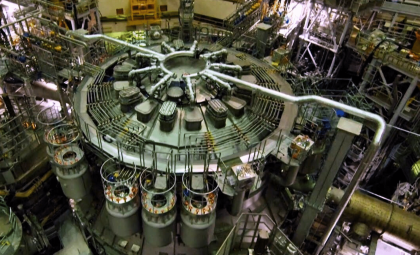
The Experimental Advanced Superconducting Tokamak (EAST) in China has successfully reached a novel fusion state known as the “density-free regime,” enabling the plasma to maintain stability at densities once deemed unfeasible. This groundbreaking advancement, detailed in Science Advances on January 1, overcomes a critical hurdle that has slowed progress toward viable fusion power.
Surpassing Conventional Fusion Density Limits
Typically, in tokamak fusion devices, pushing the plasma density past a certain threshold causes instabilities that disrupt plasma confinement. Such disturbances risk damage to reactor components and often force interruptions to experiments. This empirical density boundary has long been a limiting factor that prevented reactors from achieving ignition, the stage where fusion reactions sustain themselves.
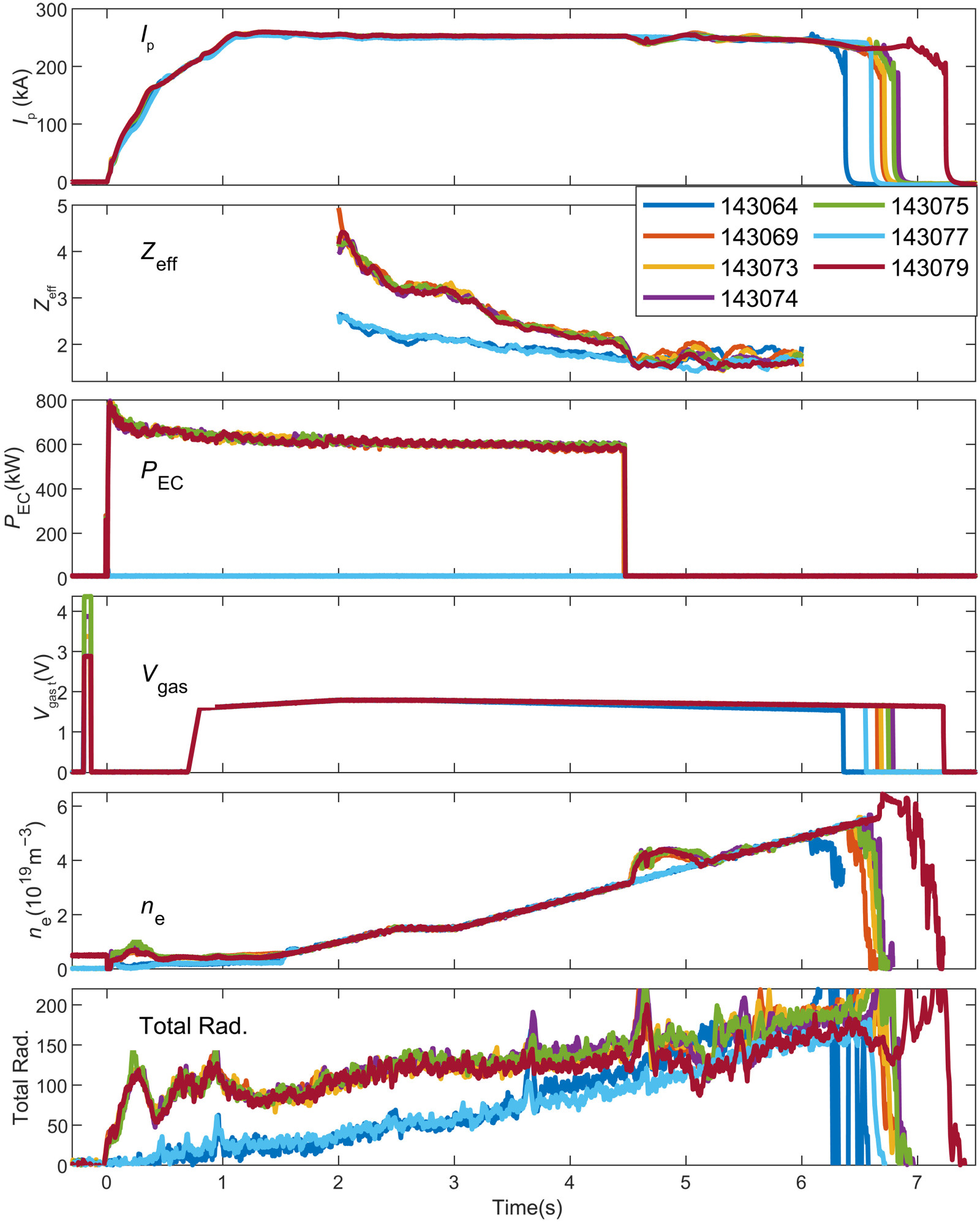
The EAST research team, led by Prof. Ping Zhu from Huazhong University of Science and Technology and Assoc. Prof. Ning Yan of the Hefei Institutes of Physical Science, devised a novel approach. By precisely tailoring the plasma’s starting conditions—manipulating the fueling gas pressure and heating configuration—they optimized how the plasma interacted with the reactor’s inner surface from the outset of each plasma pulse.

This strategy effectively controlled impurity accumulation and reduced energy losses, two major causes of plasma instability at elevated densities. As a result, EAST achieved steady operation beyond traditional density caps, entering what researchers describe as the “density-free regime.” Prof. Zhu noted, “These results pave the way for practical, scalable methods to enhance density limits in future tokamaks and burning plasma devices.”
Experimental Verification of Plasma-Wall Self Organization Theory
This breakthrough demonstrates the first empirical proof of the Plasma-Wall Self Organization (PWSO) theory, initially proposed by D.F. Escande and colleagues in France. The theory posited that under ideal conditions, interactions between plasma and reactor walls reach a self-regulating balance that mitigates destabilizing effects.
Contrary to earlier assumptions treating plasma and wall interactions as antagonistic, PWSO regards them as an integrated dynamic system, where wall erosion contributes to stabilizing the plasma. Until now, this concept lacked experimental evidence in fusion reactors. EAST’s success signifies a paradigm shift in reactor design, potentially reducing the need for complex active control mechanisms.
The comprehensive findings were published in the peer-reviewed journal Science Advances, marking a milestone in fusion research progress.
Implications for the Future of Fusion Energy
To realize fusion as a sustainable and large-scale energy source, reactors must endure extreme plasma conditions: immense temperatures, pressures, and densities. These factors are interlinked, and raising plasma density increases fusion reaction rates—and thus power output—if stability can be preserved.
By breaking through previously established density bounds, EAST’s achievement transforms expectations. It suggests that next-generation tokamaks, including projects like ITER and commercial ventures, might operate at enhanced performance levels without the severe disruptions that plagued earlier designs.
Assoc. Prof. Yan highlighted that this success is just the beginning, with plans to apply the technique to high-confinement plasma states that could unlock even greater reactor performance. This advancement heralds a new era in fusion research focused on integrating plasma-wall interactions into reactor engineering.
China’s EAST Sets New Fusion Benchmarks Worldwide
The significance of this development extends far beyond EAST’s laboratory walls. Nicknamed China’s “artificial sun,” EAST consistently pushes the envelope in tokamak experimentation. This recent accomplishment firmly positions China as a global leader, not only in fusion performance demonstrations but also in challenging established scientific limits.
While the global fusion race engages powerhouse programs across Europe, the United States, and Japan, China’s ongoing innovations signal a formidable competitor for future energy solutions. EAST’s approach shows that overcoming fusion’s toughest challenges may come more from refined plasma-material control than brute-force scaling.
Shifting theoretical proposals into proven experiments, EAST’s progress marks a pivotal moment in the pursuit of fusion energy, offering fresh inspiration and pathways for innovation across the fusion research community.
- Categories:
- News





0 comments
Sign in to Comment