
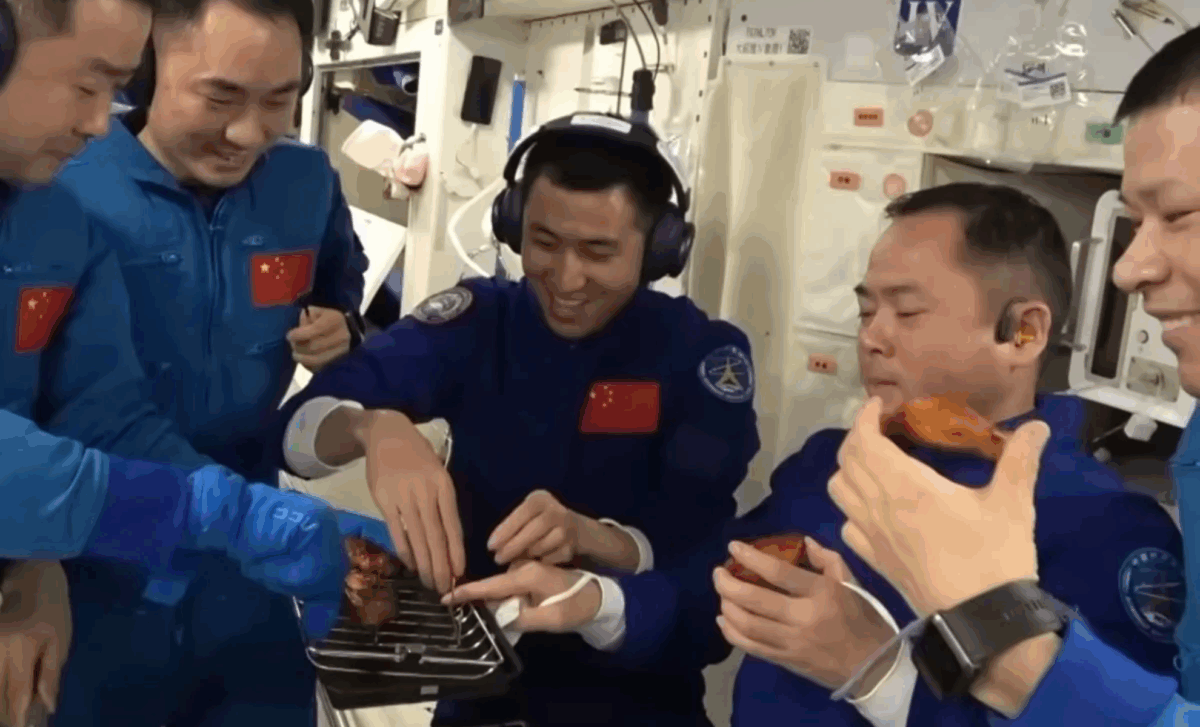
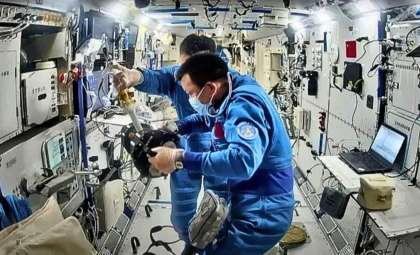
For the first time in history, six Chinese astronauts gathered aboard the Tiangong space station to enjoy a barbecue, marking a significant advancement in space living conditions. This event occurred during the transition from the Shenzhou-20 to the Shenzhou-21 mission and featured specialties like marinated chicken wings and pepper-seasoned steaks. Despite a subsequent delay in crew handover caused by space debris threats, this culinary endeavor represents a new cultural milestone for astronauts in orbit.
Breaking New Ground with Cooking in Weightlessness
The CCTV coverage revealed that this novel space barbecue was achieved through innovative cooking gear. The Shenzhou-21 team arrived with a compact hot-air oven specifically designed to operate safely in zero gravity. This appliance enabled astronauts to prepare grilled meals resembling those made on Earth, complete with golden-browned, crispy finishes.
“By raising the temperature to 190 degrees Celsius, astronauts can now really cook in orbit. Previous food heating is purely physical warming, but this is actual cooking, with chemical reactions included. The food can now come out golden and crispy,” Liu Weibo, deputy chief designer of astronaut systems at the China Astronaut Research and Training Center, explained in a statement to CCTV.
Add Cosmo Herald as a Preferred Source

This breakthrough goes beyond novelty, significantly improving life quality on extended space missions. The ability to cook meals fresh rather than simply heating pre-prepared packages boosts morale and enhances nutrition. It signals a strategic emphasis by China on long-term sustainability and comfort in space exploration, especially for missions that may extend for months.
Engineering a Smoke-Free Oven for Orbit
Creating an oven that functions effectively in microgravity posed unique challenges. Scientists at the China Astronaut Research and Training Center dedicated years to inventing a convection-like cooking mechanism that avoids producing smoke or airborne particles—critical for safety in the closed environment of Tiangong.
“We used high-temperature catalysis and multi-layer filtration technologies to enable smoke-free baking,” said Xian Yong, a researcher at the center.
The oven’s design prioritizes both safety and performance. Elements such as air circulation, even heat distribution, and waste control were rigorously tested through simulations. According to Xian, managing smoke and maintaining consistent cabin pressure were vital to protect both the crew and the quality of their meals.
“Given the special conditions in orbit, we have made sure that the hot air oven is completely reliable and safe. Every part of the oven astronauts may touch remains cool so as to prevent burns,” he added.
This advancement is indicative of China’s broader philosophy in space technology development—integrating comfort, safety, and exacting engineering to enhance life beyond Earth.
Cooking as a Cultural and Psychological Bond
Food has always played a crucial role in astronauts’ psychological wellbeing. From NASA’s pioneering freeze-dried meals to ESA’s culinary experiments, space cuisine has evolved to support emotional health as much as physical sustenance. China's latest step incorporates authentic cooking as a communal cultural experience in orbit.
“They can bake cakes, roast peanuts, or grill meat, and it’s really delicious. This means astronauts can enjoy special meals on weekends, birthdays, or holidays. It greatly helps to enrich their dining experience and improves overall living conditions in orbit,” Liu Weibo noted.
This human-centered approach—celebrating food beyond survival—holds deep significance for extended journeys to destinations such as the Moon or Mars, where mental resilience and comfort will be as essential as technical resources.
- Categories:
- Space





0 comments
Sign in to Comment