
A recent investigation featured in The Open Journal of Astrophysics presents a groundbreaking cosmic map revealing the elusive structures of the universe. By examining delicate distortions in millions of distant galaxies, researchers have uncovered fresh perspectives on dark matter and dark energy—two fundamental yet mysterious components that dominate the cosmos. This study not only questions current cosmological theories but also deepens our grasp of how unseen forces sculpt the universe we observe.
Exploring the Cosmos’ Hidden Landscape: Tracing Dark Energy and Matter
Approximately 95% of the universe consists of dark matter and dark energy, invisible elements that continue to puzzle scientists. Utilizing the Dark Energy Camera (DECam) and data from the Dark Energy Survey (DES), researchers have advanced our understanding of these enigmatic phenomena. Through the faint shifts detected in galactic shapes, a team from the University of Chicago achieved a significant stride toward decoding the universe's vast framework. Their findings, published in The Open Journal of Astrophysics, offer a fresh viewpoint on how dark forces interact with visible matter within cosmic structures.
Harnessing Gravitational Lensing to Reveal the Unseen
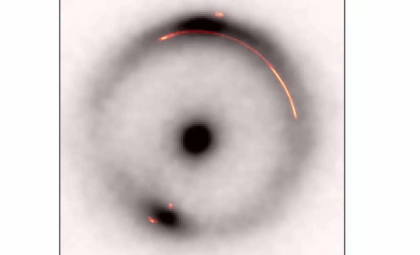
Gravitational lensing serves as a critical tool for astronomers to infer the presence of hidden mass throughout the cosmos. This phenomenon occurs when light from remote galaxies bends as it passes through the gravitational influence of massive structures in space. By studying these subtle bends, scientists can chart the distribution of both observable and invisible matter over huge cosmic distances. The current research leveraged weak gravitational lensing to map the large-scale arrangement of matter with remarkable precision.

Dhayaa Anbajagane, a doctoral candidate at the University of Chicago and the team’s lead analyst, described the research:
“Weak lensing measurements are best at probing the ‘clumpiness’ of matter. Quantifying this clumpiness sheds light on the origin and evolution of structures like galaxies and galaxy clusters.”
This technique enables scientists to delineate dark matter’s density and its critical role in shaping galaxy formation and other cosmic features.
It is comparable to understanding the dynamics within a city by observing population patterns: densely settled neighborhoods reveal much about how the city evolved. Similarly, the clumping of matter exposes the underlying history of cosmic growth.
An Extensive Dataset Unveils the Universe in Unprecedented Detail
Between 2013 and 2019, the Dark Energy Survey conducted an extensive sky survey, cataloging over 150 million galaxies within a 5,000 square-degree patch—about one-eighth of the entire sky. Additional data captured beyond the original scope nearly doubled the number of galaxies analyzed. By merging the newer findings with the original DES data, scientists created a richer, more complete model of cosmic structure.
“We combined DECADE lensing data with DES to produce the largest galaxy lensing dataset to date, featuring 270 million galaxies across 13,000 square degrees,” explained Anbajagane. This vast resource provides unparalleled insights, enabling precise testing of cosmological models, including comparisons to Cosmic Microwave Background (CMB) measurements.

Dark Matter and Dark Energy: Fundamental Cosmic Architects
Though invisible, dark matter and dark energy are essential to the universe's evolution. Dark matter’s gravitational pull influences galaxy formation and clustering, while dark energy appears to drive the accelerating expansion of space. Together, these components constitute the majority of the universe’s total mass-energy, yet their true nature continues to elude scientists.
This research is a vital step toward grasping these cosmic ingredients. By tracing how both visible and non-luminous matter are spread across space, the study offers valuable clues about the universe’s expansion and large-scale behavior. The lensing maps could refine existing theories or inspire new frameworks to describe these enigmatic forces more accurately.
Innovative Use of Archival Data Enhances Cosmic Insights
A notable aspect of this work is its unique reliance on archival data. Typically, weak lensing studies demand years of specific observations, often discarding images that do not meet strict quality criteria. Contrarily, the DECADE project harnessed a wide range of images initially taken for varied astronomical objectives, repurposing them for lensing analysis.
“One unique result from this work has to do with choices we make on image quality,” said Anbajagane. “The DECADE project is unique as it repurposes archival data—images originally taken by the astronomy community for a wide variety of science goals—and uses significantly more permissive criteria for image quality. Our work shows robust lensing analyses can be done even if we do not have lensing-dedicated imaging campaigns.”
This creative methodology expands the potential for future surveys by demonstrating the scientific value of previously unused data, enhancing resource efficiency and opening new research avenues.
- Categories:
- News




0 comments
Sign in to Comment