
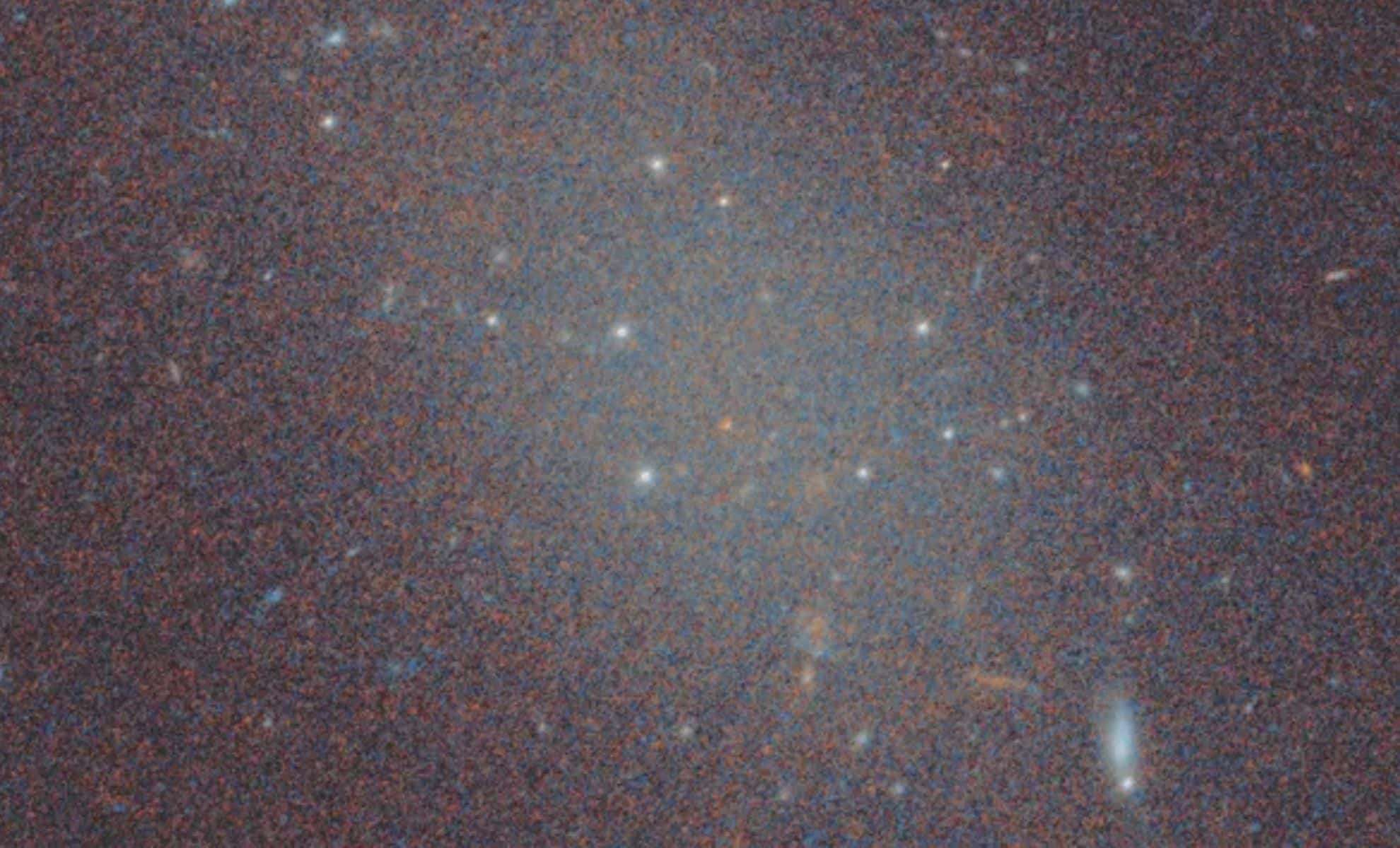
Astronomers have uncovered an ultra-diffuse galaxy that defies the widely accepted notion that dark matter is crucial in galaxy formation. This galaxy, named FCC 224, resides on the outskirts of the Fornax Cluster, approximately 65 million light-years from Earth, and intriguingly shows no signs of dark matter—a key component thought to stabilize galaxies. Even more fascinating is the possibility that FCC 224 is not a lone exception but part of an emerging group of “ghost galaxies” missing the invisible framework believed to support cosmic structures.
According to Space.com and a peer-reviewed article published in The Astrophysical Journal, two research teams independently analyzed data from the Hubble Space Telescope and Keck Observatory to investigate the galaxy’s internal dynamics and morphology. Their findings position FCC 224 among a scarce but perplexing classification that challenges existing theories of galactic development.
Dense Star Clusters Despite Missing Dark Matter
FCC 224 is categorized as an ultra-diffuse galaxy, roughly comparable in scale to our Milky Way but far less populated with stars. These galaxies tend to be faint and extensively spread out, complicating their detection. What makes FCC 224 unusual is its abundance of tightly packed star clusters, a trait typically tied to galaxies rich in dark matter.

Maria Buzzo, a PhD candidate from Swinburne University of Technology, observed that the star clusters within FCC 224 exhibited unexpectedly slow velocity dispersion, indicating the absence of the gravitational influence dark matter usually provides. “Current galaxy formation theories within the accepted cosmological model fail to explain how such a galaxy can exist,” Buzzo stated, highlighting the significant enigma presented by FCC 224.
Formed Through Violent Galaxy Mergers?
Another study led by Yimeng Tang at UC Santa Cruz hypothesizes that FCC 224 may have originated from a catastrophic collision involving gas-rich galaxies. In these events, gas can decouple from dark matter, enabling star formation from expelled gaseous matter that lacks dark matter, giving rise to galaxies with minimal dark matter content.
Tang’s group draws comparisons with previously discovered dark matter-deficient galaxies like NGC 1052-DF2 and DF4, suspected to share a similar genesis. They suggest FCC 224 has a closely resembling counterpart named FCC 240, matching in size and orientation, which if confirmed would support the collision-based formation theory.
Questioning Established Cosmological Models
The presence of galaxies like FCC 224 poses significant challenges to the ΛCDM cosmological framework, which currently underpins our understanding by asserting that dark matter is essential for galaxy formation. Some scientists propose that extreme starburst activity or unique feedback effects might expel dark matter during early galaxy life, though these ideas remain speculative.
These new discoveries add vital insight while intensifying the mystery. “FCC 224 provides an important observational anchor in the search for more dark-matter-starved galaxies,” remarked Buzzo. Expanding this sample is crucial for advancing knowledge about galaxy formation processes, stellar dynamics, and ultimately, the enigmatic nature of dark matter.
- Categories:
- News






0 comments
Sign in to Comment