

A recent study featured in ChemSystemsChem introduces a novel perspective on life's beginnings, suggesting that life might have originated not from biomolecules or biopolymers, but from adhesive surface gels. These viscous, semi-solid substances may have been crucial in early biological complexity, shedding new light on Earth's early conditions and the quest for alien life.
Introducing the Gel-First Hypothesis: Rethinking Life’s Origins
The mystery of how life emerged has challenged scientists for centuries, leading to numerous hypotheses about how simple molecules transitioned into self-sustaining, complex systems. Traditional views typically highlight the importance of biomolecules like proteins and nucleic acids as foundational. However, an international research team, in a study published in ChemSystemsChem, puts forward a fresh concept prioritizing surface-bound gels as the cradle of life’s origins.
Known as the “prebiotic gel-first” hypothesis, this theory proposes that life’s earliest chemical networks developed within sticky gels attached to surfaces. These gels resemble modern biofilms formed by microbes and may have provided the ideal setting for complex chemical interactions long before cells appeared.

Professor Tony Z. Jia, co-leader from Hiroshima University, points out that this approach shifts focus from traditional biomolecules to the significant but underappreciated role of gels.
“While many theories focus on the function of biomolecules and biopolymers, our theory instead incorporates the role of gels at the origins of life,” he said.
This new viewpoint is transforming our understanding of prebiotic chemistry by proposing that gels might have been essential for driving molecular reactions critical to life’s emergence.
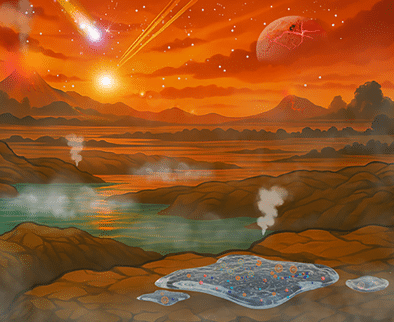
Gels as a Vital Interface Between Chemistry and Life
In this framework, surface-bound gels are thought to serve more than a structural role; they may have acted as selective filters, concentrating specific molecules while excluding others. This sorting could have enabled early chemical systems to support emerging proto-metabolic functions and primitive replication, processes foundational to biological evolution and more sophisticated biochemical pathways.
Kuhan Chandru, co-lead author, acknowledges the gel-first hypothesis is one among numerous ideas investigating life’s beginnings.
“This is just one theory among many in the vast landscape of origin-of-life research,” he said.
Nonetheless, this approach stands out by emphasizing gels, a factor frequently neglected in previous hypotheses. By addressing this gap, the research aims to enrich our understanding of early chemical evolution.
This concept also resonates with broader questions about the prerequisites for life. If gels could have facilitated the rise of self-replicating chemical networks, analogous gel-like systems with different chemistries — termed “Xeno-films” — might exist on other celestial bodies, opening new pathways in the search for extraterrestrial life.
Broader Impact on Evolutionary Biology and Astrobiology
The findings of this research extend beyond Earth, urging scientists to explore the possibility that gel-like structures could underpin life elsewhere. As missions to detect life beyond Earth multiply, identifying surface-bound gels might become a pivotal strategy, providing an alternative to searching for specific molecular signs.
The idea of “Xeno-films,” with potentially unique chemical compositions tailored to alien environments, is especially intriguing. Expanding life-detection frameworks to include such formations could greatly enhance the likelihood of discovering life in the cosmos.
Future Directions in Studying Prebiotic Gels
Despite the promising nature of the prebiotic gel-first theory, the investigators emphasize that further experimentation is needed. Upcoming research will focus on replicating early Earth conditions to test gel formation and properties, aiming to clarify their potential role in life's emergence.
“We also hope that our work inspires others in the field to further explore this and other underexplored origins-of-life theories,” said Ramona Khanum, co-first author of the study.
The team aspires for their findings to revive interest in this lesser-known research avenue, potentially unlocking new breakthroughs about life’s dawn on Earth and its prospects elsewhere in the universe.
- Categories:
- Science







0 comments
Sign in to Comment