
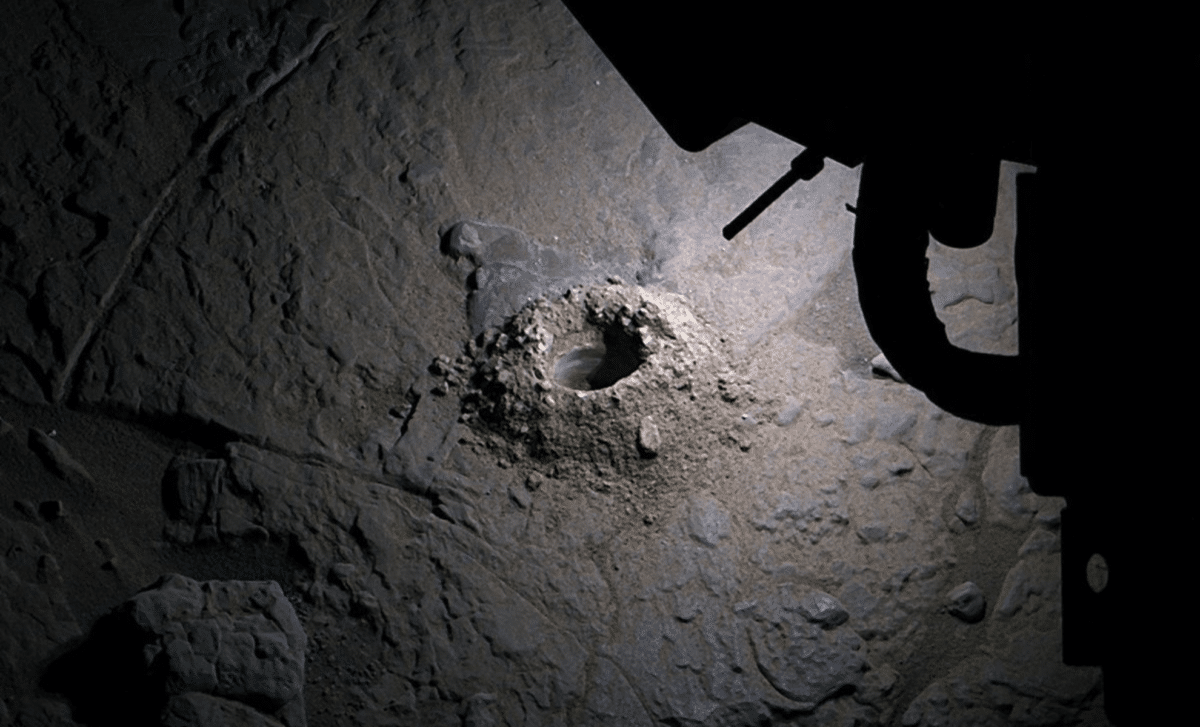
NASA’s Curiosity rover has provided an extraordinary night view of the Martian terrain by lighting up a drill site named Nevado Sajama. This innovative image, shared by NASA Science, was produced using the rover’s onboard LED lighting system, offering a novel method to examine Mars after dark.
Groundbreaking Nighttime Study on the Martian Surface
Throughout most of its expedition, Curiosity has conducted analyses relying on sunlight to explore the rocks, soil, and geological formations within Gale Crater. Despite this, nighttime observations have been rare due to the limited scientific advantage without natural illumination. This latest endeavor challenged that norm by turning on LED lights on the rover’s robotic arm, generating artificial lighting strong enough to highlight subtle surface features usually hidden at night.
The image was captured on December 6, 2025, marking Sol 4,740 of Curiosity’s mission. Using its Mast Camera (Mastcam) alongside illumination from the Mars Hand Lens Imager (MAHLI) LEDs, the rover showcased the freshly drilled rock with remarkable detail. This setup enabled researchers to study the interaction between light and newly exposed rock surfaces, revealing textures and contrasts unattainable through daylight imaging alone.

Significance of the Nevado Sajama Drilled Sample
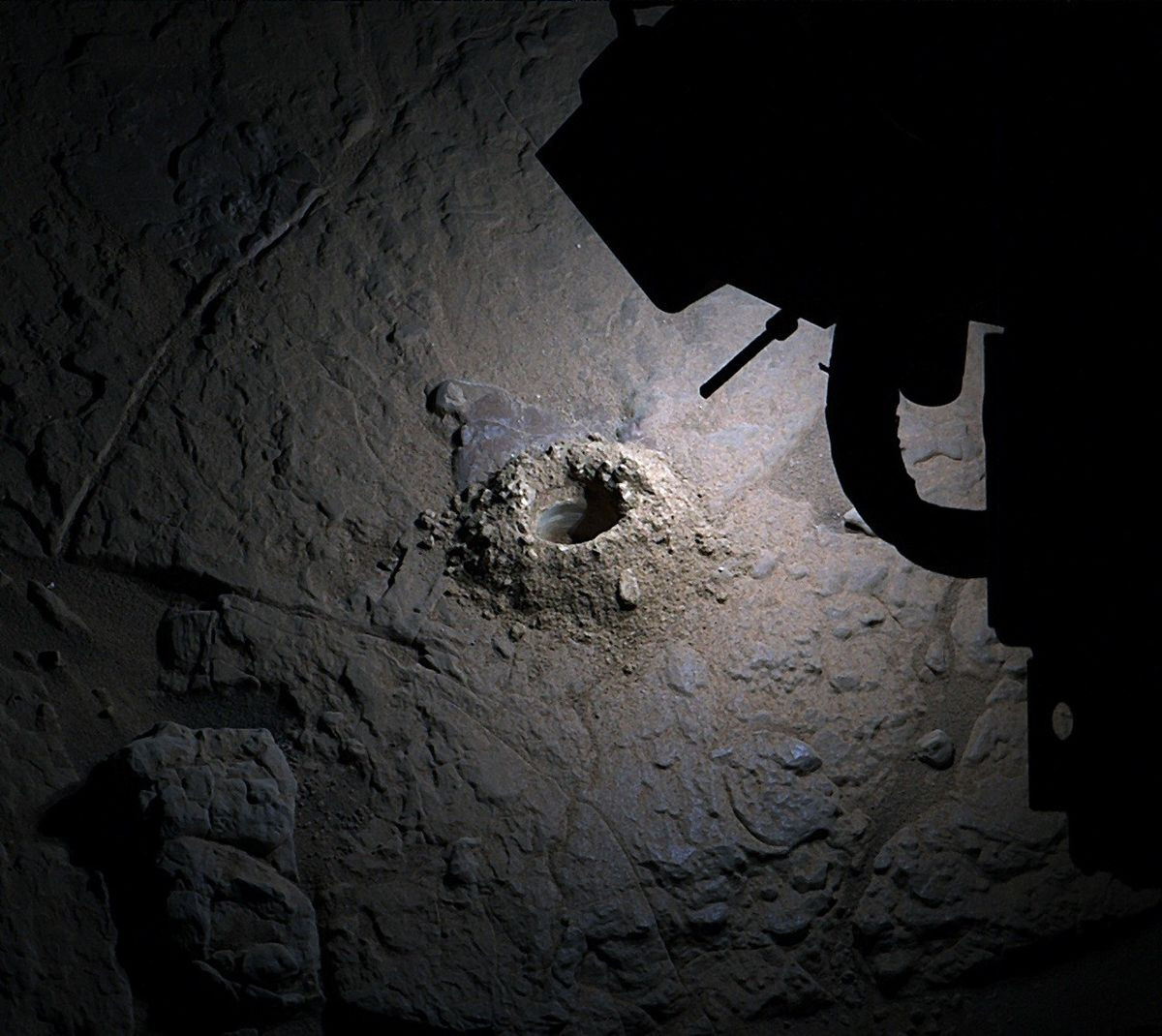
The site dubbed Nevado Sajama was targeted by the rover’s drill on November 13, 2025, situated in a region noted for distinctive geological features called boxwork. These formations, visible from orbit as sprawling, web-like patterns, are thought to have formed from mineral-rich fluids flowing through fractures in primordial rock.
Post-drilling, scientists observed that the interior walls of the hole were unusually smooth—a vital clue. Earlier in the mission, LED-illuminated nighttime imaging helped detect layering within the drill holes, shedding light on the formation processes of Martian rocks. However, recent drilling methods often left holes too coarse or dusty for such observations. Nevado Sajama offered a valuable chance to revive this technique and determine if subsurface layering could still be effectively studied using controlled lighting.
Curiosity’s Use of Artificial Lighting on Mars
The LEDs employed in this experiment are not designed as broad floodlights but as precise lighting instruments integrated into MAHLI to illuminate close-range targets. Normally used during the day to peer into shaded areas or instrument inlets shrouded from sunlight, their nighttime use adds a new capability.
Operating without interference from solar glare or shifting shadows, the rover generates stable lighting conditions that allow scientists to examine grain size, texture, and subtle color shifts within the rock. This controlled illumination also reduces visual interference from dust reflecting sunlight, making it easier to identify authentic geological details.
NASA’s Vision Behind Nighttime Illumination on Mars
As detailed by NASA Science, conducting this night experiment was a deliberate geological investigation rather than routine procedure. The Jet Propulsion Laboratory, overseen by Caltech, continuously evolves Curiosity’s instrument use, seeking innovative techniques to maximize scientific output despite the rover’s advancing age.
This approach epitomizes NASA’s adaptable strategy across its Mars missions: embracing flexibility. Even after ten years on the Red Planet, Curiosity still delivers groundbreaking discoveries by repurposing existing tools. Each success enriches the knowledge base and tactics for future rovers equipped with comparable imaging technology.
- Categories:
- News







0 comments
Sign in to Comment