
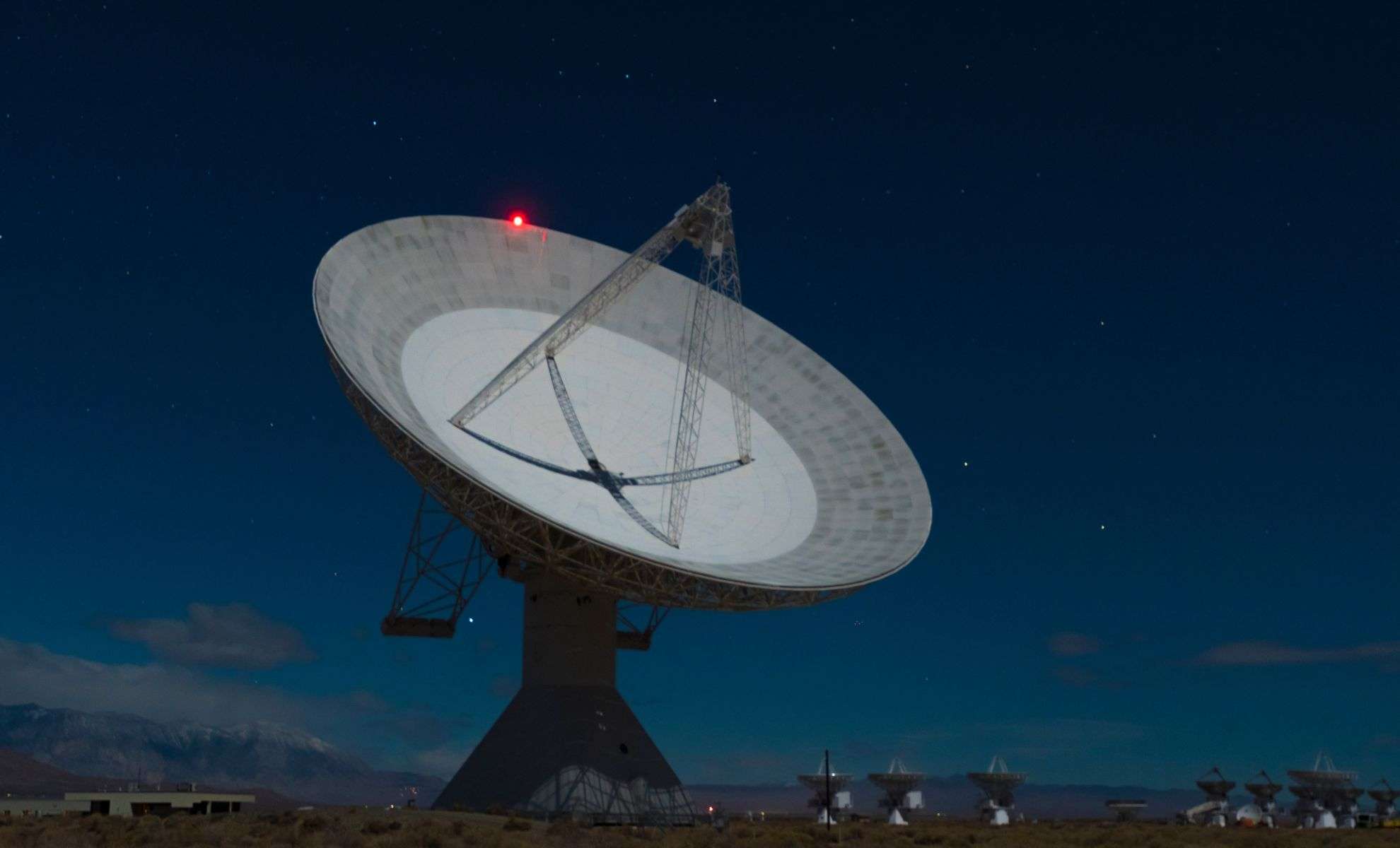
Located in the remote Western Australian outback, a radio telescope has enabled astronomers to peer back nearly 13 billion years, unveiling surprising insights that challenge conventional ideas. Contrary to earlier beliefs that the universe remained extremely cold before the first stars lit up, evidence now suggests it began warming earlier than assumed.
This revelation derives from a decade of observations made by the Murchison Widefield Array (MWA), a cutting-edge low-frequency radio telescope crafted to pick up faint emissions from neutral hydrogen — one of the few relics from the universe’s infancy. Scientists targeted the closing stage of the so-called “cosmic dark ages,” a window after the Big Bang but before galaxies fully took shape.
The results contradict the predominant cold start scenario concerning the epoch of reionization—a time when the universe’s intergalactic gas was drastically transformed. Previously, it was believed that this gas remained frigid until the ultraviolet light from newborn stars began ionizing it. However, fresh data indicates that warming processes may have been active earlier.

Signs of Early Cosmic Heating
Led by Cathryn Trott from Curtin University, researchers searched for a specific radio emission. The expectation was that if the early universe were truly extremely cold, neutral hydrogen would produce a distinctive signature at certain frequencies. Yet, data from the MWA revealed no such signal.
“Our measurements show that it is at least heated by a certain amount,” said Trott, quoted by Popular Mechanics. “Not by a lot, but it tells us that very cold reionization is ruled out.”
The lack of this predicted signal hints at the role of x-ray radiation that could have gradually warmed the space between galaxies well before visible light appeared. The timing of this warming phase is believed to be approximately 800 million years following the Big Bang.
A Decade of Filtering Cosmic Signals
The Murchison Widefield Array operates across frequencies from 70 to 300 MHz, making it ideal for capturing the subtle hydrogen emissions from the reionization epoch. However, teasing out these faint signals is challenging as they are often overshadowed by stronger radio waves from Earth’s atmosphere, neighboring galaxies, and other cosmic noise.
The research team used sophisticated filtering and subtraction methods on a decade-long dataset to isolate genuine signals. According to the The Astrophysical Journal publication, the key discovery was not finding the anticipated signal itself but rather confirming its absence, dismantling the cold-start hypothesis.
Ridhima Nunhokee, a co-author from Curtin University, explained that the sought-after signal likely remains concealed underneath layers of interference.
“The signal is definitely buried in there,” she said. “It’s just improving on our data, and getting more data, cleaner data, to reach it.”
Unveiling the Universe’s Cosmic Dark Ages
The era preceding the formation of the first stars stretched nearly a billion years during which neutral hydrogen dominated and visible light was absent—a phase dubbed the cosmic dark ages. Roughly one billion years post-Big Bang, the epoch of reionization began as early stars ignited, emitting ultraviolet radiation that transformed the intergalactic medium.
Until now, it was assumed the universe’s temperature remained low throughout this dark span, heating only after star formation commenced. New evidence, however, points to earlier warming, implying a more dynamic early universe influenced by phenomena such as early black hole activity.
With forthcoming enhancements to the MWA and the arrival of next-generation telescopes, astronomers aim to shed clearer light on these distant, formative cosmic moments.
- Categories:
- News



0 comments
Sign in to Comment