

A fossil dating back 113 million years has been unearthed in Brazil, revealing the oldest ant specimen ever recorded.
This fossil is identified as Vulcanidris cratensis, belonging to the extinct hell ant subfamily, Haidomyrmecinae.
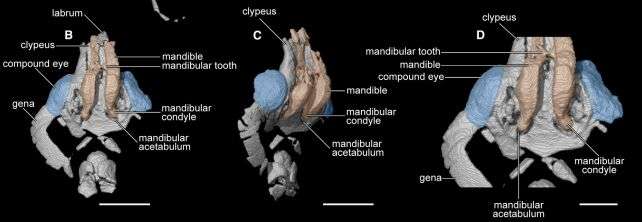
These prehistoric ants featured distinctive scythe-shaped mandibles, adapted for spearing and restraining their prey with remarkable precision.

Significant Discovery in South American Fossil Beds
The specimen was excavated from the Crato Formation Lagerstätte, a region renowned for exceptionally preserved fossils.
What sets this finding apart is that it represents the first hell ant discovered as a rock impression and is the inaugural record of such ants on the South American continent.
Previously, hell ants were mainly known through amber fossils dating between 80 and 100 million years old, found in Europe, Asia, and North America.
The fact that Vulcanidris cratensis originated from rock rather than amber expands our understanding of their age and geographic range.
This points to a broader distribution and an earlier existence of hell ants than formerly documented.
Insights Into Ancient Ant Anatomy and Behavior
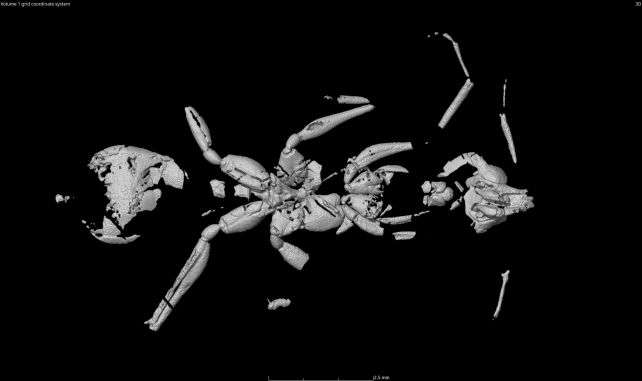
Researchers employed micro-CT scanning to study the fossil’s structure despite its two-dimensional preservation.
These scans revealed anatomical similarities between this species and a hell ant from 99-million-year-old Myanmar amber.
Entomologist Anderson Lepeco from the University of São Paulo’s Museum of Zoology expressed surprise at the complexity of this early ant: “Discovering such a highly specialized ant from 113 million years ago challenges existing ideas about the pace of evolutionary adaptation in these insects.”
The impressive jaws of Vulcanidris cratensis, which moved vertically rather than laterally as in modern ants, likely gave it a unique predatory advantage.
These characteristics highlight the distinctiveness and specialization of hell ants compared to contemporary ant species.
Rewriting the Story of Ant Evolution
Ants are thought to have originated between the late Jurassic and early Cretaceous periods, with hell ants possibly representing one of the earliest branches to emerge.
The scientists emphasized that this fossil represents the earliest confirmed ant specimen discovered and offers unparalleled evidence for the initial phases of ant evolution.
By analyzing Vulcanidris cratensis, researchers have extended the timeline for ant origins and established a crucial reference for studying their ancient evolutionary trajectory.
The exceptional quality of the fossil sheds light on an early ant lineage that thrived alongside the rise of flowering plants during the Cretaceous before its eventual disappearance due to environmental transformations at the period’s close.
- Categories:
- Science








0 comments
Sign in to Comment