
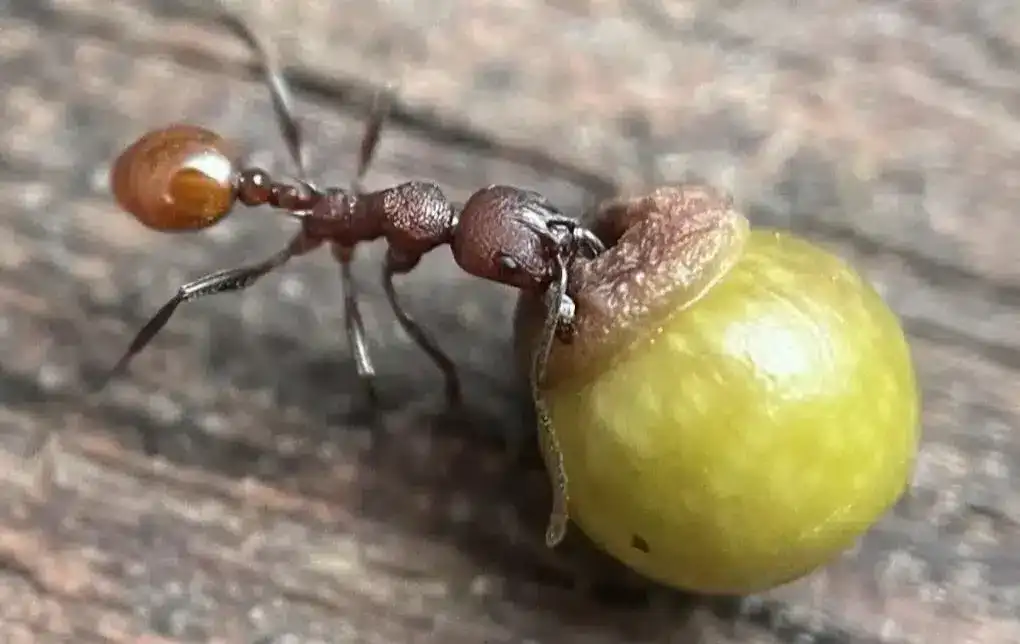
Young naturalist Hugo Dean, just eight years old, made a fascinating observation close to his home that has transformed our understanding of insect and plant relationships. At first, he noticed ants appearing to gather seeds, but his astute attention revealed a far more complex interaction. Andrew Deans, Hugo’s father and an entomology professor at Penn State, confirmed that the ants were actually collecting oak galls — unusual plant structures formed due to wasp activity.
This finding challenges a century of assumptions in ant-plant ecology. For over 100 years, research into myrmecochory has focused on ants transporting seeds equipped with elaiosomes — distinctive nutrient-rich appendages. But discovering ants collecting oak galls introduces a previously unknown dimension to how ants and plants interact.
The discovery holds significant ecological importance. Oaks are increasingly threatened by environmental changes, and the delicate interplay involving ants, wasps, and oak galls may be vulnerable. This highlights the intricate links within ecosystems and stresses the need to protect biodiversity.

Decoding the Evolutionary Tactics Hidden in Oak Galls
Oak galls produced by wasps like Kokkocynips decidua and Kokkocynips rileyi feature a specialized structure called a “kapéllo,” derived from the Greek for “cap.” These kapéllos closely resemble elaiosomes in composition, being rich in fatty acids that entice ants.
Once the galls drop to the ground, ants transport them into their nests, where they consume the kapéllos but leave the main gall intact. This behavior provides shelter for the developing wasp larvae inside. The relationship resembles typical myrmecochory, but here the wasps have cleverly manipulated the oak trees to produce kapéllos, effectively harnessing ant foraging behavior for their offspring’s protection.
The research points to an extraordinary example of evolutionary convergence, where different species independently evolve similar mechanisms to exploit ant behavior. The discovery prompts intriguing questions:
- Did gall-inducing wasps first evolve their manipulation of oak trees before engaging ants?
- Or did ant behavior influence the emergence of kapéllos?
- How ancient is the evolution of these complex interactions?
Fossil records indicate that gall wasps have been influencing oak growth for millions of years, predating their recognized role with ants. As Andrew Deans remarked, “It’s probable that wasps refined their gall-inducing abilities before evolving strategies to involve ants,” underlining evolutionary dynamism.
Curiosity and Chance Fuel Scientific Discovery
The importance of chance in science is clear in this case. What started as a child’s curiosity ignited a major advance in ecological knowledge. This underscores fostering inquisitiveness at every age.
Hugo reflected, “At first, I thought they were seeds. I was amazed to learn they were galls and even more surprised that ants collected them.” Though he may not plan to pursue science professionally, his observation has made a lasting impact.
This discovery adds to groundbreaking biological research, such as the creation of a living mouse from ancient genes, highlighting how fast our understanding of genetics and evolution is expanding.
Expanding Frontiers for Ecological Research
The newfound complexity between ants, wasps, and oak trees opens exciting research pathways. Scientists look to identify other similar intricate relationships. As Andrew Deans noted, “Despite over a century of study, discoveries like this reveal how much remains unknown about plant-insect interactions.”
These insights emphasize the complexity of ecological webs and call for ongoing investigation to expose hidden interdependencies critical for biodiversity. Through field observation and lab tests, researchers confirmed ants prefer galls with intact kapéllos, summarizing their findings in a table:
This mimicry highlights the sophistication of evolutionary adaptations that blur the distinctions between plant and insect strategies. The implications of this research go beyond ant-plant dynamics and could reshape our comprehension of various ecological relationships.
As scientists delve deeper into nature’s secrets, more surprising connections emerge. For example, efforts to revive extinct carnivores promise new perspectives on historical ecosystems and evolution.
Moreover, discoveries such as the spread of invasive bee species in Europe spotlight the urgent need for ongoing surveillance and research amidst rapid ecological shifts.
Exploring these natural complexities reveals just how much remains to be learned. Hugo’s remarkable discovery stands as a testament to the power of observation and curiosity to inspire scientific progress.
- Categories:
- Science








0 comments
Sign in to Comment