
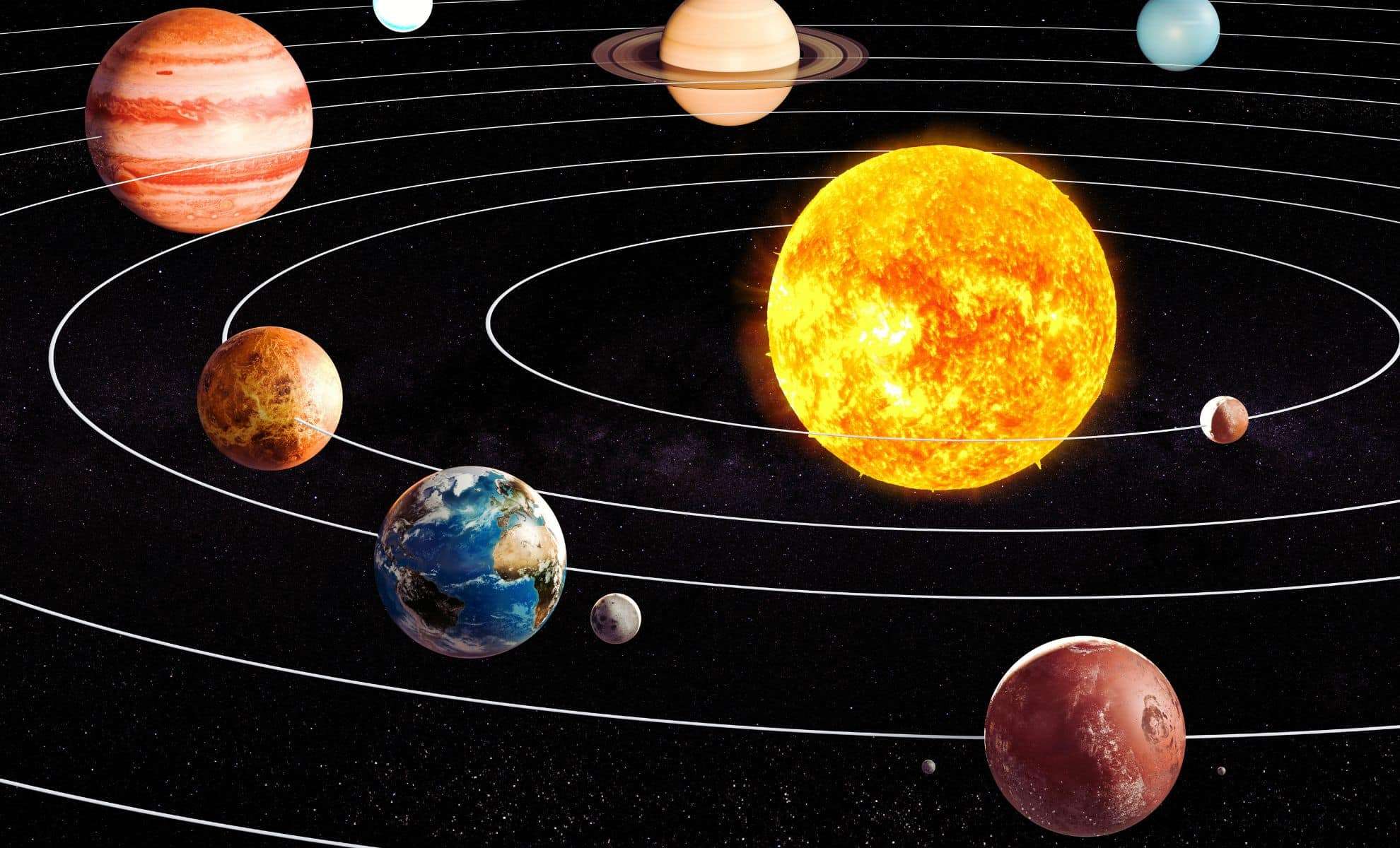
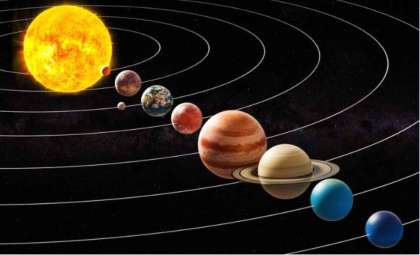
New computational models and research have shed light on the formative years of the solar system’s rocky planets. For decades, researchers have debated how Earth, Venus, Mars, and the enigmatic vanished planet Theia developed and influenced each other. A recent study The Astrophysical Journal reveals that these planets might have once followed an elegant, mathematically precise orbital pattern around the Sun in their early phases.
Led by Associate Professor Chris Ormel of Tsinghua University and doctoral candidate Shuo Huang, this investigation presents strong evidence that the four terrestrial planets might have been locked in orbital resonance. Their motions were potentially synchronized in simple integer ratios, resembling a celestial choreography dancing gracefully around the Sun. These discoveries challenge long-held beliefs about planetary formation and suggest these inner planets may have originated much earlier — possibly 20 million years sooner than conventional theories propose.
A Revolutionary View: Resonance as a Key to Planet Formation
Conventional models of planet formation have emphasized that Earth, Venus, and Mars emerged from a chaotic sequence of massive collisions that shaped their current orbits. This “giant impact” scenario has been the prevalent explanation. Yet, the concept that gravitational resonance—planets orbiting in rhythmic, stable configurations—played a role remained largely unexamined until now.

“No prior study explored whether the inner rocky planets have ever been locked in resonance,” co-author Chris Ormel shared in an email to Live Science. “The dominance of the giant impacts theory overshadowed alternative explanations.” While resonance has been observed in exoplanet systems such as TRAPPIST-1, it hadn’t been investigated within our own planetary neighborhood before.
Ormel’s team addressed this knowledge gap by proposing that the terrestrial planets initially formed in a resonant orbital chain. Their findings imply that the early solar system’s inner region was highly dynamic, with planets moving cohesively in precisely timed patterns.
Simulating the Birth of a Resonant Chain
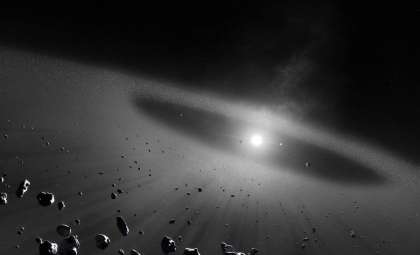
To evaluate their hypothesis, the researchers crafted detailed simulations replicating the young solar system's environment. This included the giant gas planets Jupiter and Saturn, alongside the terrestrial planets Earth, Venus, Mars, and Theia, all immersed in a gaseous protoplanetary disk. By fine-tuning planetary positions and masses, the team explored scenarios where their orbits became synchronized over time.
With more than 13,000 simulation runs, the results demonstrated that the inner planets could establish a resonant chain. Remarkably, Venus, Earth, Theia, and Mars settled into a 2:3:4:6 resonance, indicating their orbital periods maintained exact integer ratios. This harmony prevented gravitational disturbances, enabling the planets to orbit in coordinated rhythm.
“To model the giant planet instability,” first author Shuo Huang explained, “we adjusted conditions to reflect movements of the outer giants, notably Saturn’s initial position closer to Jupiter.” This event occurred about 4.4 billion years ago as the protoplanetary disk dissipated, causing gas giants to shift, ultimately disrupting the inner planets’ synchronized orbits.
Broadening Our Perspective on Planet Formation and Evolution
The implications of this research are profound for planetary science. It proposes that the inner solar system’s assembly wasn’t just a chaotic pileup of collisions but also influenced by smooth, gravitational resonances guided by a gas-rich environment.
Additionally, the study redefines the timeline for the formation of terrestrial planets. It suggests these worlds arose much earlier—in the first 10 million years after the solar system’s birth—about 20 million years sooner than prior models indicated. Given Venus’ relative lack of large impacts since its formation, scientists believe its mantle might retain evidence supporting this accelerated timeline.
Insights into Planetary Instability and Resonant Systems like TRAPPIST-1
The work also enhances understanding of planetary instability, highlighting how the giant outer planets’ migrations may have dismantled early resonances among inner worlds. This insight helps clarify why planetary systems such as TRAPPIST-1 maintain resonant orbits despite lacking massive outer planets, which otherwise might disrupt such harmony.
By analyzing both resonant and non-resonant planetary systems, researchers hope to refine our knowledge of how planets form, evolve, and maintain stability within their cosmic neighborhoods.
- Categories:
- News







0 comments
Sign in to Comment