
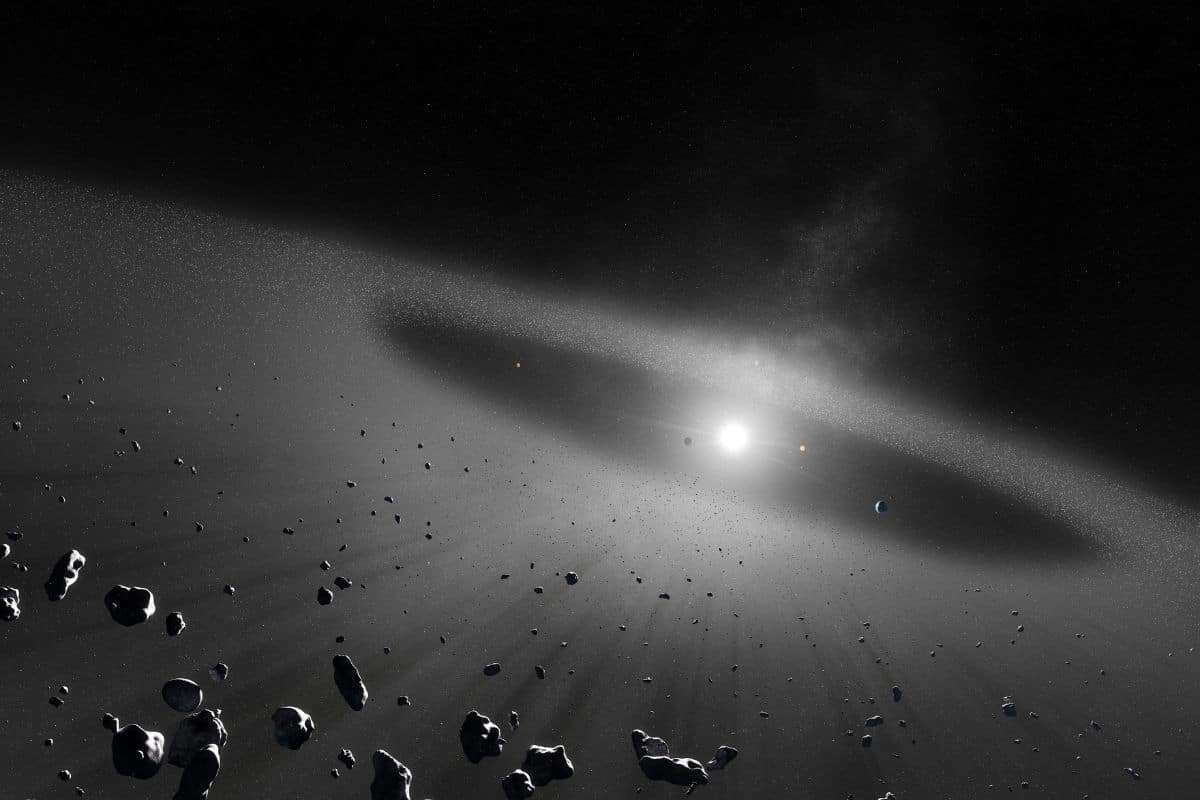
Microscopic particles retrieved from the Ryugu asteroid have provided researchers with fresh insights into the magnetic environment that influenced the solar system’s outer regions more than 4.6 billion years ago. Through detailed examination of these ancient dust grains, scientists have gathered evidence suggesting that a subtle yet enduring magnetic field likely played a key role in shaping the formation of gas giants such as Jupiter and Neptune by affecting how matter gathered during the solar system’s infancy.
A recent report featured in AGU Advances details the collaborative work of experts from MIT, Caltech, and Harvard. They analyzed the magnetic characteristics of Ryugu’s dust, which was brought to Earth by Japan’s Hayabusa2 mission.
Ryugu: A Cosmic Time Capsule
Thought to have originated in the outer reaches of the early solar system, the asteroid Ryugu eventually migrated to the asteroid belt between the orbits of Earth and Mars. In 2020, the Japanese space probe Hayabusa2 returned samples from Ryugu’s surface to laboratories on Earth.

Scientists eagerly explored these untainted cosmic particles, hoping they would reveal conditions prevalent during the solar system’s earliest period.
The investigation focused on detecting remnants of primordial magnetic fields, particularly investigating if a nebular magnetic field existed beyond 7 astronomical units (AU), where gas giants took shape.
Magnetism’s Role in Planet Formation
Prior research demonstrated that a strong magnetic field influenced the inner solar system's development, guiding dust and gases to form planets like Earth, Venus, and Mars. However, whether similar magnetic effects reached the outer planets had remained uncertain.
By employing a magnetometer, the researchers unraveled the magnetic imprint preserved in Ryugu’s particles. Their analysis indicated that if a nebular magnetic field was present in the distant solar system, it was extremely weak—capping at 15 microtesla, much less than Earth’s modern-day 50 microtesla.
“This nebular field vanished roughly 3 to 4 million years after the solar system began forming, and we are intrigued by its influence on the assembly of early planets,” said Elias Mansbach, the study's principal investigator.
Though faint, this magnetic force would have been adequate to attract surrounding gas and dust, facilitating the accumulation of large planet-forming material around gas giants like Jupiter and Saturn.
Decoding Our Solar History
The team also compared these findings with data from meteorites thought to originate in the outer solar system.
One particular meteorite classified as an ungrouped carbonaceous chondrite exhibited a weak magnetic signature of about 5 microtesla, aligning with results from Ryugu’s particles.
This discovery implies that magnetic fields influenced even the farthest parts of the early solar nebula, challenging earlier hypotheses which suggested negligible magnetic activity in these zones.
“Our observations confirm that magnetic fields were widespread, playing a vital role in funneling material where the sun and planets originated,” explained Benjamin Weiss, a planetary scientist at MIT and co-author of the research.
- Categories:
- News



0 comments
Sign in to Comment