
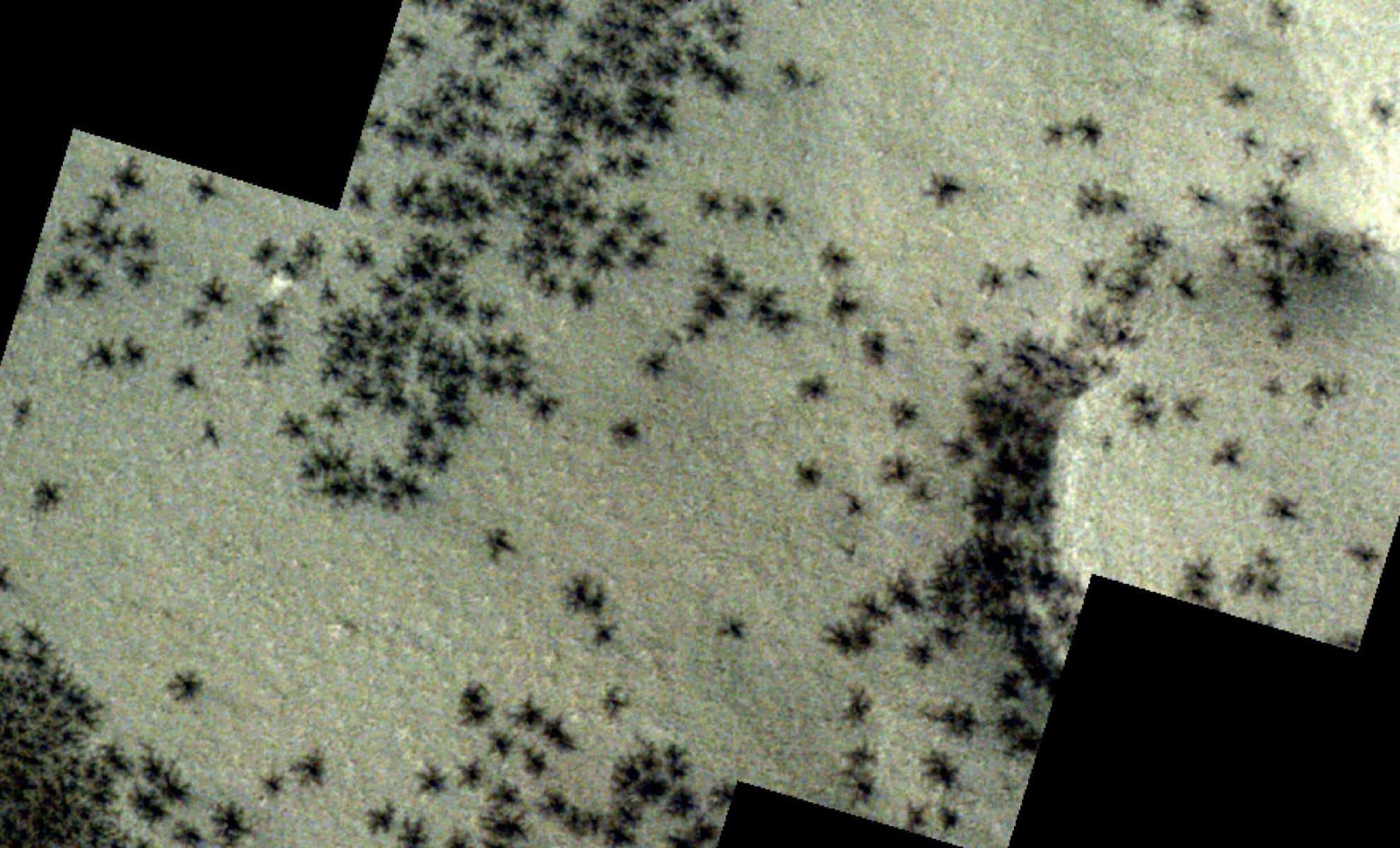
Mars continues to fascinate researchers and space fans with its extraordinary terrain and drastic seasonal shifts. Recent high-resolution pictures from ESA’s Mars Express and the ExoMars Trace Gas Orbiter have uncovered one of the Red Planet’s most captivating natural characteristics: extensive dark formations resembling giant spiders sprawled across the frozen landscape.
These peculiar shapes are not signs of alien life, but are caused by a striking process occurring beneath the ice-covered surface.
The Seasonal Drama Behind Mars’ ‘Spiders’
Mars, despite its desolate appearance, undergoes intense seasonal transformations due to its axial tilt. Throughout the chilly Martian winter, atmospheric carbon dioxide solidifies, blanketing the ground in dry ice. However, when spring arrives, the frozen CO2 undergoes a remarkable change.

Instead of melting, the carbon dioxide sublimates, transitioning directly from a solid to a gaseous state. Trapped gas beneath the ice accumulates pressure until it suddenly bursts through, carrying dark dust from beneath and dispersing it into the thin Martian atmosphere.
This phenomenon results in dark splotches that can span up to a kilometer across, accompanied by branching, vein-like channels etched into the surface—the so-called ‘spider’ formations.
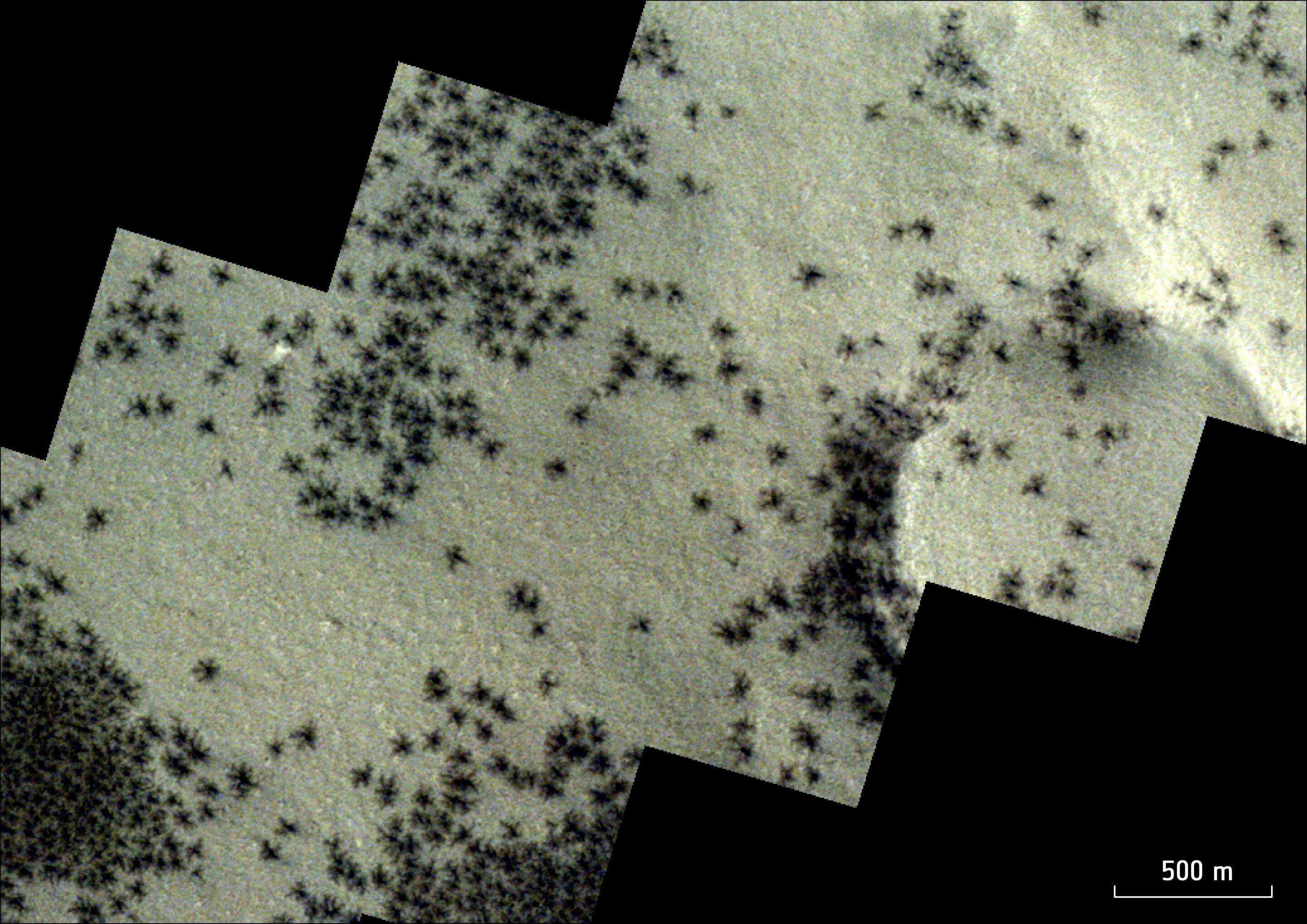
How Mars Express and ExoMars TGO Capture These Alien-Like Signals
ESA’s two flagship missions have played a crucial role in documenting these enigmatic patterns.
- Mars Express uses its High Resolution Stereo Camera (HRSC) to track the dark patches created by escaping gas and dust on the surface.
- Simultaneously, the Colour and Stereo Surface Imaging System (CaSSIS) on the ExoMars Trace Gas Orbiter delivers detailed views of the intricate, spider-like networks beneath the icy crust.
One notable location dubbed Inca City features a maze-like arrangement of ridges that strikingly resembles ancient city ruins. While some have speculated on extraterrestrial influences, scientists contend these structures are natural geological features, possibly linked to historical impact sites.

Prospects for Human Observation of This Martian Phenomenon
If future astronauts set foot on Mars, they could witness this incredible spectacle live—the cracking ice releasing bursts of dark dust as the landscape subtly transforms. These ‘spiders’ uniquely showcase the dynamic, ever-changing nature of the Martian environment unlike anything on Earth.
For now, missions like Mars Express and ExoMars TGO continue to provide vivid evidence of Mars’ geophysical activity, moving us closer to unlocking the secrets of our planetary neighbor and eventually exploring it firsthand.
- Categories:
- Space






0 comments
Sign in to Comment