
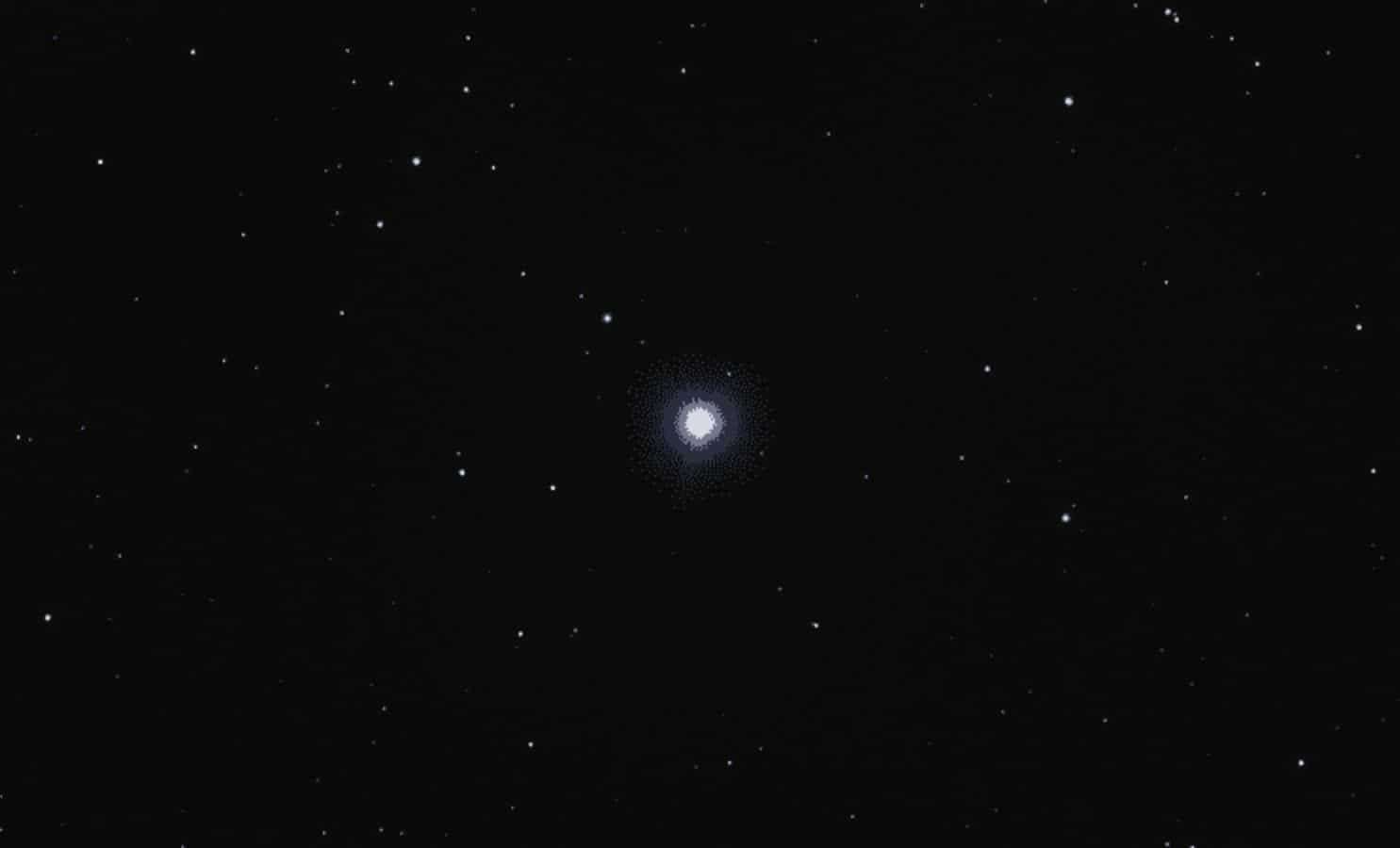
Researchers have obtained unprecedented high-resolution visuals of Polaris, commonly known as the North Star, revealing surprising details on its surface.
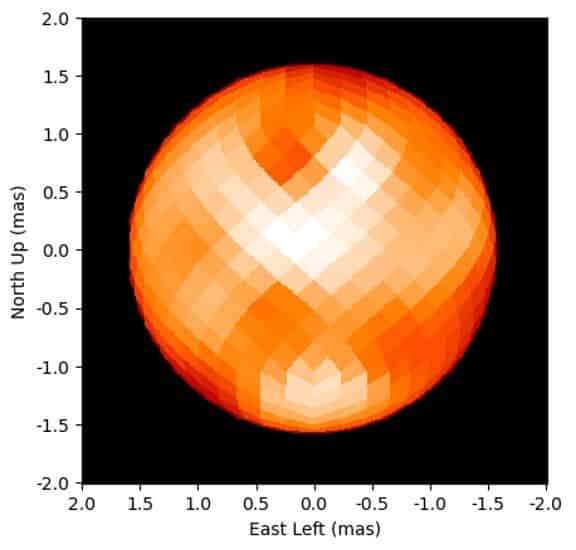
Captured through the CHARA Array at Mount Wilson Observatory in California, these images display prominent bright and dark regions on Polaris, challenging previously held views about this distinguished star.
Polaris Shows Dynamic Surface Patterns
Polaris has long been famous for its nearly fixed position in the night sky, but new observations reveal its surface is much more active than expected. By utilizing the CHARA Array, which combines multiple telescopes to simulate a larger instrument capable of fine detail, astronomers managed to visualize features on Polaris’s surface for the very first time.

The findings uncovered extensive bright and dark patches resembling sunspots, which appear to vary over time. This revelation adds complexity to what we know about Cepheid variable stars, a class of stars to which Polaris belongs.
Cepheid variables exhibit rhythmic expansions and contractions in their outer layers, leading to observable brightness fluctuations. Polaris, specifically, pulsates roughly every four days. These predictable changes make Cepheids essential tools in determining distances across the cosmos as "standard candles."
Nonetheless, the identification of these surface spots implies that Polaris’s brightness variations might be influenced by factors other than pulsations alone. As noted by Gail Schaefer, head of the CHARA Array, “The CHARA images revealed large bright and dark spots on the surface of Polaris that changed over time.” It suggests magnetic phenomena linked to these spots could be altering the star’s luminosity in ways still not wholly understood.
New Perspectives on Polaris’s Mass and Stellar System
Beyond mapping surface irregularities, the investigation also sheds light on Polaris’s mass and overall structure. Formerly estimated to be several times the mass of our Sun, recent data indicate it may be as massive as five Suns.
Polaris is a giant star roughly 46 times larger than the Sun and exists within a complex triple-star system. Its binary companion completes an orbit every 30 years, though studying it directly is difficult due to the small spatial separation and large brightness disparity between the stars.
This revised mass estimation raises new scientific questions, as a brighter, more massive Polaris could challenge current Cepheid star models. Astronomer Nancy Evans from the Center for Astrophysics at Harvard & Smithsonian explains, “The small separation and large contrast in brightness between the two stars makes it extremely challenging to resolve the binary system during their closest approach.” This complexity hints at a need to revisit theoretical models of Cepheid variables and possibly broader stellar evolution theories.

Advancing Studies on Polaris and Similar Stars
The revelation of surface spot activity combined with updated mass insights paves the way for ongoing exploration. Scientists intend to continue monitoring Polaris to elucidate the nature and effects of these surface irregularities.
John Monnier, professor of astronomy at the University of Michigan, states, “We plan to continue imaging Polaris in the future… to better understand the mechanism that generates the spots on the surface of Polaris.” These investigations may provide critical understanding of how magnetic fields influence Cepheid variables.
Additionally, this research enhances knowledge about other stars. By studying Cepheids like Polaris, which serve as vital distance indicators, astronomers aim to refine measurement methods for cosmic scales and deepen insights into stellar life cycles.
- Categories:
- Astronomy ,
- News ,
- Space ,
- Nasa











0 comments
Sign in to Comment