
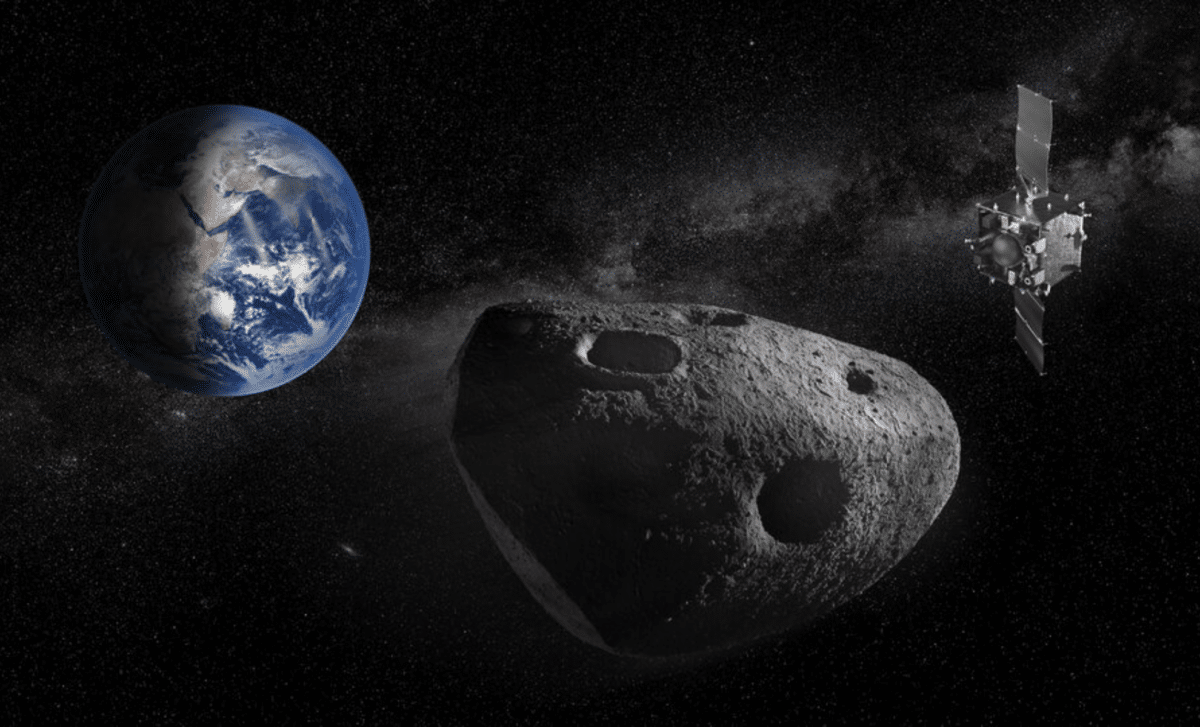
On February 10, 2026, the European Space Agency (ESA) awarded a crucial contract to OHB Italia for the creation of the Rapid Apophis Mission for Space Safety (Ramses). Scheduled for launch in 2028, this mission aims to investigate the asteroid Apophis prior to its close approach to Earth in 2029. This collaboration among ESA, OHB Italia, and global partners represents a significant stride toward enhancing our planetary defense capabilities and expanding our knowledge of near-Earth objects.
Exploring Apophis: The Ramses Mission’s Scientific Goals
ESA’s Ramses project stands out as a unique opportunity to closely study asteroid Apophis, which has intrigued scientists due to its rare and potentially dangerous close passage past Earth in April 2029. Orson Sutherland, ESA’s Mars & Beyond Projects Group Leader explains,
“With Ramses, ESA is seizing a once-in-a-lifetime opportunity to study asteroid Apophis as it swings past Earth, deepening our understanding of near-Earth objects and advancing our capabilities to protect our planet.”
Add Cosmo Herald as a Preferred Source

The importance of this mission lies in acquiring detailed observations of Apophis’s physical characteristics such as its shape, spin, and internal makeup. Such data will be vital for formulating effective measures to safeguard Earth from possible asteroid threats. As Apophis draws within just 32,000 km — a closer distance than the Moon’s orbit — Ramses will have the prime vantage point to gather real-time observations of the asteroid’s dynamics, offering an unprecedented research window.
European Excellence and Global Cooperation
Exemplifying strong European teamwork, the Ramses mission places OHB Italia at the forefront of spacecraft development efforts.
“We are proud to be entrusted by ESA with the Ramses mission,” said Roberto Aceti, CEO of OHB Italia. “This contract reflects the confidence placed in our team’s expertise and decades-long heritage in delivering complex space systems. We look forward to working with ESA and our partners to deliver this truly ambitious mission for planetary defense.”
Furthermore, ESA is collaborating with the Japan Aerospace Exploration Agency (JAXA), which will provide critical technologies such as solar panels and a thermal infrared camera, among other contributions. This partnership underscores the mission’s international dimension and the collective commitment to planetary defense.
Integrating CubeSats to Enhance Science Returns
A key element of Ramses is the deployment of miniature satellites known as CubeSats. These compact craft will supplement the primary spacecraft’s observations after arriving at Apophis. One such CubeSat, named “Farinella” in honor of the late Italian planetary scientist Paolo Farinella, is being developed by Italy’s Tyvak International. Fabio Nichele, CEO of Tyvak International, shared, “We are excited to take on the challenge of delivering a small spacecraft that can make a big contribution to the study of the asteroid Apophis during its historic close Earth flyby.”
By offering multiple vantage points through these CubeSats, scientists expect to gain a richer, multi-angle understanding of Apophis’s properties and behavior during its near-Earth encounter. This innovative use of small satellite technology highlights the evolving landscape of planetary defense research.
- Categories:
- Space








0 comments
Sign in to Comment