
Poland's Prime Minister Donald Tusk has ignited a critical conversation about Europe's defense outlook by proposing that Poland explore the possibility of establishing its own nuclear deterrent. Speaking before the Polish parliament on March 7, 2024, Tusk highlighted how significant shifts in American geopolitical priorities have compelled Europe to reassess its defense posture.
His remarks come amid growing doubts concerning the steadfastness of U.S. security guarantees to NATO, particularly influenced by former President Donald Trump's expressed doubts about the alliance. Tusk clarified that Poland is not immediately pursuing nuclear weapons but noted that moving in that direction would be a lengthy process requiring broad agreement.
As reported by The Economist, Germany’s Friedrich Merz, a leading candidate to become chancellor, has suggested initiating discussions with the UK and France about complementing the American nuclear shield. Meanwhile, French President Emmanuel Macron has called for a “strategic debate” on expanding France’s nuclear umbrella to better protect European allies.

Europe’s Delicate Dependence on U.S. Nuclear Deterrence
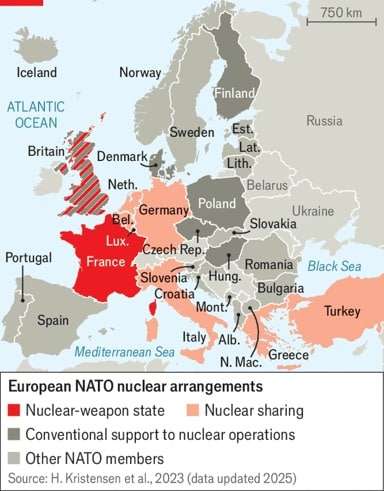
For almost eight decades, European security has rested largely on the protection afforded by the U.S. nuclear umbrella. NATO’s defense framework has been anchored in American nuclear forces deployed across several European nations.
Nonetheless, this extended deterrence arrangement has always been precarious, as its effectiveness depends on the United States’ readiness to engage in nuclear war to defend its partners. To sustain this guarantee, Washington has maintained substantial nuclear capabilities and forward-based arsenals in Europe.
While the UK maintains a comparatively small nuclear arsenal, it is integrated into NATO’s collective defense posture. The authority to deploy these weapons, however, stays firmly with the British Prime Minister.
France has preserved an independent nuclear stance, having withdrawn from NATO's Nuclear Planning Group and emphasizing national control over its weapons.
Emmanuelle Maitre from Paris’s Foundation for Strategic Research notes that France’s approach is designed to preserve presidential freedom of action without alliance restrictions.
Nevertheless, French administrations have indicated that their nuclear deterrent carries a European significance. Back in 1995, Britain and France jointly declared that if one’s vital interests face threats, the other's vital interests are equally at risk.
A similar commitment was echoed in the 2019 Franco-German Aachen Treaty, underscoring a shared but undefined commitment to continental security.
Poland Seeks Greater Influence Over Europe’s Nuclear Decisions
Tusk’s statements have intensified questions about the extent of France’s nuclear protection toward others. During a press event, the Polish leader challenged the practical implications of France’s deterrent framework, remarking:
“I would like to know, first of all, in detail what it means in terms of power to use these weapons… If we were to decide on this, it would be worth making sure it is in our hands, and we make the ultimate decisions.”
This indicates Poland may demand a more prominent say in the governance of Europe’s nuclear protection, a stance that contrasts with France’s tight control over its arsenal.
This idea recalls earlier efforts to form a joint European nuclear force. In the 1950s and 1960s, NATO examined a Multilateral Nuclear Force (MLNF), envisioning a multinational fleet armed with nuclear missiles operated by crews from various nations.
Subsequently, the Atlantic Nuclear Force (ANF) concept proposed similar arrangements under international command, but both plans failed due to political and logistical obstacles.
France’s Position on European Nuclear Cooperation
President Macron has strongly dismissed proposals for shared control, reiterating that France’s nuclear forces are fully sovereign. He declared:
“The decision to use nuclear weapons has always been, and will always be, up to the president and commander-in-chief of France.”
Yet, analysts suggest France might still enhance its role in Europe’s nuclear defense through alternative approaches. Former British defense official Peter Watkins has recommended that France could reengage with NATO’s Nuclear Planning Group as an observer, allowing more transparency without compromising sovereignty.
Another potential route involves increased allied participation in French nuclear exercises. Macron has invited European partners to become more involved, exemplified by an Italian tanker refueling French jets during a 2022 nuclear drill. Reports indicate more European countries are interested in such collaboration.
Assessing France’s Capacity as Europe’s Nuclear Guardian
France’s nuclear forces depend on two strategic pillars:
- Submarine-launched ballistic missiles (SLBMs), providing deterrence against major threats.
- Air-launched nuclear missiles serving as a warning before a full nuclear escalation.
The U.S. currently deploys around 180 nuclear weapons across Belgium, Germany, Italy, the Netherlands, and Turkey, all under American command but deliverable by allied aircraft if necessary.
Some experts, such as Bruno Tertrais, have suggested adopting a comparable French model, where Rafale jets capable of nuclear strikes could rotate through Eastern European bases to show solidarity. However, technical, political, and escalation concerns with Russia stand as hurdles.
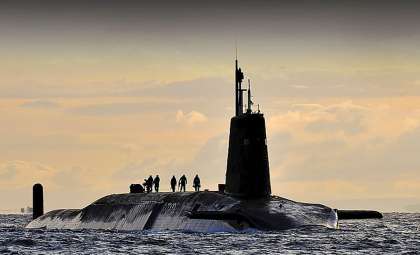
Britain faces an even more intertwined relationship with the U.S. Its nuclear warheads are constructed to fit American Trident missiles, and its submarine missile tubes are identical to those used by U.S. Columbia-class vessels.
Should America halt nuclear cooperation, Britain's deterrent could weaken substantially. Some analysts propose rekindling a Franco-British nuclear partnership, a concept explored during the 1970s and 1980s but never realized.
- Categories:
- News






0 comments
Sign in to Comment